SEOUL: North Korea’s second naval destroyer was damaged in a failed launch this week, state media reported Thursday, sparking fury from leader Kim Jong Un, who wants bigger warships to deal with what he calls escalating US-led threats against his country.
It’s not common for North Korea to acknowledge military-related setbacks, but observers say the disclosure of the failed ship launch suggests that Kim is serious about his naval advancement program and confident of ultimately achieving that objective.
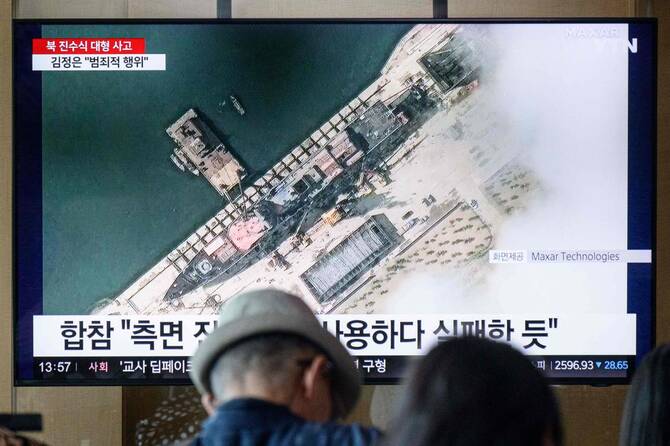
During a launching event at the northeastern port of Chongjin on Wednesday, the newly built 5,000-tonne-class destroyer became unbalanced and was punctured in its bottom sections after a transport cradle on the stern section slid off first and became stuck, according to the Korean Central News Agency.
KCNA didn’t provide details on what caused the problem, the severity of the damage or whether anyone was injured.
According to KCNA, Kim, who was present at the ceremony, blamed military officials, scientists and shipyard operators for a “serious accident and criminal act caused by absolute carelessness, irresponsibility and unscientific empiricism.” Kim called for a ruling Workers’ Party meeting slated for late June to address their “irresponsible errors.”
The destroyers are North Korea’s most advanced warships
“It’s a shameful thing. But the reason why North Korea disclosed the incident is it wants to show it’s speeding up the modernization of its navy forces and expresses its confidence that it can eventually build” a greater navy, said Moon Keun-sik, a navy expert who teaches at Seoul’s Hanyang University.
Moon suspected the incident likely happened because North Korean workers aren’t yet familiar with such a large warship and were rushed to put it in the water.
The damaged vessel was likely the same class as the country’s first destroyer unveiled last month, which experts assessed as North Korea’s largest and most advanced warship to date. Kim called the first vessel, named Choe Hyon – a famed Korean guerilla fighter during the Japanese colonial period – a significant asset for advancing his goal of expanding the military’s operational range and nuclear strike capabilities.
State media described that ship as designed to carry weapons systems including nuclear-capable ballistic and cruise missiles. Kim said the ship was expected to enter active duty early next year and later supervised test-firings of missiles from the warship.
Satellite photos show the partially submerged destroyer
Lee Sung Joon, spokesperson for South Korea’s Joint Chiefs of Staff, said Thursday that the damaged vessel was likely equipped with similar systems and remains toppled over in the sea. An Associated Press analysis of Planet Labs PBC images taken Thursday showed the ship partially submerged on its side with tarpaulins draped over the wreckage.
Earlier commercial satellite images indicated that the country was building its second destroyer at a shipyard in Chongjin.
Beyond Parallel, a website run by the Center for Strategic and International Studies think tank, said the satellite imagery of Chongjin’s Hambuk shipyard on May 12 showed that a second vessel in the Choe Hyon-class of guided missile destroyers was under construction.
A report by the North Korea-focused 38 North website assessed last week that the destroyer in Chongjin was being prepared to be launched sideways from the quay, a method that has been rarely used in North Korea. The report said the previous destroyer launched at the western shipyard of Nampo, in contrast, used a floating dry dock.
South Korean officials and experts say the Choe Hyon destroyer was likely built with Russian assistance as the two countries’ military partnerships are booming. While North Korea’s naval forces are considered far inferior to those of its rivals, analysts say the destroyer with nuclear-capable missiles and an advanced radar system would still enhance the North’s offensive and defensive capabilities.
Kim has framed the arms buildup as a response to perceived threats from the United States and South Korea, which have been expanding joint military exercises in response to the North’s advancing nuclear program. He says the acquisition of a nuclear-powered submarine would be his next big step in strengthening the North Korean navy.
Hours after releasing the report on the damaged destroyer, North Korea test-fired multiple cruise missiles from an area about 300 kilometers (185 miles) south of Chongjin, according to South Korea’s military. The launches were a continuation of a streak of weapons-testing activities by North Korea in recent years. South Korea’s Joint Chiefs of Staff said the launches were being analyzed by South Korean and US intelligence authorities.


![]()

North Korea’s second naval destroyer damaged in a failed launch attended by Kim Jong Un
Short Url
https://arab.news/jwtse
North Korea’s second naval destroyer damaged in a failed launch attended by Kim Jong Un
- Disclosure of the failed ship launch suggests that Kim Jong Un is serious about his naval advancement program
- The damaged vessel was likely the same class as the country’s first destroyer unveiled last month


Latest updates


© 2026 SAUDI RESEARCH & PUBLISHING COMPANY, All Rights Reserved And subject to Terms of Use Agreement.