Gunmen kill seven in central Mexico

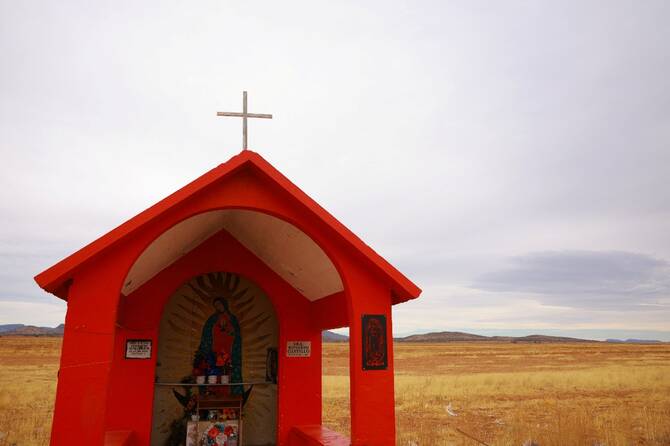
A shrine to the Virgin of Guadalupe near the Chihuahua Regional Livestock Union, in Nuevo Palomas, Mexico. (Reuters).
Short Url
Updated 20 May 2025
Follow

Gunmen kill seven in central Mexico

CELAYA: Gunmen have shot dead seven people, including some minors, in Mexico’s most deadly state, where violence between warring drug cartels has triggered condemnation by the Catholic Church.
The attack in the central state of Guanajuato occurred at around 2:00 am Monday in a plaza in the city of San Felipe where local police found seven bodies, all male, and a damaged van after reports of gunfire, the local government said in a statement.
The officers also found two banners with messages alluding to the Santa Rosa de Lima gang, which operates in the area, the statement said.
Guanajuato is a thriving industrial hub and home to several popular tourist destinations, but it is also Mexico’s deadliest state, according to official homicide statistics.
The violent crime is linked to conflict between the Santa Rosa de Lima gang and the Jalisco New Generation cartel, one of the most powerful in the Latin American nation.
Mexican leaders of the Catholic Church condemned the shooting on Monday, calling it “an alarming sign of the weakening of the social fabric, impunity and the absence of peace in vast regions” of the country, which is majority Catholic.
“We cannot remain indifferent in the face of the spiral of violence that is wounding so many communities,” the Episcopal Conference of Mexico, an organization of Mexican bishops, added in a statement.
The shooting was “one more among so many that are repeated with painful frequency,” it said.
In December, the Church in Mexico called on warring cartels to declare a truce.
Guanajuato recorded the most homicides of any state in Mexico last year, with 3,151, 10.5 percent of murders nationwide, according to official figures.
Since 2006, when the military launched an anti-drug operation, Mexico has tallied about 480,000 violent deaths.


Mali, Burkina say restricting entry for US nationals in reciprocal move

Updated 31 December 2025
Follow

Mali, Burkina say restricting entry for US nationals in reciprocal move

  • Both countries said they are applying the same measures on American nationals as imposed on them

ABIDJAN: Mali and Burkina Faso have announced travel restrictions on American nationals in a tit-for-tat move after the US included both African countries on a no-entry list.
In statements issued separately by both countries’ foreign ministries and seen Wednesday by AFP, they said they were imposing “equivalent measures” on US citizens, after President Donald Trump expanded a travel ban to nearly 40 countries this month, based solely on nationality.
That list included Syrian citizens, as well as Palestinian Authority passport holders, and nationals of some of Africa’s poorest countries including also Niger, Sierra Leone and South Sudan.
The White House said it was banning foreigners who “intend to threaten” Americans.
Burkina Faso’s foreign ministry said in the statement that it was applying “equivalent visa measures” on Americans, while Mali said it was, “with immediate effect,” applying “the same conditions and requirements on American nationals that the American authorities have imposed on Malian citizens entering the United States.”
It voiced its “regret” that the United States had made “such an important decision without the slightest prior consultation.”
The two sub-Saharan countries, both run by military juntas, are members of a confederation that also includes Niger.
Niger has not officially announced any counter-measures to the US travel ban, but the country’s news agency, citing a diplomatic source, said last week that such measures had been decided.
In his December 17 announcement, Trump also imposed partial travel restrictions on citizens of other African countries including the most populous, Nigeria, as well as Ivory Coast and Senegal, which qualified for the football World Cup to be played next year in the United States as well as Canada and Mexico.