


NEW MEXICO: Dr. Hector Ocaranza knew El Paso would see measles the moment it began spreading in West Texas and eastern New Mexico.
Highways connect his border city with the epicenter of Texas’ massive outbreak, which is up to 663 cases. They’re the same roads used by thousands of families and commercial truckers who cross into Mexico and back each day.
“Diseases know no borders,” said Ocaranza, El Paso’s top public health doctor, “so as people are mobile, they’re going to be coming and receiving medical attention in El Paso but they may be living in Juarez.” It took a couple of months, but El Paso now has the highest measles case count in the state outside of West Texas with 38. Neighboring Ciudad Juarez has 14 cases as of Monday.
North America’s three biggest measles outbreaks continue to balloon, with more than 2,500 known cases; three people have died in the US and one in Mexico. It started in the fall in Ontario, Canada; then took off in late January in Texas and New Mexico; and has rapidly spread in Chihuahua state, which is up to 786 cases since mid-February.
These outbreaks are in areas with a notable population of certain Mennonite Christian communities who trace their migration over generations from Canada to Mexico to Seminole, Texas. Chihuahua health officials trace their first case to an 8-year-old Mennonite child who visited family in Seminole, got sick and spread the virus at school. And Ontario officials say their outbreak started at a large gathering in New Brunswick involving Mennonite communities.
Mexican and US officials also say the genetic strains of measles spreading in Canada match the other large outbreaks.
“This virus was imported, traveling country to country,” said Leticia Ruíz, director of prevention and disease control in Chihuahua.
North and South American countries have struggled to maintain the 95 percent measles vaccination rate needed to prevent outbreaks, said Dr. Jarbas Barbosa, director of the Pan American Health Organization. And a recent World Health Organization report said measles activity in the Americas region is up elevenfold from the same time last year and that the risk level is “high” compared to the rest of the world’s “moderate” level.
Measles cases have been confirmed in six of the region’s countries — Argentina, Belize, Brazil, Canada, the United States and Mexico — and investigating the disease’s spread is labor-intensive and pricey. The response to each measles case in the US costs an estimated $30,000 to $50,000, according to Dr. David Sugerman, a US Centers for Disease Control and Prevention scientist.
Measles at the US-Mexico border
The cases in Ciudad Juarez have no direct connection to the Mennonite settlement in Chihuahua, said Rogelio Covarrubias, a health official in the border city. The first measles case in El Paso was in a child at Fort Bliss, Ocaranza said.
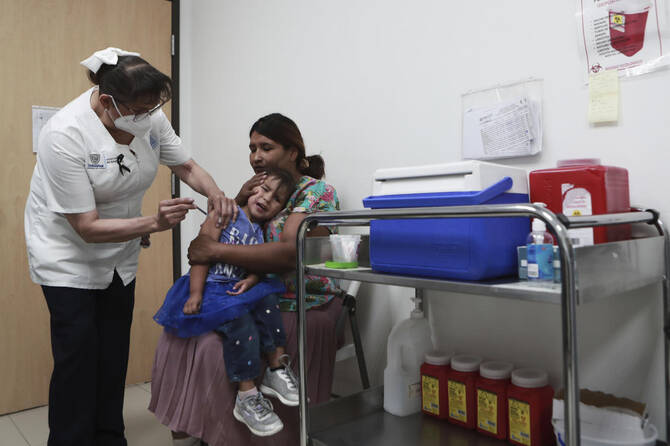
More than half of El Paso’s cases are in adults, which is unusually high, and three people have been hospitalized. The health department is holding vaccination clinics in malls and parks and says hundreds have gotten a shot. The vaccines are free — no questions asked, no matter which side of the border you live on.
Communication about measles between the two health departments is “informal” but “very good,” Ocaranza said. Covarrubias said his team was alerted last week to a case of someone who became sick in El Paso and returned home to Juarez.
“There is constant concern in Ciudad Juarez … because we have travelers that pass through from across the world,” Covarrubias said. “With a possible case of measles without taking precautions, many, many people could be infected.”
Measles at the US-Canada border
Michigan health officials said the outbreak of four cases in Montcalm County are linked to Ontario.
The state’s chief medical executive, Dr. Natasha Bagdasarian, expects to see more cases. Michigan has a 95 percent vaccination rate for measles, mumps and rubella, but it hides weak spots — counties with 70 percent vaccination rates and individual schools where just 30 percent of kids vaccinated.
“If we think about measles as a forest fire, we’ve got these burning embers that are floating in the air right now,” Bagdasarian said. “Whether those embers result in another wildfire just depends on where they land.”
In Canada, six out of 10 provinces have reported measles cases. Alberta has the second-most with 83 as of April 12, according to government data.
Case counts in Ontario reached 1,020 as of Wednesday, mostly in the southwest part that borders Michigan. In one of the hardest-hit regions, Chatham-Kent Public Health officials announced a public exposure at a Mennonite church on Easter Sunday.
“It sometimes feels like we’re just behind, always trying to catch up to measles,” Dr. Sarah Wilson, a public health physician for Public Health Ontario. “It’s always moving somewhere.”


