

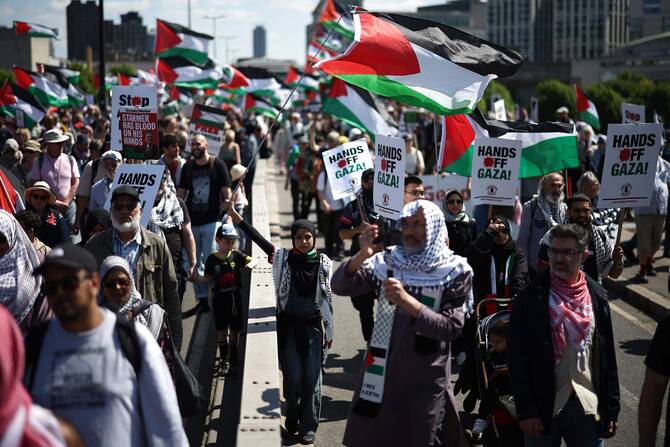
Pro-Palestine demonstrators mark Nakba anniversary with rally in London

Pro-Palestinian supporters wave Palestinian flags as they march across Waterloo Bridge in central London, on May 17, 2025. (AFP)
Short Url
Updated 17 May 2025
Follow

Pro-Palestine demonstrators mark Nakba anniversary with rally in London

  • Protesters demand UK government action to halt Gaza conflict
  • Mass rally passes central London landmarks, including Downing Street

LONDON: Tens of thousands of pro-Palestinian demonstrators marched through central London on Saturday to mark the 77th anniversary of the Nakba.

The word, which means “catastrophe” in Arabic, refers to the mass displacement of Palestinians during the creation of Israel in 1948. The UN estimates more than half the Palestinian population was permanently displaced.

The march, which was organized by the Palestine Solidarity Campaign, began at Embankment and passed key landmarks, including Big Ben and Downing Street, with protesters calling on the UK government to take action over the war in Gaza.

The PSC said the protest aimed to “mark the 77th anniversary of the 1948 Nakba and demand our government take action to end the ongoing ethnic cleansing of Palestinians from their land,” The Independent reported.

This year’s commemoration came amid reports that the Trump administration has been in talks with Libya about resettling up to a million Palestinians from Gaza in exchange for billions of dollars.

The proposal has drawn comparisons to the Nakba and widespread international criticism.

A PSC spokesperson said they expected around 100,000 attendees from across the UK, describing the turnout as larger than recent demonstrations. “We expected around 100,000 people to attend the London march,” the spokesperson said.

However, London’s Metropolitan Police estimated the crowd at around 20,000 and enforced Public Order Act conditions that restricted protesters to designated areas.

A small counter-protest organized by Stop The Hate gathered on the Strand, waving Israeli flags and remaining in an area outlined by police at the north end of Waterloo Bridge.

Pro-Palestinian protests in the UK reached their height following the Hamas attack on Israel on Oct. 7, 2023, which killed around 1,200 people in Israel, and the subsequent Israeli military response in Gaza, in which 53,000 people have been killed.

Nearly all the enclave’s 2.3 million residents have been displaced.

That November, a march held on Armistice Day drew an estimated 300,000 people, the largest to date since the war began.

Negotiations to end the war have so far stalled, with both Hamas and Israeli Prime Minister Benjamin Netanyahu resisting proposed ceasefires. Netanyahu’s government recently approved new plans for further attacks in Gaza.

Humanitarian agencies and global leaders have continued to call on Israel to allow the delivery of vital aid into the besieged territory.

Also on Saturday, Spanish Prime Minister Pedro Sanchez called for increased pressure “to halt the massacre in Gaza” at an Arab League summit in Iraq, while UN chief Antonio Guterres told the Baghdad meeting “we need a permanent ceasefire, now.”


India rolls out strictest anti-pollution curbs as toxic smog engulfs Delhi

Demonstrator wearing an oxygen mask and holding oxygen tanks takes part in protest.
Updated 14 December 2025
Follow

India rolls out strictest anti-pollution curbs as toxic smog engulfs Delhi

  • Private monitors in several parts of northern Delhi recorded AQI spikes between 550 and 700s
  • Authorities invoked stage four of the capital region’s emergency pollution-control framework

NEW DELHI: India’s capital choked under a thick blanket of smog on Sunday, with the government imposing anti-pollution curbs after monitoring stations in some areas recorded extremely hazardous air quality.

Home to 30 million people, Delhi has not recorded a single “clean air” day in 2025, with Air Quality Index readings hitting high above the 50 score throughout the year.

On the AQI scale from 0 to 500, good air quality is represented by levels below 50, while levels above 300 are dangerous.

Worsening since late October, official records over the weekend were in the severe to severe-plus range of 400–500, but as 24-hour averages, they did not capture the peaks. Private monitors in several parts of North and North West Delhi recorded AQI spikes above 550 and even into the 700s in real-time.

On Saturday evening, the Ministry of Environment’s Commission for Air Quality Management invoked stage four — the highest level — of the Graded Response Action Plan for Delhi and surrounding areas.

To “prevent further deterioration of air quality in the region,” the commission suspended all non-essential construction, shut stone crushers and mining operations, stopped entry of trucks into the capital region, and ordered schools to shift to hybrid classes or online, where possible.

While authorities blamed the pollution on “adverse meteorological conditions,” residents have been demanding more government action.

“The situation is so bad in Delhi that we don’t have any option but to force kids to do online classes. The government has failed us; it has not done anything to address the issue,” said Nabanita Nayak, who decided for her teenage children to attend school online only, despite concerns over their screen addiction.

“If the kids are too much in front of laptops, that’s also an issue. As a mother, I am worried.” 

Delhi’s pollution has been worsening since Diwali in late October, when the average AQI has been above 370, or “very poor.” Since mid-November, it has been over 400, which means “severe” air quality, with certain areas recording 500 and above, which is classified as a “hazardous” level.

“I don’t feel proud living in Delhi. It’s the capital city of the country … We talk about being a developed nation by 2047 — we have deadlines,” said Jagriti Arora, who is keeping her 7-year-old daughter at home to prevent allergy flare-ups caused by air pollution.

“The government has to do something … China had a big problem with pollution, but now they’ve managed to bring it down.”

Delhi’s air quality deteriorates in winter due to local emissions and seasonal weather conditions. Cold temperatures and low wind speeds result in a temperature inversion, which traps pollutants close to the ground instead of letting them disperse. This allows emissions from millions of vehicles, ongoing construction, and nearby industrial activity to accumulate in the air. Urban waste burning and dust from construction sites further add to it.

“This is not a new thing. This has been happening now for over 10 years,” Arora said. “You can see it. You don’t need to actually look at an AQI meter to see how bad the pollution is these days.”