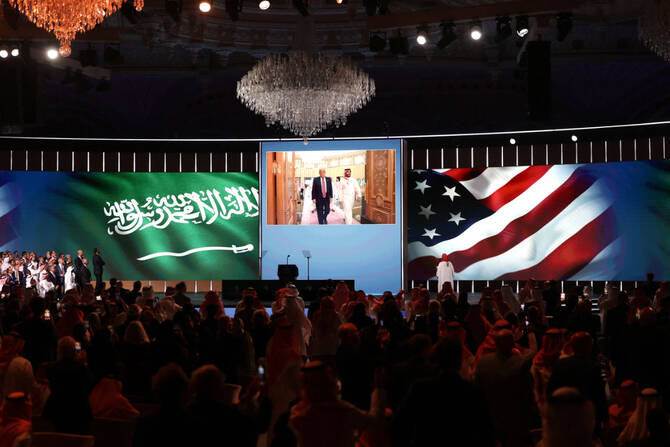

RIYADH: Mutual investments between Saudi Arabia and the US are expanding in key sectors as industry leaders from both countries eye deeper partnerships and co-development opportunities.
Speaking to Arab News on the sidelines of the Saudi-US Investment Forum, held during US President Donald Trump’s state visit to the Kingdom on Tuesday, Joseph Rank, vice president and CEO of Lockheed Martin for Saudi Arabia and Africa, said that enhanced partnerships are paving the way for two-way investments.
“This is an opportunity to really enhance our partnership and grow business. There’s actually almost too many to talk about. But the real key is growing our partnership, which then leads to investment on both sides,” Rank said.

Joseph Rank, vice president and CEO of Lockheed Martin for Saudi Arabia and Africa. (AN photo)
Lockheed Martin’s role in the Kingdom is shifting from traditional collaboration to advanced manufacturing and technology sharing, Rank said.
“We used to build things here. Now we’re actually manufacturing things here. So the big opportunity is manufacturing, co-production, co-development and transfer of technology,” he said.
“This is jobs for Lockheed Martin in the US and jobs for Saudi industry here. A win-win-win.”
Marc Winterhoff, interim CEO of electric vehicle manufacturer Lucid Group Inc., stressed the importance of Saudi Arabia as a manufacturing base, with its King Abdullah Economic City facility expected to reach a 150,000-unit capacity.

Marc Winterhoff, interim CEO of electric vehicle manufacturer Lucid Group Inc., is pictured at the Saudi-US Investment Forum in Riyadh on Tuesday. (AN photo)
“We have very, very close ties to Saudi Arabia, both from an investment point of view, but also we’re building a big plant in KAEC here,” he said, adding that 65 percent of the workforce is currently made up of Saudi citizens.
“There’s a lot of investment going into this plant to build vehicles for the local market, but then also for exports.”
Winterhoff said Lucid is also working with Saudi research institutions, including King Abdullah University of Science and Technology, to co-develop advanced technologies like artificial intelligence models, autonomous driving, and crash simulation.
Sadek Wahba, chairman and managing partner of I Squared Capital, echoed the sentiment, describing the forum as a reflection of enduring US-Saudi economic cooperation and the role infrastructure will play in future development.

Sadek Wahba, chairman and managing partner of I Squared Capital is pictured at the Saudi-US Investment Forum in Riyadh on Tuesday. (AN photo)
“The event represents the best of what you can find in Saudi in the cooperation that can exist between the United States and Saudi Arabia.
“Cooperation that already exists for the last decades, and I think will continue to flourish over the coming period,” Wahba said.
He said the company sees significant opportunity in Saudi Arabia’s infrastructure sector, particularly in telecoms, digital infrastructure, transport and logistics.
IN NUMBERS
• $1billion+ Planned investment by I Squared Capital, with backing from the Saudi PIF and others. • 65% Of Lucid’s workforce in the Kingdom is made up of Saudi citizens.
The biggest investment opportunities are in transport and logistics, he said, citing the growing needs of a rapidly developing economy.
Wahba also announced a memorandum of understanding with the Public Investment Fund to establish a Middle East infrastructure fund focused mainly on Saudi Arabia.
“I Squared Capital is looking to invest over $1 billion over the coming years, and PIF and others will be contributing to that effort,” he said.
Meanwhile, Kathy Warden, president and CEO of Northrop Grumman Corp., emphasized the company’s longstanding partnership with the Kingdom and its commitment to investing in defense and local talent.

Kathy Warden, president and CEO of Northrop Grumman Corp., is pictured at the Saudi-US Investment Forum in Riyadh on Tuesday. (AN photo)
Warden said that the company signed a memorandum of intent with the Saudi government’s General Authority of Military Industries to procure capabilities from Northrop Grumman, which total nearly $14 billion.
The US company is also partnering locally with Saudi Arabian Military Industries to deliver its capabilities.
“These investments will contribute to the security and safety of the Kingdom and also create local jobs that are high-skilled engineering jobs,” she added.
From a technology perspective, Chris Rouland, founder and CEO of Phosphorus Cybersecurity Inc., emphasized the need to secure AI and data-driven systems as Saudi Arabia ramps up its digital transformation.

Chris Rouland, founder and CEO of Phosphorus xIOT Cybersecurity Inc., is pictured at the Saudi-US Investment Forum in Riyadh on Tuesday. (AN photo)
“I think one thing that was overlooked in today’s conversations was the importance of security in artificial intelligence,” Rouland said. “Just as security and safety has made the Kingdom such a great place to do business, security and privacy are very important for AI and data centers.”
He said that the company is exploring a joint venture in Saudi Arabia aimed at securing Internet of Things infrastructure and AI systems to prevent exploitation by cybercriminals.
The forum underscored the Kingdom’s growing role as a magnet for American industry leaders seeking to invest in sectors aligned with Vision 2030 — from defense and infrastructure to advanced manufacturing and cybersecurity — reinforcing Saudi-US economic ties built on shared long-term objectives.