

UK and 4 other European nations urge Israel to lift Gaza aid blockade, warn against annexation

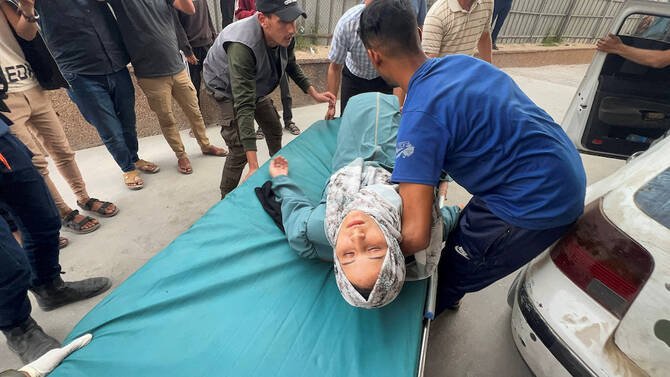
A wounded Palestinian woman is placed on a stretcher, after the European Hospital was partially damaged following Israeli airstrikes, according to the Gaza Health Ministry, at Nasser Hospital in Khan Younis, in the southern Gaza Strip, May 13, 2025. (Reuters)
Short Url
Updated 14 May 2025
Follow

UK and 4 other European nations urge Israel to lift Gaza aid blockade, warn against annexation

  • Britain, France, Denmark, Greece and Slovenia tell UN Security Council the obstruction of aid deliveries, in its 3rd month, is ‘unacceptable’ with famine looming
  • ‘Blocking aid as a “pressure lever” is unacceptable. Palestinian civilians, including children, face starvation,’ they warn

NEW YORK CITY: The UK and four other European countries on Tuesday called on Israeli authorities to immediately lift their blockade on humanitarian aid to Gaza. They said the continuing restrictions are placing millions of Palestinian civilians at risk of starvation, and undermining prospects for peace.

In a joint statement delivered at the UN, Britain, France, Denmark, Greece and Slovenia said the Israeli government’s ongoing obstruction of aid deliveries, now entering its third month, was “unacceptable” and risked compounding what UN agencies have warned is a looming famine.

“Blocking aid as a ‘pressure lever’ is unacceptable,” the nations said. “Palestinian civilians, including children, face starvation … Without an urgent lifting of the aid block, more Palestinians are at risk of dying; deaths that could easily be avoided.”

The nations, which had called an emergency meeting of the Security Council to discuss the situation in Gaza, also warned that any Israeli move to seize parts of the territory would breach international law and increase instability in the region.

“Any attempt by Israel to annex land in Gaza would be unacceptable and violate international law,” they said. “Palestinian territory must not be reduced nor subjected to any demographic change.”

The intervention followed the recent approval by the Israeli Security Cabinet of plans to expand military operations in Gaza, a move the European countries said would only add to Palestinian suffering while doing little to secure the release of hostages still held by Hamas.

“We strongly oppose both these actions,” they added, referring to the blockade and the expansion of military activity. “They do nothing to serve the long-term interests of peace and security in the region, nor to secure the safe return of the hostages.”

The governments of the five countries welcomed the release on Monday of Edan Alexander, an Israeli American hostage held by Hamas since the attacks against Israel on Oct. 7, 2023, but reiterated their demands for the immediate and unconditional release of all remaining captives.

“Their suffering must end,” they said. “Hamas must have no future role in Gaza or be in a position to threaten Israel.”

The five nations also expressed concern about Israeli proposals for a new aid-delivery mechanism in Gaza that the UN warns would fail to meet established humanitarian principles.

“Humanitarian aid must never be used as a political tool or military tactic,” the countries warned. “Any model for distributing humanitarian aid must be independent, impartial and neutral, and in line with international law.”

They said international humanitarian law places an obligation on Israel to allow “safe, rapid and unimpeded” access for the delivery of humanitarian assistance, adding: “Gaza is not an exception.”

The nations also condemned recent attacks on humanitarian workers, including the killing of representatives of the Palestinian Red Crescent and a military strike on a UN compound on March 19, which they described as “outrageous.”

“At least 418 aid workers have been killed in Gaza since the conflict began,” they said. “That is at least 418 too many.”

The countries urged Israel authorities to complete their investigation into the incident at the UN compound, publish the findings and “take concrete action to ensure this can never happen again.”

They repeated previous calls for an immediate ceasefire agreement, the release of all hostages, and renewed efforts to achieve a two-state solution to the wider conflict between the Israelis and Palestinians. They backed plans by France and Saudi Arabia to host an international conference on this issue in New York next month.

“This is the only way to achieve long-term peace and security for both Palestinians and Israelis,” the countries said.


Lebanon PM says IMF wants rescue plan changes as crisis deepens

Updated 4 sec ago
Follow

Lebanon PM says IMF wants rescue plan changes as crisis deepens

  • “We want to engage with the IMF. We want to improve. This is a draft law,” Salam said
  • “They wanted the hierarchy of claims to be clearer. The talks are all positive”

DAVOS, Switzerland: The International Monetary Fund has demanded amendments to a draft rescue law aimed at hauling Lebanon out of its worst financial crisis on record and giving depositors access to savings frozen for six years, Prime Minister Nawaf Salam said.
The “financial gap” law is part of a series of reform measures required by the IMF in order to access its funding and aims to allocate the losses from Lebanon’s 2019 crash between the state, the central bank, commercial banks and depositors.
Salam told Reuters the IMF wants clearer provisions in the hierarchy of claims, which is a core element of the draft legislation designed to determine how losses are allocated.
“We want to engage with the IMF. We want to improve. This is a draft law,” Salam said in an interview at the World Economic Forum annual meeting in ⁠the Swiss mountain resort of Davos.
“They wanted the hierarchy of claims to be clearer. The talks are all positive,” Salam added.
In 2022, the government put losses from the financial crisis at about $70 billion, a figure that analysts and economists forecast is now likely to be higher.
Salam stressed that Lebanon is still pushing for a long-delayed IMF program, but warned the clock is ticking as the country has already been placed on a financial ‘grey list’ and risks falling onto the ‘blacklist’ if reforms stall further.
“We want an IMF program and we want to continue our discussions until we get there,” he said, adding: “International pressure is real ... The longer we delay, the more people’s money will evaporate.”
The draft law, which was passed by Salam’s government in December, is under parliamentary review. It aims to give depositors a guaranteed path to recovering their funds, restart bank lending, and end a financial crisis that has left nearly a million accounts frozen and confidence in the system shattered.
The roadmap would repay depositors up to $100,000 over four years, starting with smaller accounts, while launching forensic audits to determine losses and responsibility.
Lebanon’s Finance Minister Yassine Jaber, who is driving the reform push with Salam, told Reuters it was ⁠essential to salvage a hollowed-out banking system, and to stop the country from sliding deeper into its cash-only, paralyzed economy.
The aim, Jaber said, is to give depositors clarity after years of uncertainty and to end a system that has crippled Lebanon’s international standing.
He framed the law as part of a broader reckoning: the first time a Lebanese government has confronted a combined collapse of the banking sector, the central bank and the state treasury.
Financial reforms have been repeatedly derailed by political and private vested interests over the last six years and Jaber said the responsibility now lies with lawmakers.
Failure to act, he said, would leave Lebanon trapped in “a deep, dark tunnel” with no way back to a functioning system.
“Lebanon has become a cash economy, and the real question is whether we want to stay on the grey list, or sleepwalk into a blacklist,” Jaber added.