

WHO warns of permanent impact of hunger on a generation of Gazans

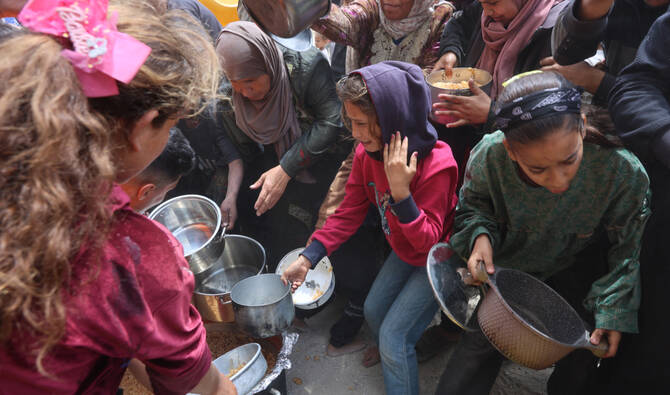
Palestinians shove to get a ration of hot food from a charity kitchen set up at the Islamic University campus in Gaza City on May 12, 2025. (AFP)
Short Url
Updated 13 May 2025
Follow

WHO warns of permanent impact of hunger on a generation of Gazans

GENEVA: Malnutrition rates are rising in Gaza, emergency treatments to counter it are running out and hunger could have a lasting impact on “an entire generation,” a World Health Organization official said on Tuesday.

Israel has blockaded supplies into the enclave since early March, when it resumed its devastating military campaign against Hamas, and a global hunger monitor on Monday warned that half a million people there faced starvation.

WHO representative for the Occupied Palestinian Territory Rik Peeperkorn said he had seen children who looked years younger than their age and visited a north Gaza hospital where over 20 percent of children screened suffered from acute malnutrition.

“What we see is an increasing trend in generalized acute malnutrition,” Peeperkorn told a press briefing by video link from Deir Al-Balah. “I’ve seen a child that’s five years old, and you would say it was two-and-a-half.”

“Without enough nutritious food, clean water and access to health care, an entire generation will be permanently affected,” he said, warning of stunting and impaired cognitive development.

The head of the UN Palestinian refugee agency Philippe Lazzarini told the BBC that he thought Israel was denying food and aid to civilians as a weapon of war.

The WHO criticized it in a statement late on Monday as “grossly inadequate” to meet the population’s immediate needs.

Due to the blockade, WHO only has enough stocks to treat 500 children with acute malnutrition, which is only a fraction of what is needed, Peeperkorn said.

Already, 55 children have died of acute malnutrition, he said.


Amman ranks among world’s top cities after first Quality of Life Index

Updated 14 sec ago
Follow

Amman ranks among world’s top cities after first Quality of Life Index

  • Jordanian capital second Arab city to be ranked in UN-backed index after Saudi Arabia’s Madinah

AMMAN: Jordan’s capital Amman has completed its first Quality of Life Index, ranking among the world’s leading cities to be assessed under the globally recognized framework, it was reported on Monday.

As a result, the city has become only the second in the Arab world — after Saudi Arabia’s Madinah — to be ranked in the program.

The Greater Amman Municipality said the city placed 10th globally out of 100 participating cities, with its index set to be officially listed on the international Quality of Life platform, the Jordan News Agency reported.

The assessment was developed in collaboration with the Quality of Life Initiative of the UN Human Settlements Programme — known as UN-Habitat — to advance urban well-being and human-centered development.

The Quality of Life Index combines objective data with residents’ perceptions, using global well-being indicators alongside local measures, offering a comprehensive picture of daily life.

The index measures performance across nine key areas: basic services, mobility, culture and recreation, education, environment, economy, governance, health and well-being, and housing and social cohesion.

Yousef Shawarbeh, the mayor of Amman, said the initiative aimed to support the city’s long-term vision of becoming a prosperous, inclusive and sustainable urban center, Petra reported.

He added that the index provided deeper insight into residents’ lived experiences and would help guide policymaking to improve quality of life.

Akram Khraisat, director of the Amman Urban Observatory, said the city’s participation marked a major step toward data-driven urban planning.

He added that the index would enable the municipality to better prioritize services, promote inclusive development, and assess the impact of policies on residents’ well-being, in line with the UN Sustainable Development Goals.

Officials said the initiative complemented a range of ongoing development projects in the capital, including public transport improvements, participatory greening and urban agriculture schemes, climate action planning, digital transformation initiatives and the Greater Amman Municipality Strategic Plan 2022–2026.