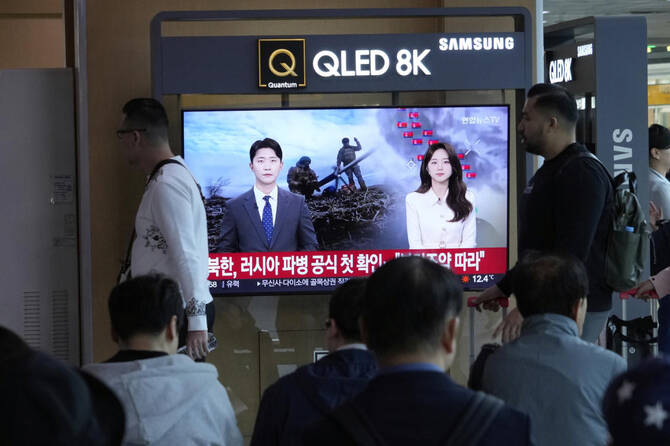
SEOUL: An estimated 4,700 North Korean soldiers have been killed or wounded while fighting alongside Russia against Ukrainian forces, South Korea’s spy agency told lawmakers Wednesday.
The assessment came two days after North Korea confirmed for the first time that it had sent combat troops to help Russia recapture parts of the Kursk region, which it lost control of to a surprise Ukrainian incursion last year.
In a closed-door parliamentary committee briefing, South Korea’s National Intelligence Service said North Korea had suffered 4,700 casualties, including 600 deaths, on the Russia-Ukraine battlefronts, according to Lee Seong Kweun, one of the lawmakers who attended the meeting.
Lee told reporters the NIS said that 2,000 injured North Korean soldiers were repatriated to North Korea by air or train between January and March. He cited the NIS as saying the dead North Korean soldiers were cremated in Russia before their remains were sent back home.
In January, the NIS said about 300 North Korean soldiers had died and another 2,700 had been injured, and the South Korean military increased the estimated casualties to 4,000 last month.
On Monday, North Korea announced that leader Kim Jong Un had decided to dispatch troops to “annihilate and wipe out the Ukrainian neo-Nazi occupiers and liberate the Kursk area in cooperation with the Russian armed forces.” Russian President Vladimir Putin later issued a statement thanking North Korea and promising not to forget the sacrifices of North Korean soldiers.
Both Kim and Putin said the North Korean deployment was made under their countries’ landmark 2024 defense treaty, which requires each side to provide aid if the other is attacked. The US, South Korea and their partners say North Korea has been supplying vast amounts of conventional weapons to replenish Russia’s depleted stocks as well. They suspect Russia is providing North Korea with military and economic assistance in return.
US, South Korean and Ukraine officials have said North Korea dispatched 10,000-12,000 troops to Russia last fall. South Korea’s military said in March that North Korea sent about 3,000 additional troops to Russia earlier this year.
During its Wednesday briefing, the NIS said it assessed that Russia has given North Korea air defense missiles, electronic warfare equipment, drones and technology for spy satellite launches, according to Kim Byung-kee, another lawmaker who attended the NIS briefing.
Kim quoted the NIS as saying that 15,000 North Korean laborers have also been sent to Russia under bilateral industrial cooperation programs. The lawmaker said the amount of North Korean missiles and artillery sent to Russia was worth billions of dollars but the NIS hasn’t detected signs that Russia has sent North Korea cash remittances for them.


About 4,700 North Korean soldiers have been killed or wounded fighting for Russia, South Korea says
https://arab.news/ns4zw
About 4,700 North Korean soldiers have been killed or wounded fighting for Russia, South Korea says

- Seoul says North Korea has suffered some 4,700 casualties so far, including injuries and deaths
- North Korean labor overseas is known as a source of the regime’s hard currency income


‘Peace and stability are ultimate prerequisites for growth and prosperity,’ Indonesia’s president tells WEF
- While world faces tightening financial conditions, trade tensions, political uncertainty, ‘Indonesia continues to grow,’ says Prabowo Subianto
- He says country does not fear economic integration
BEIRUT: History teaches us that “peace and stability are our most valuable assets” and the “ultimate prerequisites for growth and prosperity” as there will be no prosperity without peace, Indonesia’s president said on Thursday.
Prabowo Subianto, in his special address before the World Economic Forum, said: “We gather here in Davos at a time of great uncertainty; a time when wars continue to break out … a time when trust between nations, between institutions, between peoples is fragile.”
According to Subianto, the International Monetary Fund recently described Indonesia as “a global bright spot with strong economic growth amid a challenging external environment.”
While the world faced tightening financial conditions, trade tensions and political uncertainty, “Indonesia continues to grow,” Subianto said, adding that his country’s economy had grown by more than 5 percent every year over the last decade.
“I am confident that this year our growth will be higher,” he said, noting that inflation remained at about 2 percent, while the government deficit had been kept below 3 percent of gross domestic product.
He said that international institutions did not praise Indonesia because of unfounded optimism, but because of evidence. “They recognized that Indonesia’s economy is resilient,” he said, emphasizing that “peace and stability in Indonesia over the years” did not happen by chance.
He added that his country had always chosen unity over fragmentation, and friendship and collaboration over confrontation. He stressed “friendship over enmity.”
Subianto explained that his country had never defaulted on paying its debts and “succeeding regimes always pay the debts of the preceding regime.”
Regarding the economy, the Indonesian president said his country did not fear economic integration, adding: “We have been a trading nation for hundreds of years, and we now conclude trade agreements, not because it is fashionable but we consider it necessary.
“We believe in the concept of win-win. Last year we signed free trade agreements and comprehensive economic partnership agreements with Europe, the EU, Canada (and) Peru, and I have just visited the UK to sign our new strategic partnership and also an economic growth agreement.” He hopes that by 2027 Indonesia has in place a comprehensive economic partnership agreement with the UK.
Its policy is part of the country’s strategy to deepen productivity, reduce barriers and unlock private sector growth for Indonesia, ASEAN (the Association of Southeast Asian Nations) and the Global South, he said.
Subianto added in a session chaired by Borge Brende, WEF’s president and CEO: “We believe that trade integration, when done fairly, is not a threat to sovereignty. We believe trade is a tool for prosperity.
“Indonesia has a clear vision, as we are determined to become a modern country integrated with the global economy (while) providing (a) good quality of life for its citizens, living free of poverty and hunger.”
He further highlighted the importance of political and economic stability as a prerequisite for investments.
Toward the end of his address, the Indonesian president reiterated that “peace and stability is a long and arduous program.”
He added: “Indonesia chooses peace versus chaos. We want to be a friend to all, and an enemy to none. We want to be a good neighbor and a good, responsible citizen of the world, protecting the environment and protecting nature. We must not destroy nature, and live with it.
“Let us build the world we want to live in together. Let us continue the journey to improve the quality of life for all to live in peace, freedom, friendship, tolerance, coexistence, and (with) cooperation for all races, ethnicities, and religions.
“Let us continue our pursuit of justice for all, and security and freedom for all.”


