

Indonesia joins BRICS foreign ministers meeting as member

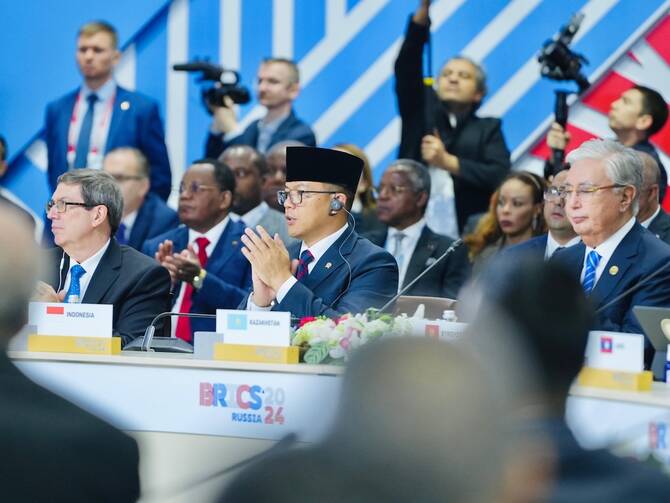
Indonesia’s Foreign Minister Sugiono attends the BRICS Summit in Kazan, Russia on Oct. 24, 2024. (Ministry of Foreign Affairs)
Short Url
Updated 27 April 2025
Follow

Indonesia joins BRICS foreign ministers meeting as member

  • BRICS accounts for about 48% of world’s population, over 37% of global economy
  • Ministerial meeting comes amid Trump’s trade tariffs on nearly all goods imported to US

JAKARTA: Indonesia’s Foreign Minister Sugiono will attend a meeting with his counterparts of the BRICS bloc of emerging economies in Rio de Janeiro on Monday, the country’s first ministerial participation since becoming a full member of the geopolitical forum earlier this year.

Initially comprising Brazil, Russia, India, China and South Africa, the group has expanded with the accession of Egypt, Iran, Ethiopia and the UAE last year, and Indonesia in January.

Morphing into the most powerful geopolitical forum outside the Western world, BRICS now accounts for about 48 percent of the world’s population and more than 37 percent of the global economy.

“The Indonesian foreign minister will encourage BRICS to play a more constructive role in maintaining peace and upholding global norms that have been mutually agreed upon,” Indonesia’s Ministry of Foreign Affairs said in a statement.

“(He) will also emphasize the importance of reforming various multilateral institutions to be more inclusive, transparent, and responsive in facing various challenges in the world.” 

Brazil holds the BRICS presidency this year under the theme “Enhancing Global South Cooperation for a More Inclusive and Sustainable Governance.” 

The two-day meeting of the group’s foreign ministers in Rio de Janeiro will also cover preparations for the upcoming annual leaders’ summit, which Brazil will host in July.

The ministerial-level meeting comes amid the US’ 90-day pause on sweeping “reciprocal” tariffs, while it has raised tariffs on Chinese imports to an effective rate of 145 percent. Beijing has responded with retaliatory hikes on US exports.

The Trump administration has imposed a 47 percent tariff on Indonesian imports, raising concerns about its billions of dollars-worth exports to the US.

The intensifying trade war with the US and the impacts of Washington’s tariffs around the world will be high on the agenda of the BRICS meeting, said Dinna Prapto Raharja, founder of Jakarta-based think-tank Synergy Policies.

“It will be a big part of the agenda, how BRICS countries will respond to the US tariffs,” Raharja told Arab News on Sunday. 

Alternative payment methods in international trade and the role of the New Development Bank — a multilateral bank developed by BRICS member nations — are also likely to be discussed. 

She noted that the BRICS meeting is taking place as China urges a unified response in Southeast Asia, following Chinese President Xi Jinping’s tour to the region earlier this month.

“Indonesia must be able to choose and talk about extremely strategic matters in these negotiation processes,” Raharja said. 

Jakarta must decide on which aspects it is willing to work with the US and in which areas it is open to create alternatives with BRICS countries.

She added: “This must be decided, so that in the case of China coming into the forums with offers or even a little push for BRICS member countries to choose a certain path, Indonesia is ready.”


Iceland joins Eurovision boycott over Israel’s participation

Updated 5 sec ago
Follow

Iceland joins Eurovision boycott over Israel’s participation

  • Decision follows similar moves by Spain, the Netherlands, Ireland and Slovenia over the Gaza war
  • Iceland’s national broadcaster says it pulled out 'given the public debate' in the country
LONDON: Iceland’s national broadcaster said Wednesday it will boycott next year’s Eurovision Song Contest because of discord over Israel’s participation, joining four other countries in a walkout of the pan-continental music competition.
Broadcasters in Spain, the Netherlands, Ireland and Slovenia told contest organizer the European Broadcasting Union last week that they will not take part in the contest in Vienna in May after organizers declined to expel Israel over its conduct of the war against Hamas in Gaza.
The board of Iceland’s RÚV met Wednesday to make a decision.
At its conclusion the broadcaster said in a statement that “given the public debate in this country ... it is clear that neither joy nor peace will prevail regarding the participation of RÚV in Eurovision. It is therefore the conclusion of RÚV to notify the EBU today that RÚV will not take part in Eurovision next year.”
“The Song Contest and Eurovision have always had the aim of uniting the Icelandic nation but it is now clear that this aim cannot be achieved and it is on these program-related grounds that this decision is taken,” the broadcaster said.
Last week the general assembly of the EBU — a group of public broadcasters from 56 countries that runs Eurovision — met to discuss concerns about Israel’s participation. Members voted to adopt tougher contest voting rules in response to allegations that Israel manipulated the vote in favor of its competitor, but took no action to exclude any broadcaster from the competition.
The pullouts include some big names in the Eurovision world. Spain is one of the “Big Five” large-market countries that contribute the most to the contest. Ireland has won seven times, a record it shares with Sweden.
Iceland, a volcanic North Atlantic island nation with a population of 360,000, has never won but has the highest per capita viewing audience of any country.
The walkouts cast a cloud over the future of what’s meant to be a feel-good cultural party marked by friendly rivalry and disco beats, dealing a blow to fans, broadcasters and the contest’s finances.
The contest, which turns 70 in 2026, strives to put pop before politics, but has repeatedly been embroiled in world events. Russia was expelled in 2022 after its full-scale invasion of Ukraine.
It has been roiled by the war in Gaza for the past two years, stirring protests outside the venues and forcing organizers to clamp down on political flag-waving.
Opponents of Israel’s participation cite the war in Gaza, where more than 70,000 Palestinians have been killed, according to the territory’s Health Ministry, which operates under the Hamas-run government and whose detailed records are viewed as generally reliable by the international community.
Israel’s government has repeatedly defended its campaign as a response to the attack by Hamas-led militants on Oct. 7, 2023. The militants killed around 1,200 people — mostly civilians — in the attack and took 251 hostage.
A number of experts, including those commissioned by a UN body, have said that Israel’s offensive in Gaza amounts to genocide, a claim Israel has vigorously denied.
Wednesday marked the final day for national broadcasters to announce whether they planned to participate. More than two dozen countries have confirmed they will attend the contest in Vienna, and the EBU says a final list of competing nations will be published before Christmas.