BRICS offered Turkiye partner country status, Turkish trade minister says

Turkish President Tayyip Erdogan attended a BRICS leaders’ summit hosted by Russian President Vladimir Putin in Kazan last month, after Ankara said it had taken formal steps to become a member of the group. (REUTERS)
Short Url
Updated 14 November 2024
Follow

BRICS offered Turkiye partner country status, Turkish trade minister says

  • Turkish officials have repeatedly said potential membership of BRICS would not affect Turkiye’s responsibilities to the Western military alliance

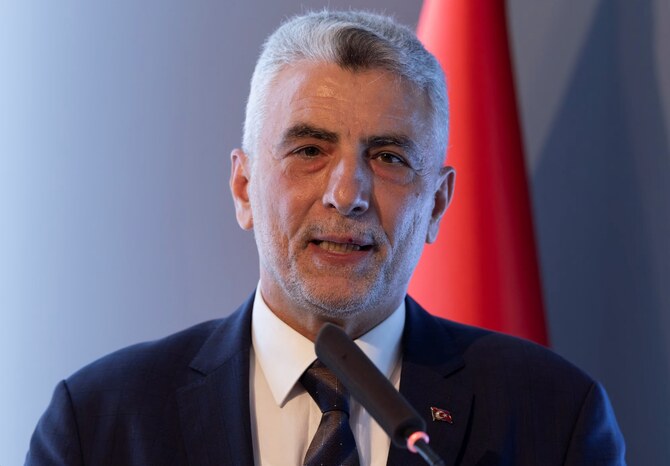
ANKARA: Turkiye was offered partner country status by the BRICS group of nations, Trade Minister Omer Bolat said, as Ankara continues what it calls its efforts to balance its Eastern and Western ties.
Turkiye, a NATO member, has in recent months voiced interest in joining the BRICS group of emerging economies, comprising Brazil, Russia, India, China, South Africa, Ethiopia, Iran, Egypt, and the United Arab Emirates.
Turkish President Tayyip Erdogan attended a BRICS leaders’ summit hosted by Russian President Vladimir Putin in Kazan last month, after Ankara said it had taken formal steps to become a member of the group.
“As for Turkiye’s status regarding (BRICS) membership, they offered Turkiye the status of partner membership,” Bolat said in an interview with private broadcaster TVNet on Wednesday.
“This (status) is the transition process in the organizational structure of BRICS,” he said.
Ankara sees the BRICS group as an opportunity to further economic cooperation with member states, rather than an alternative to its Western ties and NATO membership, Erdogan has said.
Turkish officials have repeatedly said potential membership of BRICS would not affect Turkiye’s responsibilities to the Western military alliance.
Aside from full membership, BRICS members introduced a “partner country” category in Kazan, according to the declaration issued by BRICS on Oct. 23.
Bolat did not say whether Ankara had accepted the proposal.
An official in Erdogan’s ruling AK Party told Reuters this month that while the proposal had been discussed in Kazan, partner country status would fall short of Turkiye’s demands for membership.


US House backs Europe, rebukes Trump on foreign policy

Updated 9 sec ago
Follow

US House backs Europe, rebukes Trump on foreign policy

  • The security strategy openly supports far-right European parties

WASHINGTON: US lawmakers on Wednesday approved a sweeping defense bill bolstering European security — a sharp rebuke to President Donald Trump’s mounting threats to downgrade Washington’s ties to traditional allies and NATO.
The bipartisan House of Representatives vote came on the heels of the publication of a White House national security strategy that amounted to a startling attack on Europe — rattling its governments and opening the biggest transatlantic rift in years.
By contrast, the House’s $900 billion Pentagon bill stands out for its pro-Europe orientation and its clampdown on Trump’s authority to reduce troop numbers, move equipment or downgrade NATO-linked missions.
“President Trump and congressional Republicans are restoring American strength, defending our homeland, standing with our allies, and ensuring the United States remains the most powerful and capable military force the world has ever known,” House Speaker Mike Johnson said ahead of the vote.
In his security strategy published last week, Trump lambasted Europe as an over-regulated, censorious continent lacking in “self-confidence” and facing “civilizational erasure” due to immigration.
His administration accuses European nations of taking advantage of American generosity and of failing to take responsibility for their own destiny.
The security strategy openly supports far-right European parties, questioning the continent’s commitment to peace and indicating that its security is no longer a top US priority.
But lawmakers are explicitly moving in the opposite direction — deepening US resources for the Baltic states and hardening NATO’s northeastern flank, in a move that amounts to one of the strongest congressional assertions in years of Europe’s strategic importance.
The 2026 National Defense Authorization Act  — which now advances to the Senate — carries a robust $8 billion more than the funding Trump requested in May.
It leans hard into European defense, barring troop levels on the continent from falling below 76,000 for more than 45 days and blocking the removal of major equipment.

Demand for drug-strike videos

The White House has backed the 3,086-page text, despite its misgivings over Europe, as well as a provision forcing the Pentagon to hand over videos of maritime strikes against suspected drug-smuggling vessels in Latin American waters.
The footage has become a flashpoint in a transparency dispute between congressional defense and security committees and the military.
To ensure compliance, lawmakers will withhold a quarter of Defense Secretary Pete Hegseth’s travel budget until the videos arrive — an unusually personal tactic reflecting frustration over slow document production and the administration’s expanding use of lethal force in drug interdictions.
The NDAA also adds traditional security priorities. It places fresh limits on any reduction of the 28,500 US troops in South Korea, a signal to Seoul amid uncertainty over America’s long-term military commitment in East Asia.
With support from the administration wavering, the bill also doubles down on Ukraine — setting aside $400 million in security assistance to sustain a baseline of support even if emergency funding stalls.
The National Transportation Safety Board had warned against a provision that it said would roll back critical air-safety requirements for military aircraft operating in Washington’s restricted airspace.
A group of conservative hard-liners mulled blocking the bill over its Ukraine assistance and the absence of a ban on a central bank digital currency.
But opposition on multiple fronts is routine for a final NDAA, and there was never significant risk of a rebellion capable of sinking the package.