

Bangladesh plans to send hundreds of troops to serve in Qatari forces

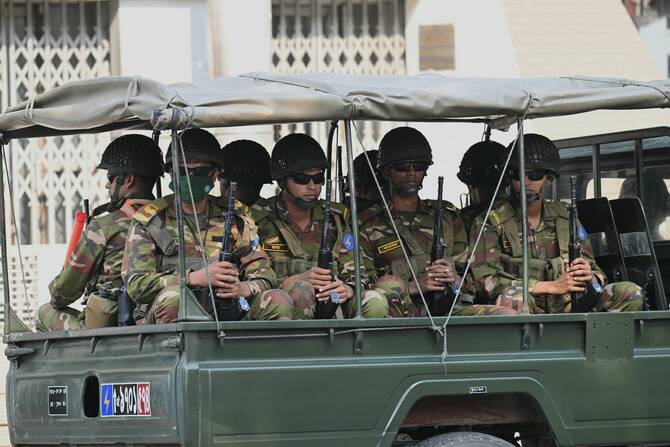
Soldiers patrol outside the state secretariat in Dhaka on Jan. 6, 2024, on the eve of Bangladesh's general elections. (AFP)
Short Url
Updated 26 April 2025
Follow

Bangladesh plans to send hundreds of troops to serve in Qatari forces

  • Bangladesh’s chief adviser discusses deployment with Qatar leadership
  • 6,000 Bangladeshi soldiers are already in service of Kuwait Armed Forces

DHAKA: Bangladesh is planning to send hundreds of soldiers to work for the Qatar Armed Forces, a government spokesperson said, following this week’s talks between the Qatari leadership and the head of the Bangladeshi interim government.

Bangladesh’s chief adviser, Prof. Mohammed Yunus, was in Doha from Monday to Friday to attend the Earthna Summit organized by the Qatar Foundation. On the sidelines of the summit, the Nobel-winning economist also held meetings with top Qatari officials.

Yunus discussed the deployment of Bangladeshi troops with Sheikh Saoud bin Abdulrahman Al-Thani, Qatar’s deputy prime minister and minister of state for defense affairs.

“An agreement was reached to send 725 members of the Bangladesh Armed Forces on deputation to work with the Qatar Armed Forces,” Azad Majumder, deputy press secretary to the chief adviser, told Arab News on Friday.

“During the discussion, our National Security Adviser Dr. Khalilur Rahman was also present. So, all our topmost responsible authorities held this discussion with Qatari authorities.”

As the head of Bangladesh’s interim government, Yunus also oversees its defense portfolio. His caretaker administration assumed office in August last year, when former prime minister Sheikh Hasina quit and fled the country amid violent protests.

Talks between the Bangladeshi and Qatari armed forces will determine the structure of the team that will be dispatched from Bangladesh and identify areas where Qatar requires its expertise.

“It could be in sectors such as medical, infantry, engineering, etc. The details are still being worked out,” Majumder said.

“This is not a tough job for us, as Bangladesh already has this experience. For many years, Bangladesh has been sending soldiers to different UN missions. Bangladeshi armed forces members have also been serving in Kuwait for many years.”

Bangladeshi soldiers are known for contributing to UN peacekeeping missions, with more than 6,300 personnel currently deployed to 10 such operations worldwide.

Beyond these commitments, Bangladesh also engages non-UN international deployments, with its most prominent military presence being in Kuwait.

About 6,000 members of the Bangladesh Military Contingent are currently enlisted with the Kuwait Armed Forces, according to data from the Bangladeshi embassy in the Gulf state.

Kuwait has been recruiting soldiers from Bangladesh under a bilateral agreement with the Bangladeshi government since the end of the 1991 Gulf War.

Initially, they were deployed to conduct extensive land mine clearance operations, but their responsibilities have expanded over the years to include engineering, construction, medical support and logistical assistance.


Thousands protest Slovak leader Fico over whistleblower office closure and penal code changes

Updated 6 sec ago
Follow

Thousands protest Slovak leader Fico over whistleblower office closure and penal code changes

  • Rallies took place in 10 communities, including the capital, Bratislava
  • Fico has long been a divisive figure in Slovakia and people rally often to protest his pro-Russian and other policies

BRATISLAVA: Thousands rallied across Slovakia on Tuesday to protest the latest moves by the government of populist Prime Minister Robert Fico to dismantle an independent office that protects those who report corruption and other criminal activities and amend the penal code.
Rallies took place in 10 communities, including the capital, Bratislava, where the protesters at Freedom Square had a massage for Fico: “Resign, resign.”
Fico has long been a divisive figure in Slovakia and people rally often to protest his pro-Russian and other policies.
This time, people were angered after lawmakers in Parliament loyal to Fico’s coalition government approved a plan to cancel the Whistleblower Protection Office last week despite critical responses to such a move at home and abroad.
In another controversial step, they voted to ban the use of evidence gathered from the suspects who cooperated with law enforcement authorities in exchange for a lower sentence. Such evidence cannot also be used if they lied in any other case.
A banner in the crowd read: “Fico’s government helps mafia.”
Michal Šimečka, the head of the Progressive Slovakia opposition party that organized the rally told the crowd: “Slovakia is the only country where the government approves laws to make life easier for criminals and mafia.”
“Shame, shame,” people chanted.
The opposition charged that the changes were designed to help a prominent ally of Fico, deputy speaker of Parliament Tibor Gašpar, who should face trial on charges of establishing a criminal group.
Protesters called on President Peter Pellegrini, usually an ally of Fico, to veto the changes. Pellegrini has to sign the legislation to become law, but the government has a majority to override it.
Fico’s critics claim that under his government, Slovakia is following the direction of Hungary under Prime Minister Viktor Orbán.
László Gubík, head of the Hungarian Alliance, a party that represents the 450,000 strong Hungarian minority in Slovakia, joined the anti-government protest for the first time.