

Lawsuit challenges Trump administration crackdown on international students

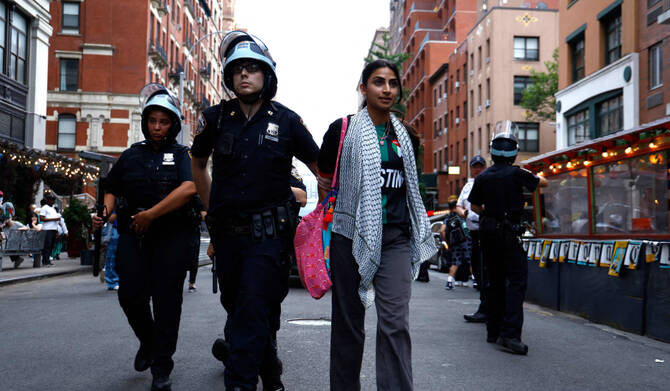
Police detain a pro-Palestine demonstrator during a protest march in New York City on July 18, 2024. (AFP)
Short Url
Updated 19 April 2025
Follow

Lawsuit challenges Trump administration crackdown on international students

  • About 1,100 students at more than 170 colleges, universities and university systems have been affected since late March, according to an Associated Press review of university statements, correspondence with school officials and court records

WASHINGTON: A class action lawsuit filed Friday asks a federal court to reinstate the legal status of international students caught up in a Trump administration crackdown that has left more than a thousand fearful of deportation.
The suit filed by several American Civil Liberties Union affiliates seeks to represent more than 100 students in New England and Puerto Rico.
“International students are a vital community in our state’s universities, and no administration should be allowed to circumvent the law to unilaterally strip students of status, disrupt their studies, and put them at risk of deportation,” said Gilles Bissonnette, legal director of the ACLU of New Hampshire.
At schools around the country, students have seen their visas revoked or their legal status terminated, typically with little notice.
About 1,100 students at more than 170 colleges, universities and university systems have been affected since late March, according to an Associated Press review of university statements, correspondence with school officials and court records. The AP is working to confirm reports of hundreds more students affected.
Students have filed other lawsuits arguing they were denied due process. Federal judges have granted temporary restraining orders in New Hampshire, Wisconsin and Montana, shielding students from efforts to remove them from the US.
Plaintiffs in the new lawsuit, filed in federal court in New Hampshire, learned without warning their F-1 student statuses had been terminated, leaving in doubt their ability to stay in the country and finish their studies, according to the complaint.
One of them, Manikanta Pasula of India, was on the brink of getting his master’s in computer science at Rivier University in New Hampshire and applying to remain in the country through a work program for international students. Hangrui Zhang of China had come to the US for a Ph.D. program in electronic and computer science at Worcester Polytechnic Institute in Massachusetts. Now, he cannot work as a research assistant, which was his only source of income, the complaint said.
The government did not give notice it is required to provide before terminating a foreign student’s legal status, the lawyers said.
The Department of Homeland Security did not immediately respond to a message seeking comment.
Last month, Secretary of State Marco Rubio said the State Department was revoking visas held by visitors who were acting counter to national interests, including some who protested Israel’s war in Gaza and those who face criminal charges.
In some high-profile cases, such as that involving Columbia University activist Mahmoud Khalil, the Trump administration has cited involvement in pro-Palestinian activism as a rationale for deportation.
But colleges say most students affected by visa revocations played no role in those protests. Many are being singled out over minor infractions such as traffic violations that occurred long ago, and in some cases the reason is unclear, colleges say.


EU leaders to reassess US ties despite Trump U-turn on Greenland

Updated 22 January 2026
Follow

EU leaders to reassess US ties despite Trump U-turn on Greenland

  • Diplomats stressed that, although Thursday’s emergency EU talks in Brussels would now lose some of their urgency, the longer-term issue of how to handle the relationship with the US remained

BRUSSELS: EU leaders will rethink their ties with the US at an emergency summit on Thursday after Donald Trump’s threat of tariffs and even military action to ​acquire Greenland badly shook confidence in the transatlantic relationship, diplomats said.
Trump abruptly stepped back on Wednesday from his threat of tariffs on eight European nations, ruled out using force to take Greenland, a semi-autonomous territory of NATO ally Denmark, and suggested a deal was in sight to end the dispute.
German Chancellor Friedrich Merz, welcoming Trump’s U-turn on Greenland, urged Europeans not to be too quick to write off the transatlantic partnership.
But EU governments remain wary of another change of mind by a mercurial president who is increasingly seen as a bully that Europe will have to stand up to, and they are focused on coming up with a longer-term plan on how to deal with the ‌United States under this ‌administration and possibly its successors too.
“Trump crossed the Rubicon. He might do ‌it ⁠again. ​There is no ‌going back to what it was. And leaders will discuss it,” one EU diplomat said, adding that the bloc needed to move away from its heavy reliance on the US in many areas.
“We need to try to keep him (Trump) close while working on becoming more independent from the US It is a process, probably a long one,” the diplomat said.
EU RELIANCE ON US
After decades of relying on the United States for defense within the NATO alliance, the EU lacks the needed intelligence, transport, missile defense and production capabilities to defend itself against a possible Russian attack. This gives the US substantial leverage.
The US ⁠is also Europe’s biggest trading partner, making the EU vulnerable to Trump’s policies of imposing tariffs to reduce Washington’s trade deficit in goods, and, as in ‌the case of Greenland, to achieve other goals.
“We need to discuss where ‍the red lines are, how we deal with this bully ‍across the Atlantic, where our strengths are,” a second EU diplomat said.
“Trump says no tariffs today, but does ‍that mean also no tariffs tomorrow, or will he again quickly change his mind? We need to discuss what to do then,” the second diplomat said.
The EU had been considering a package of retaliatory tariffs on 93 billion euros ($108.74 billion) on US imports or anti-coercive measures if Trump had gone ahead with his own tariffs, while knowing such a step would harm Europe’s economy as well ​as the United States.
WHAT’S THE GREENLAND DEAL?
Several diplomats noted there were still few details of the new plan for Greenland, agreed between Trump and NATO Secretary General Mark Rutte late on ⁠Wednesday on the sidelines of the World Economic Forum in Davos, Switzerland.
“Nothing much changed. We still need to see details of the Greenland deal. We are a bit fed up with all the bullying. And we need to act on a few things: more resiliency, unity, get our things together on internal market, competitiveness. And no more accepting tariff bullying,” a third diplomat said.
Rutte told Reuters in an interview in Davos on Thursday that under the framework deal he reached with Trump the Western allies would have to step up their presence in the Arctic.
He also said talks would continue between Denmark, Greenland and the US on specific issues.
Diplomats stressed that, although Thursday’s emergency EU talks in Brussels would now lose some of their urgency, the longer-term issue of how to handle the relationship with the US remained.
“The approach of a united front in solidarity with Denmark and Greenland while focusing on de-escalation and finding an off-ramp has worked,” a fourth EU diplomat said.
“At the ‌same time it would be good to reflect on the state of the relationship and how we want to shape this going forward, given the experiences of the past week (and year),” he said.