



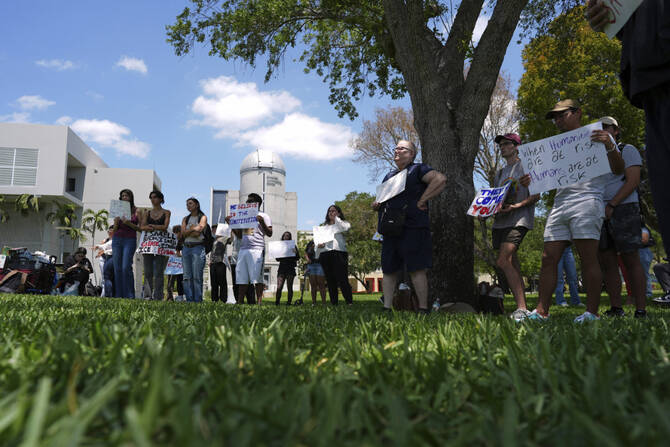

BERKELEY, California/CAMBRIDGE, Massachusetts: Hundreds of students, faculty and community members on a California campus booed on Thursday as speakers accused the administration of President Donald Trump of undermining American universities, as he questioned whether Harvard and others deserve tax-exempt status.
The protest on the University of California’s Berkeley campus was among events dubbed “Rally for the Right to Learn!” planned across the country.
The administration has rebuked American universities over their handling of pro-Palestinian student protests that roiled campuses from Columbia in New York to Berkeley last year, following the 2023 Hamas-led attack inside Israel and the subsequent Israeli attacks on Gaza.
Trump has called the protests anti-American and antisemitic and accused universities of peddling Marxism and “radical left” ideology. On Thursday, he called Harvard, an institution he criticized repeatedly this week, “a disgrace,” and also criticized others.
Asked about reports the Internal Revenue Service was planning to remove Harvard’s tax-exempt status, Trump told reporters at the White House he did not think a final ruling had been made, and indicated other schools were under scrutiny.
Trump had said in a social media post on Tuesday he was mulling whether to seek to end Harvard’s tax-exempt status if it continued pushing what he called “political, ideological, and terrorist inspired/supporting ‘Sickness?’“
“I’m not involved in it,” he said, saying the matter was being handled by lawyers. “I read about it just like you did, but tax-exempt status, I mean, it’s a privilege. It’s really a privilege, and it’s been abused by a lot more than Harvard.”
“When you take a look whether it’s Columbia, Harvard, Princeton, I don’t know what’s going on, but when you see how badly they’ve acted and in other ways also. So we’ll, we’ll be looking at it very strongly.”

A motorist holds a sign in Harvard Square in Cambridge, Massachusetts, on April 17, 2025, during a protest against the Trump administration. (REUTERS)
At Berkeley on Thursday, protesters raised signs proclaiming “Education is a public good!” and “Hands off our free speech!” Robert Reich, a public policy professor, compared the responses of Harvard and Columbia to demands from the administration that they take such steps as ending diversity, equity and inclusion programs and putting academic departments under outside control.
Harvard President Alan Garber, in a letter on Monday, rejected such demands as unprecedented “assertions of power, unmoored from the law” that violated constitutional free speech and the Civil Rights Act.
Columbia had earlier agreed to negotiations after the Trump administration said last month it had terminated grants and contracts worth $400 million, mostly for medical and other scientific research. After reading the Harvard president’s letter, Columbia’s interim President Claire Shipman, said her university would continue “good faith discussions” with the administration, but “would reject any agreement in which the government dictates what we teach, research, or who we hire.”
You cannot appease a tyrant,” said Reich, who served in President Bill Clinton’s cabinet. “Columbia University tried to appease a tyrant. It didn’t work.”
“After Harvard stood up to the tyrant, Columbia, who had been surrendering, stood up and said no.”
Columbia University in New York initially agreed to several demands from the Trump administration. But its acting president took a more defiant tone in a campus message Monday, saying some of the demands “are not subject to negotiation.”
About 150 protesters rallied at Columbia, which had been the scene of huge pro-Palestinian protests last year. They gathered on a plaza outside a building that houses federal offices, holding signs emblazoned with slogans including “stop the war on universities” and “censorship is the weapon of fascists.”
After Harvard’s Garber released his letter on Monday, the Trump administration said it was freezing $2.3 billion in funding to the university. Department of Homeland Security Secretary Kristi Noem announced on Wednesday the termination of two DHS grants totaling more than $2.7 million to Harvard and said the university would lose its ability to enroll foreign students if it does not meet demands to share information on some visa holders.
In response, a Harvard spokesperson said the university stood by its earlier statement to “not surrender its independence or relinquish its constitutional rights,” while saying it will comply with the law.
CNN was first to report on Wednesday the IRS was making plans to rescind Harvard’s tax-exempt status and that a final decision was expected soon.
Harvard said there was no legal basis to rescind it, saying such an action will be unprecedented, will diminish its financial aid for students and will lead to abandonment of some critical medical research programs.
Harrison Fields, a White House spokesperson, said “any forthcoming actions by the IRS are conducted independently of the President, and investigations into any institution’s violations of their tax status were initiated prior to the President’s TRUTH.”
Under federal law the president cannot request that the IRS, which determines whether an organization can have or maintain tax-exempt status, investigate organizations.
Ronald Cox, a professor of political science and international relations at Florida International University in Miami, said during a small event Thursday that the international students are fearful.
“They don’t know if they could be deported, they don’t know if they can be directed to the El Salvadoran prison,” Cox said. “There’s been no due process. It’s kind of open season on the most vulnerable students.”
The protests were organized by the Coalition for Action in Higher Education, which includes groups such as Higher Education Labor United and the American Federation of Teachers.
Kelly Benjamin, a spokesperson for American Association of University Professors, said in a phone call that the Trump administration’s goal of eviscerating academia is fundamentally anti-American.
“College campuses have historically been the places where these kind of conversations, these kind of robust debates and dissent take place in the United States,” Benjamin said. “It’s healthy for democracy. And they’re trying to destroy all of that in order to enact their vision and agenda.”



