

Half a million weapons lost or smuggled after Taliban takeover in Afghanistan

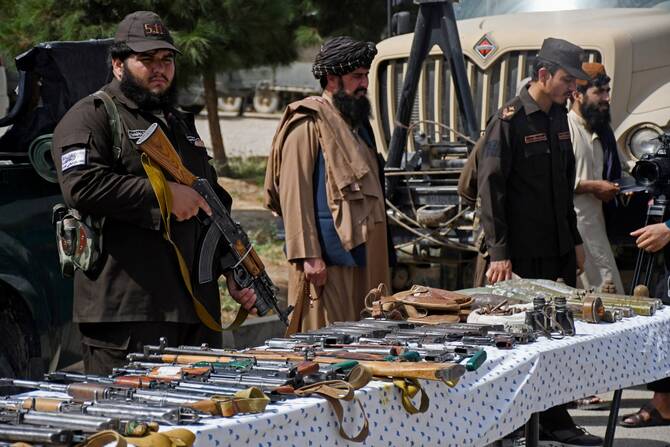
Taliban security personnel display seized weapons in Mazar-i-Sharif district of Balkh province on August 29, 2023. (AFP/File Photo)
Short Url
Updated 18 April 2025
Follow

Half a million weapons lost or smuggled after Taliban takeover in Afghanistan

  • When Taliban swept through Afghanistan, they captured about 1 million pieces of US-funded military equipment
  • Many weapons were abandoned by retreating Afghan soldiers or left behind by US forces

LONDON: Around half a million weapons seized by the Taliban after their 2021 takeover of Afghanistan have been lost, sold, or smuggled to militant groups, according to sources who spoke to the BBC.

Some of the missing weapons are believed to be in the hands of Al-Qaeda affiliates, UN officials say.

When the Taliban swept through Afghanistan, they captured about 1 million pieces of US-funded military equipment, including M4 and M16 rifles, according to the report published on Thursday.

Many weapons were abandoned by retreating Afghan soldiers or left behind by US forces, it added.

At a closed-door UN meeting in Doha last year, Taliban officials reportedly admitted that half of this equipment is now “unaccounted for.”

A UN report in February said groups such as Tehreek-e-Taliban Pakistan and the Islamic Movement of Uzbekistan were accessing Taliban-captured weapons or buying them on the black market.

The Taliban government denies the claims, insisting that all weapons are securely stored.

However, a 2023 UN report said local Taliban commanders were allowed to keep 20 percent of seized US arms, fueling a thriving black market.

Sources described an underground trade where US-made weapons are now sold via messaging apps like WhatsApp.

Oversight of US equipment in Afghanistan has long been criticized, and a US watchdog, Sigar, said tracking efforts were hampered by poor record-keeping across multiple agencies.

US President Donald Trump has vowed to reclaim the lost weaponry, though experts argue the cost of recovery would outweigh its value.

Meanwhile, the Taliban have used captured Humvees, rifles, and other simpler equipment to bolster their military strength, although they struggle to maintain more complex machinery like Black Hawk helicopters.

Concerns remain that the flow of advanced weaponry to militant groups will continue to destabilize the region.


WHO chief says reasons US gave for withdrawing ‘untrue’

Updated 25 January 2026
Follow

WHO chief says reasons US gave for withdrawing ‘untrue’

  • US Secretary of State Marco Rubio and US Health Secretary Robert F. Kennedy Jr. announced in a joint statement Thursday that Washington had formally withdrawn from the WHO
  • And in a post on X, Tedros added: “Unfortunately, the reasons cited for the US decision to withdraw from WHO are untrue”

GENEVA: The head of the UN’s health agency on Saturday pushed back against Washington’s stated reasons for withdrawing from the World Health Organization, dismissing US criticism of the WHO as “untrue.”
Tedros Adhanom Ghebreyesus warned that US announcement this week that it had formally withdrawn from the WHO “makes both the US and the world less safe.”
And in a post on X, he added: “Unfortunately, the reasons cited for the US decision to withdraw from WHO are untrue.”
He insisted: “WHO has always engaged with the US, and all Member States, with full respect for their sovereignty.”
US Secretary of State Marco Rubio and US Health Secretary Robert F. Kennedy Jr. announced in a joint statement Thursday that Washington had formally withdrawn from the WHO.
They accused the agency, of numerous “failures during the Covid-19 pandemic” and of acting “repeatedly against the interests of the United States.”
The WHO has not yet confirmed that the US withdrawal has taken effect.

- ‘Trashed and tarnished’ -

The two US officials said the WHO had “trashed and tarnished” the United States, and had compromised its independence.
“The reverse is true,” the WHO said in a statement.
“As we do with every Member State, WHO has always sought to engage with the United States in good faith.”
The agency strenuously rejected the accusation from Rubio and Kennedy that its Covid response had “obstructed the timely and accurate sharing of critical information that could have saved American lives and then concealed those failures.”
Kennedy also suggested in a video posted to X Friday that the WHO was responsible for “the Americans who died alone in nursing homes (and) the small businesses that were destroyed by reckless mandates” to wear masks and get vaccinated.
The US withdrawal, he insisted, was about “protecting American sovereignty, and putting US public health back in the hands of the American people.”
Tedros warned on X that the statement “contains inaccurate information.”
“Throughout the pandemic, WHO acted quickly, shared all information it had rapidly and transparently with the world, and advised Member States on the basis of the best available evidence,” the agency said.
“WHO recommended the use of masks, vaccines and physical distancing, but at no stage recommended mask mandates, vaccine mandates or lockdowns,” it added.
“We supported sovereign governments to make decisions they believed were in the best interests of their people, but the decisions were theirs.”

- Withdrawal ‘raises issues’ -

The row came as Washington struggled to dislodge itself from the WHO, a year after US President Donald Trump signed an executive order to that effect.
The one-year withdrawal process reached completion on Thursday, but Kennedy and Rubio regretted in their statement that the UN health agency had “not approved our withdrawal and, in fact, claims that we owe it compensation.”
WHO has highlighted that when Washington joined the organization in 1948, it reserved the right to withdraw, as long as it gave one year’s notice and had met “its financial obligations to the organization in full for the current fiscal year.”
But Washington has not paid its 2024 or 2025 dues, and is behind around $260 million.
“The notification of withdrawal raises issues,” WHO said Saturday, adding that the topic would be examined during WHO’s Executive Board meeting next month and by the annual World Health Assembly meeting in May.
“We hope the US will return to active participation in WHO in the future,” Tedros said Saturday.
“Meanwhile, WHO remains steadfastly committed to working with all countries in pursuit of its core mission and constitutional mandate: the highest attainable standard of health as a fundamental right for all people.”