

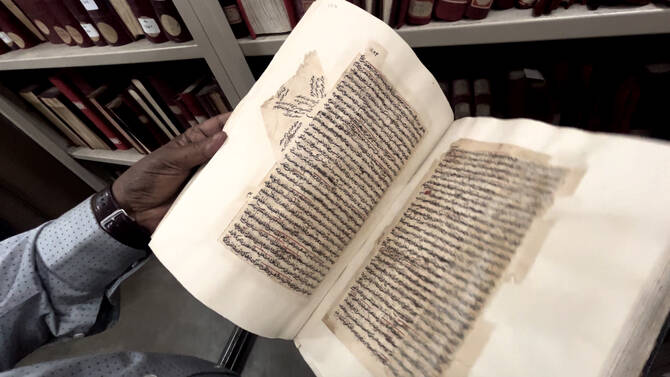

PATNA: When Khan Bahadur Khuda Bakhsh opened his book collection to the public in the late-19th century, he was fulfilling his father’s wish. Little did he know that, over the decades, their private library would grow into one of India’s richest repositories of the intellectual heritage of South Asia and the Middle East.
The Bakhsh family was a family of jurists and scholars, who migrated from Delhi in the early-19th century and established themselves in Patna — the capital of the eastern Indian state of Bihar.
Khuda Bakhsh’s father, Mohammed Bakhsh, was a lawyer and bibliophile, who collected 1,400 Arabic and Persian manuscripts. His son increased the collection to 4,000.
“He was spending all his money, all his assets, on developing this library, acquiring the manuscripts from all over the world,” Dr. Shayesta Bedar, the library’s former director, told Arab News.
“His father desired that Khuda Baksh should make a library for the use of the public, and it should also specialize in manuscripts. He kept the word.”
The Khuda Bakhsh Oriental Library opened in Patna in 1891, in a two-story building near the banks of the Ganges, where it still stands today.
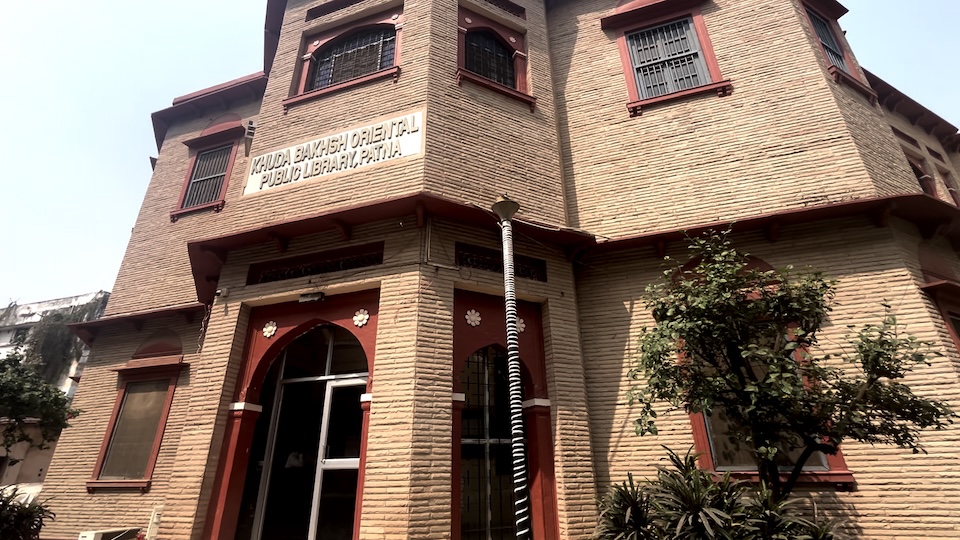
The building of Khuda Bakhsh Oriental Library in Patna, India, March 2025. (AN Photo)
It now holds more than 2 million items, including books, calligraphy, paintings and 21,136 manuscripts — half of them in Arabic and another few thousand in Persian.
The library’s founder had an employee named Makki, whose sole duties were to search for and buy centuries-old works on science, history and Islamic studies.
“Makki used to roam all over the world ... and he was acquiring them from different places,” Bedar said.
“(Khuda Bakhsh) was a rich man. He was an advocate, he has his own lands, and he had no other passion except to develop this library.”
Among the rarest manuscripts in the library’s holdings is the “Kitab Al-Tasrif.” Known in English as “The Method of Medicine,” it is an Arabic encyclopedia of medical procedures written near the year 1000 by Abu Al-Qasim Al-Zahrawi, a famed Arab physician from Andalusia.

This collage of photos shows pages from medieval Arabic manuscripts, “Kitab Al-Hashaish,” left, and “Kitab Al-Tasrif,” center and right, from the collection of Khuda Bakhsh Oriental Library in Patna, India. (Khuda Bakhsh Oriental Library)
Al-Zahrawi is considered the father of operative surgery and is credited with performing the first thyroidectomy and introducing more than 200 surgical tools.
Another rare work is the “Kitab Al-Hashaish,” known as the “Book of Herbs,” which is the Arabic translation of the famous Greek botanical and medical text by Dioscorides, a 1st-century physician and pharmacologist.
“These are 11th-century works ... Today’s medical science has been based on this ‘Kitab Al-Tasrif.’ And ‘Kitab Al-Hashaish’ is a collection of works that deal with medicinal plants and animals. These are some of the rarest manuscripts,” Bedar said.
Among the most prominent Persian works in the collection is the original manuscript of “Tarikh-e Khandan-e Timuriyah” (“Chronicle of the Descendants of Timur”), a 16th-century work commissioned by Mughal Emperor Akbar, which describes the descendants of the 14th-century ruler Timur in Iran and India, including Babur, Humayun and Akbar himself.
Another one is the “Divan of Hafez,” a collection of works by the 14th-century Persian Sufi poet Hafez.
“This (volume) was used by Mughal emperors to take out the omens and the writing of these Mughal kings, notes, are on the margins of the manuscript,” Bedar said.
“These (manuscripts) are a few to be named — just a glimpse ... These are the rarest ones, which are not available anywhere else in the world.”
The library has been administrated by the Indian government since the 1950s. In 1969, Parliament declared it an Institution of National Importance, which is fully funded by the Ministry of Culture.
Since 2023, works have been underway to digitalize the library’s collection and many texts are already available online — expanding the reach of Khuda Bakhsh’s library far beyond the Patna community it was intended for.
But most of the research work still happens offline, in the library’s reading rooms.
“We are connected with the libraries of Saudi Arabia, like the library of the Prophet’s Mosque in Madinah ... People from the Arab world come here for research,” Shakeel Ahmad Shamsi, the library’s information officer, told Arab News.
“We have about 10,000 Arabic manuscripts in this collection, about 8,000 or 9,000 in Persian, and in other languages also like Urdu, Hindi, Sanskrit, Pashto, Turkish ... This library is famous for its manuscripts ... it is famous in the whole world.”


