Trump hails ‘big progress’ in Japan tariff talks

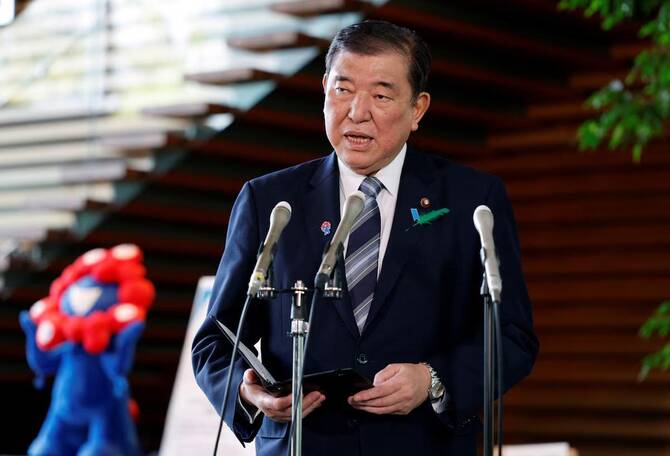
Japanese Prime Minister Shigeru Ishiba reacts as he speaks to reporters after a Japanese negotiator held ministerial talks at the White House regarding US tariffs, at the prime minister’s official residence in Tokyo, Japan, 17 April 2025. FRANCK ROBICHON/Pool via REUTERS
Short Url
Updated 17 April 2025
Follow

Trump hails ‘big progress’ in Japan tariff talks

WASHINGTON: President Donald Trump touted “big progress” in tariff talks with Japan on Wednesday, in one of the first rounds of face-to-face negotiations since his barrage of duties on global imports roiled markets and stoked recession fears.

Japan had not expected the president to get involved in Wednesday’s talks, viewing them as a preliminary, fact-finding mission, a sign that Trump wants to keep tight control over negotiations with dozens of countries expected over coming days and weeks.

Tokyo had also been hoping to limit the scope of the talks to trade and investment matters. But announcing his involvement early Wednesday, Trump said thorny issues including the amount Japan pays towards hosting US troops were among discussion topics.

“A Great Honor to have just met with the Japanese Delegation on Trade. Big Progress!” Trump said in a social media message that contained no details of the discussions.

Opposite Trump was Ryosei Akazawa, a close confidant of Japanese Prime Minister Shigeru Ishiba who serves in the relatively junior cabinet position of economic revitalisation minister.

Speaking to reporters after the talks, Akazawa gave few details but said the parties had agreed to hold a second meeting later this month and that Trump had said getting a deal with Japan was a “top priority.”

Exchange rates, which the Trump administration has said Japan and others manipulate to get a trade advantage, were not part of the talks, Akazawa added.

The dollar strengthened against the yen after his remarks on forex, up around 0.5 percent on the day. Tokyo denies it manipulates its yen currency lower to get make its exports cheaper.

Akazawa held a 50-minute meeting with Trump at the White House before another session with his Treasury Secretary Scott Bessent, Commerce Secretary Howard Lutnick and Trade Representative Jamieson Greer that stretched to almost an hour and a half, according to Japanese readouts of the talks.

Japan’s prime minister, who has previously said he won’t rush to reach a deal and does not plan to make big concessions, sounded a more cautious tone speaking to reporters later in Tokyo.

“Of course, the negotiations will not be easy going forward, but President Trump has stated that he wants to give top priority to the talks with Japan,” Ishiba said.

Italian Prime Minister Giorgia Meloni heads to the White House on Thursday to discuss tariffs imposed on the EU with Trump, while Bessent has invited South Korea’s finance minister to Washington for talks next week.

FIRST MOVER ADVANTAGE

Trump has long complained about the US trade deficit with Japan and other countries, saying US businesses have been “ripped off” by trade practices and intentional efforts by other countries to maintain weak currencies.

Japan has been hit with 24 percent levies on its exports to the US although these rates have, like most of Trump’s tariffs, been paused for 90 days. But a 10 percent universal rate remains in place as does a 25 percent duty for cars, a mainstay of Japan’s export-reliant economy.

Bessent has said there is a “first mover advantage” given Washington has said more than 75 countries have requested talks since Trump announced sweeping duties on dozens of countries — both friend and foe — earlier this month.

Akazawa declined to comment on the matter, adding only that he strongly requested a revocation of the tariffs and that he believed Washington wanted to secure a deal in the 90-day window.

Washington is hoping to strike deals with countries that would cover tariffs, non-tariff barriers and exchange rates, Bessent has said, though Tokyo had lobbied to keep the latter separate.

Trump earlier this month lambasted Japan for what he said was a 700 percent tariff on rice, a figure Tokyo disputes. Levies on autos are particularly painful for Japan as they make up nearly a third of shipments to the US, its biggest export market.

Japan hopes that pledges to expand investment in the US will help to convince the US that the allies can achieve a “win-win” situation without tariffs.

Possible Japanese investment in a multi-billion-dollar gas project in Alaska could also feature in tariff negotiations, Bessent said before Wednesday’s talks.

“It sounds like the Trump administration really does want a quick deal, which suggests it will be a less substantive deal,” said Tobias Harris of Japan Foresight, a political risk advisory.

“My baseline is that if the US really starts making demands on agriculture and maybe also on some of the auto regulations, it becomes a lot more contentious and hard to do quickly.”


UAE, Kuwait and Egypt extend non-oil growth in December: PMI survey 

Updated 8 sec ago
Follow

UAE, Kuwait and Egypt extend non-oil growth in December: PMI survey 

RIYADH: Non-oil business activity across the UAE, Kuwait and Egypt expanded further in December, supported by rising new orders and steady demand, economy trackers showed. 

In its latest report, S&P Global revealed that the UAE’s Purchasing Managers’ Index eased slightly to 54.2 in December from a nine-month high of 54.8 in November, remaining firmly in expansion territory. 

A PMI reading above 50 indicates an expansion in non-oil business activity, while a figure below 50 signals contraction. 

The UAE’s non-oil sector performance aligns with broader trends across the Middle East and North Africa, where economies continue to pursue diversification efforts aimed at reducing reliance on crude revenues. 

Saudi Arabia led the PMI readings in the region in December, with the Kingdom recording 57.4, supported by rising new orders, continued growth in business activity and expanding employment. 

Commenting on the UAE data, David Owen, senior economist at S&P Global Market Intelligence, said: “The UAE non-oil sector concluded 2025 with a solid upturn, marking a year of robust but somewhat tempered growth in business conditions.” 

He added: “Positively, firms finished the year with two of their best months of activity growth, as the survey data suggested that sales were rising much faster compared to their low point in August.” 

According to the report, the pace of business expansion in December was among the fastest recorded during the year, with more than a quarter of surveyed companies reporting month-on-month increases in output. 

Surveyed non-oil firms attributed the growth in activity to rising new business intake, driven by improving market conditions, supportive government policies, increased customer numbers, and stronger international demand. 

Some companies reported subdued sales, citing intensifying competition and ongoing economic uncertainty. 

“Firms took encouragement from signs of increased customer spending, rising tourism, greater technology adoption and supportive government policies,” added Owen. 

Companies also reported mounting cost pressures in December, with survey data pointing to the fastest rise in overall input prices in 15 months. 

Respondents highlighted above-average increases in salary expenses, along with higher transport and maintenance costs. 

Cost pressures also affected inventory management, with firms reporting a notable decline in stock levels. 

Employment growth remained relatively subdued at the end of the fourth quarter, with hiring only marginal and weaker than in November. 

“December was also characterized by an acceleration of cost pressures and leaner inventory strategies, indicating that many firms were feeling the pinch on their balance sheets. Additionally, reports of heightened competition and challenges in finalizing new work highlighted ongoing headwinds for the non-oil sector as it heads into 2026,” added Owen. 

Looking ahead, companies remained optimistic, although confidence eased and was among the lowest levels seen in the past three years. 

In the same report, S&P Global said Dubai’s non-oil economy ended the year on a positive note, with the emirate’s PMI at 54.3 in December, slightly down from 54.5 in November. 

Kuwait confidence at 2-year high 

In a separate publication, S&P Global said business confidence among non-oil firms in Kuwait hit a two-year high in December. 

The country’s PMI rose to 54 in December from 53.4 in November, driven by sharp and accelerated increases in output and new orders. 

Marketing activities and the launch of new products were cited as key factors supporting growth during the month. 

New orders increased for the 35th consecutive month in December, with the pace of expansion the fastest since May. 

Although employment increased, hiring was not sufficient to prevent a further build-up in backlogs of work. 

“The Kuwaiti non-oil private sector has been building growth momentum through the final quarter of 2025 and is in a strong position as 2026 gets underway. In fact, companies are buoyant about prospects for the coming year, with business optimism among the highest since the survey began in 2018,” said Andrew Harker, economics director at S&P Global Market Intelligence. 

He added: “New orders continued to flow in quickly in December, and despite efforts by companies to expand their staffing levels accordingly, backlogged work accumulated to the largest extent on record. This suggests that output will need to be ramped up further in the months ahead.” 

Egypt stays in expansion zone 

In another report, S&P Global said Egypt’s PMI eased to 50.2 in December from a 61-month high of 51.1 in November. 

The index remained above the 50 thresholds for the second consecutive month, signaling a sustained improvement in the health of the non-oil private sector. 

Firms benefited from increased new orders in December, supporting a modest expansion in output, although growth in both areas slowed compared to the previous month. 

“Improvements in order books have been a clear factor behind strong business performances over the past few months,” said Owen. 

He added: “The uplift in sales arrived amid a softening of inflationary pressures in the Egyptian economy, which has enabled businesses and consumers to spend with more confidence. Adding to signs of growth spreading, firms’ purchases of inputs increased for the first time in ten months.” 

Non-oil companies in Egypt reported a renewed decline in employment during December, with most firms citing difficulties in replacing staff who had left. 
The overall reduction in employment was the sharpest in 13 months, though it remained modest. 

Despite improving business conditions, firms expressed caution toward future activity. 

The outlook for the next 12 months was neutral in December, reflecting subdued confidence during the latter half of 2025. 

“The overall upturn in business conditions was softer in December compared to one month ago, suggesting this growth trend should be treated with caution. Firms also face continued uncertainties in the domestic and global sphere, which has made them hesitant to show optimism,” added Owen.