

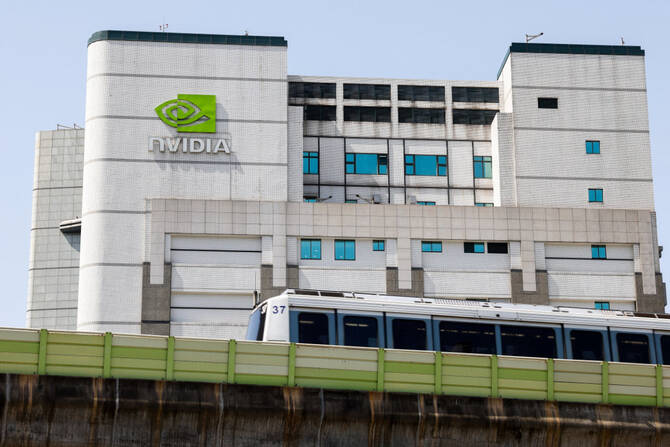

Global chip stocks were battered on Wednesday on fresh evidence of how US President Donald Trump’s shifting trade policy was complicating the outlook for semiconductor and computing giants, including AI pioneer Nvidia and its rival AMD.
Attempts to reorient global trade through tariffs and export curbs have started to show the effect as Nvidia warned of a $5.5 billion hit after Washington restricted exports of its AI processor tailored for China, while Dutch chip-making tools giant ASML raised doubts about its outlook.
The US restriction, which also hit the MI308 processor of Advanced Micro Devices, marked the latest blow for the AI chip trade that is losing steam after a two-year rally as tariff threats and fears over Big Tech’s spending weigh on sentiment.
Nvidia shares closed down nearly 7 percent on Wednesday, with the company losing more than $148 billion in market value. AMD fell 5.8 percent as it warned of a $800 million hit from the latest curb, while AI-related chip stocks including Arm, Broadcom and Micron dropped between 2.5 percent and 4.6 percent.
Nvidia said on Wednesday that it follows the US government’s directions on where it can sell its chips after the US Commerce Department announced on Tuesday it was issuing new export licensing requirements for Nvidia’s H20 chips.
“The US government instructs American businesses on what they can sell and where — we follow the government’s directions to the letter,” Nvidia said.
“The technology industry supports America when it exports to well-known companies worldwide — if the government felt otherwise, it would instruct us,” the company added.

Global stock markets mostly retreated Wednesday after the US government imposed restrictions on exports of a key Nvidia chip to China, the latest trade war salvo between the world's biggest economies. (AFP)
Tightening US export curbs have in recent years made it harder for American chipmakers to tap the Chinese market, but the country remains a key source of revenue.
“The US export restrictions on Nvidia’s H20 chips highlight the growing geopolitical uncertainty enveloping the tech and semiconductor sectors, particularly under Trump-era-style policy reversals,” said Michael Ashley Schulman, chief investment officer at Running Point Capital.
“This unpredictability rattles businesses and investment markets, as evidenced by Nvidia’s selloff this morning and broader pressure across chip stocks.”
Nvidia drew over 13 percent of its sales, or about $17 billion, from China in its last financial year, although that was down from 21 percent in fiscal 2023. For AMD, China was its second-largest market last year, accounting for more than 24 percent of total sales.
“The H20 portion was about $12 billion or so (of the total China revenue), roughly about 30 cents of earnings per share, not trivial but not enormous in the grand scheme of things,” Bernstein analyst Stacy Rasgon said.
“H20 performance is low, well below already-available Chinese alternatives; a ban essentially simply hands the Chinese AI market over to Huawei.”
Rasgon said the move may have surprised many investors as shares had surged nearly 18 percent last week, partly due to a report that the Trump administration planned to back off from such a curb after CEO Jensen Huang attended a Mar-a-Lago dinner.
The company had earlier this week unveiled plans to build AI servers worth as much as $500 billion in the US over the next four years, a move largely seen as an overture to Trump.
Trump has for now exempted semiconductors and some other electronics from his tariffs, but he has warned that sector-specific levies will be announced in the coming weeks.
Such tariffs could cost US semiconductor equipment makers more than $1 billion a year, Reuters reported on Tuesday.
NVIDIA fallout
News of the latest export curb on Nvidia sparked a selloff in chip companies and its suppliers across the globe.
In South Korea, Samsung closed down about 3 percent, while SK Hynix closed 4 percent lower.
European chipmakers ASM International and Infineon Technologies fell more than 2 percent, while Japanese chip-testing equipment maker Advantest — an Nvidia supplier — was the Nikkei’s second-worst performer with a 5 percent tumble.
Still, some analysts said Nvidia’s overall sales have continued to surge even as the China contribution slows while chip demand remains strong from big cloud companies.
“While we acknowledge the likely impact to near-term numbers, we would stress that Blackwell shipments to core hyperscale customers remains the driver of fundamentals,” TD Cowen analysts said, referring to Nvidia’s latest line of AI systems.


