

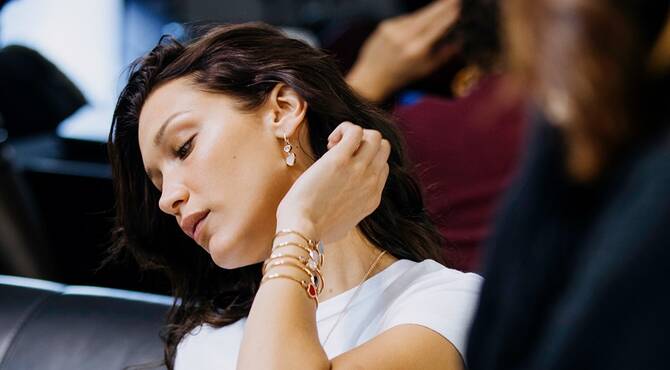
Chopard unveils new images featuring Bella Hadid

She was featured in Chopard’s latest Instagram posts, pairing an off-duty outfit with pieces from the brand’s jewelry collections. (Instagram)
Short Url
Updated 06 January 2026
Follow

Chopard unveils new images featuring Bella Hadid

  • Wears jewelry, clothes from Happy Hearts collection
  • Model also reveals images celebrating the New Year

DUBAI: US Dutch Palestinian model Bella Hadid has become a key face for Chopard, fronting several of the maison’s campaigns and reinforcing her close ties with the brand.

She was featured in Chopard’s latest Instagram posts, pairing an off-duty outfit with pieces from the brand’s jewelry collections.

In one image, Hadid embraced understated dressing in classic blue jeans and a crisp white T-shirt, elevating the minimalist look with statement pieces from Chopard’s Happy Hearts collection.

She layered five delicate gold bracelets along her wrist, each punctuated with the collection’s signature heart motif, creating a refined stacked effect.

The look was completed with a matching gold heart necklace resting softly at the neckline, coordinating ring, and gold watch, all echoing the same heart design that defines the collection.

In another post, she wore a black halter-neck top, accessorized with rose-gold rings and a stacked bracelet set from the same collection, featuring heart-shaped motifs.

The model’s collaboration with Chopard began in 2017 when she became one of the faces of the brand’s high jewelry collections.

Since then, she has appeared in several campaigns and worn Chopard pieces at major international events, including the Cannes Film Festival, Met Gala, and Paris Fashion Week.

In August, Hadid starred in the latest campaign spotlighting Chopard’s L’Heure du Diamant collection. The brand shared a behind-the-scenes video from the shoot, showing her in a white halter-neck dress as she posed in the sparkling jewelry pieces.

Hadid marked the start of the new year by sharing a carousel of images this week, offering a glimpse into how she celebrated the occasion. She rang in the New Year in Aspen.

She spent the final moments of 2025 wearing a look by Lebanese designer Georges Chakra.

The sheer-black lace dress was intricately embroidered with black crystals, featuring sculpted lace appliques framing the neckline and bodice, with satin bands finishing the hem.

Hadid and her friends appeared to celebrate in a mountain lodge, where the group gathered around a wooden fire pit to stay warm, enjoyed a fine dining experience, and continued the celebrations into the night.


Riyadh takes shape at Tuwaiq Sculpture Symposium 2026

Updated 16 January 2026
Follow

Riyadh takes shape at Tuwaiq Sculpture Symposium 2026

RIYADH: This season, one of Riyadh’s busiest streets has taken on an unexpected role.

Under the theme “Traces of What Will Be,”sculptors are carving granite and shaping reclaimed metal at the seventh Tuwaiq Sculpture Symposium, running from Jan. 10 to Feb. 22.

The symposium is unfolding along Prince Mohammed bin Abdulaziz Road, known locally as Al‑Tahlia, a name that translates to desalination. The choice of location is deliberate.

The area is historically linked to Riyadh’s early desalination infrastructure, a turning point that helped to shift the city from water scarcity toward long‑term urban growth.

Twenty‑five artists from 18 countries are participating in this year’s event, producing large‑scale works in an open‑air setting embedded within the city.

The site serves as both workplace and eventual exhibition space, with sculptures remaining in progress throughout the symposium’s duration.

In her opening remarks, Sarah Al-Ruwayti, director of the Tuwaiq Sculpture Symposium, said that this year new materials had been introduced, including recycled iron, reflecting a focus on sustainability and renewal.

She added that the live-sculpting format allowed visitors to witness the transformation of raw stone and metal into finished artworks.

Working primarily with local stone and reclaimed metal, the participating artists are responding to both the material and the place.

For Saudi sculptor Wafaa Al‑Qunaibet, that relationship is central to her work, which draws on the physical and symbolic journey of water.

“My work … presents the connection from the salted water to sweet water,” Al‑Qunaibet told Arab News.

Using five pieces of granite and two bronze elements, she explained that the bronze components represented pipes, structures that carry saline water and allow it to be transformed into something usable.

The sculpture reflected movement through resistance, using stone to convey the difficulty of that transition, and water as a force that enables life to continue.

“I throw the stone through the difficult to show how life is easy with the water,” she said, pointing to water’s role in sustaining trees, environments and daily life.

Formally, the work relies on circular elements, a choice Al‑Qunaibet described as both technically demanding and socially resonant.

“The circle usually engages the people, engages the culture,” she said. Repeated circular forms extend through the work, linking together into a long, pipe‑like structure that reinforces the idea of connection.

Sculpting on site also shaped the scale of the piece. The space and materials provided during the symposium allowed Al‑Qunaibet to expand the work beyond her initial plans.

The openness of the site pushed the sculpture toward a six‑part configuration rather than a smaller arrangement.

Working across stone, steel, bronze and cement, American sculptor Carole Turner brings a public‑art perspective to the symposium, responding to the site’s historical and symbolic ties to desalination.

“My work is actually called New Future,” Turner told Arab News. “As the groundwater comes up, it meets at the top, where the desalination would take place, and fresh water comes down the other side.”

Her sculpture engages directly with the symposium’s theme by addressing systems that often go unseen. “Desalination does not leave a trace,” she said. “But it affects the future.”

Turner has been sculpting for more than two decades, though she describes making objects as something she has done since childhood. Over time, she transitioned into sculpture as a full‑time practice, drawn to its ability to communicate across age and background.

Public interaction remains central to her approach. “Curiosity is always something that makes you curious, and you want to explore it,” she said. Turner added that this sense of discovery is especially important for children encountering art in public spaces.

Saudi sculptor Mohammed Al‑Thagafi’s work for this year’s symposium reflects ideas of coexistence within Riyadh’s evolving urban landscape, focusing on the relationships between long‑standing traditions and a rapidly changing society.

The sculpture is composed of seven elements made from granite and stainless steel.

“Granite is a national material we are proud of. It represents authenticity, the foundation, and the roots of Saudi society,” Al‑Thagafi told Arab News.

“It talks about the openness happening in society, with other communities and other cultures.”

That dialogue between materials mirrors broader social shifts shaping the capital, particularly in how public space is shared and experienced.

Because the sculpture will be installed in parks and public squares, Al‑Thagafi emphasized the importance of creating multi‑part works that invite engagement.

Encountering art in everyday environments, he said, encouraged people to question meaning, placement, simplicity and abstraction, helping to build visual‑arts awareness across society.

For Al‑Thagafi, this year marked his fifth appearance at the symposium. “I have produced more than 2,600 sculptures, and here in Riyadh alone, I have more than 30 field works.”

Because the works are still underway, visitors can also view a small on‑site gallery displaying scaled models of the final sculptures.

These miniature models offer insight into each artist’s planning process, revealing how monumental forms are conceived before being executed at full scale.

As the symposium moves toward its conclusion, the completed sculptures will remain on site, allowing the public to encounter them in the environment that shaped their creation.