

World of Coffee trade show capitalizes on Gulf’s strong coffee culture

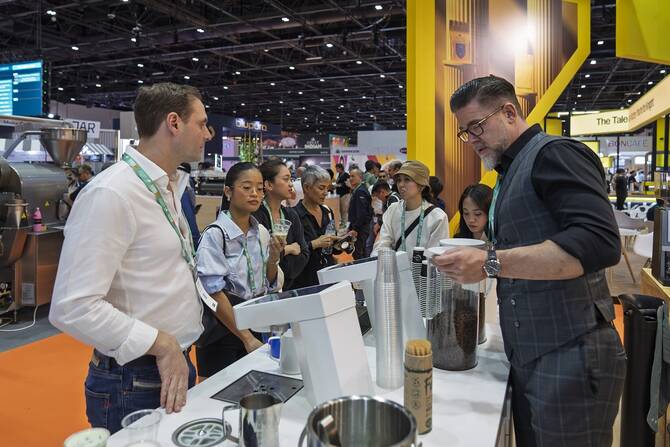
A previous edition of the World of Coffee trade show in Dubai. (Supplied)
Short Url
Updated 06 January 2026
Follow

World of Coffee trade show capitalizes on Gulf’s strong coffee culture

DUBAI: Long regarded as the birthplace of coffee brewing, the Middle East is entering a new phase of cafe culture — and the fifth edition of World of Coffee, which takes place in Dubai from Jan. 18-20, will help drive that momentum.

Saudi Arabia alone is home to more than 5,100 branded cafes, with daily coffee consumption exceeding 36 million cups. Coffee is part of the social and cultural fabric, from traditional majlis gatherings to contemporary specialty cafes.

“Saudi Arabia’s coffee sector is evolving rapidly. There is increasing investment in quality, education, and presentation, alongside renewed interest in origin storytelling and cultural context,” said Shouq Bin Redha, exhibition manager for World of Coffee Dubai 2026, where Saudi Arabia will host a national pavilion.

“Saudi coffee has a very distinct identity rooted in heritage, ritual, and hospitality. Its profile is closely tied to traditional preparation methods and regional flavor preferences, which sets it apart on the global stage,” she told Arab News. “The national pavilion reflects this balance between tradition and modernization.”

Organized by DXB LIVE in partnership with the Specialty Coffee Association, World of Coffee Dubai has expanded dramatically, growing from 5,000 sq. meters in 2022 to more than 20,000 sq. meters in 2026. The event brings together producers, traders, roasters, cafe owners and innovators from around the world.

“At its core, the event is about bringing together the full coffee value chain in one place,” Redha said. “We want participants to leave not only having discovered new products or origins, but with stronger partnerships, clearer market insight, and a deeper understanding of how the industry is evolving.”

She added: “The Gulf has become an increasingly attractive market for producers because it combines strong consumer demand with a growing appreciation for quality, origin, and traceability.”

The UAE’s coffee market alone exceeds $3.2 billion, while Dubai continues to strengthen its position as one of the world’s most cafe-dense and diverse cities.

“Dubai, in particular, offers a unique gateway to multiple markets at once. For producers, World of Coffee Dubai provides direct access not only to local buyers, but to an international audience that uses the city as a regional and global trading hub,” Redha said.

When it comes to trends in the Gulf’s coffee scene, Redha said she expected to see “continued diversification in sourcing, with buyers exploring a broader range of origins and flavor profiles. There is also growing interest in coffees that offer greater transparency, whether through direct trade relationships, clearer traceability, or stronger sustainability credentials.”


Rubaiya Qatar’s flagship ‘Unruly Waters’ promises compelling curation

Updated 7 sec ago
Follow

Rubaiya Qatar’s flagship ‘Unruly Waters’ promises compelling curation

DOHA: The ambitious new quadrennial Rubaiya Qatar opens this November across the country and its capital Doha, and its headline exhibition, “Unruly Waters,” promises to be a major intervention in contemporary curation.

The show has four curators: Tom Eccles (executive director, Center for Curatorial Studies and the Hessel Museum of Art, Bard College); Ruba Katrib (chief curator and director of curatorial affairs, MoMA PS1); Mark Rappolt (editor-in-chief of ArtReview and ArtReview Asia); and Shabbir Hussain Mustafa (chief curator, Singapore Art Museum),

It features more than 50 artists and includes over 20 new commissions produced for the project. The show offers both a literal and metaphorical examination of water.

“Water is a kind of foil to talk about something else,” said Eccles at a briefing panel held alongside Art Basel Qatar last week, signaling a show that will use seas, currents and maritime histories to open conversations about trade, migration, ecology and cultural exchange.

The curators’ research was sparked, in part, by a maritime find now in Qatar’s collections: a shipwreck off the coast of Sumatra that yielded tens of thousands of objects and traced routes across the historic Maritime Silk Road.

Eccles said the material “gave us the world to think” beyond conventional regional frames and to reconfigure how an exhibition might map connections from the Gulf eastwards to south and southeast Asia.

The exhibition’s scale is matched by its ambition. “More than half of the show will be commissioned,” said Katrib, underlining the quadrennial’s commitment to new production and artworks conceived in dialogue with Doha’s audiences and sites.

Katrib emphasizes the show’s intergenerational and geographically wide-ranging cast of artists.

And the curators’ intent to foreground histories of trade — cups, pots and the everyday objects that circulated across oceanic networks — alongside more speculative practices addressing climate, migration and contingency.

Rappolt pointed out that “Unruly Waters” “is very much built on the work that our colleagues have done over several years in building infrastructures and networks.”

The curators have drawn on environmental history and scholarship — inviting contributions from historians and hosting academic exchanges — so that the exhibition functions as a platform for knowledge production, and dialogue.

Mustafa spoke about the plural, polyvocal structure of the show. The project maps multiple regions at once. “We have the Arab worlds. We have the Indian ocean worlds. We have Africa, we have Southeast Asia.”

And these zones will sit “alongside each other, not necessarily in agreement, but most certainly in a state of complexity.”