

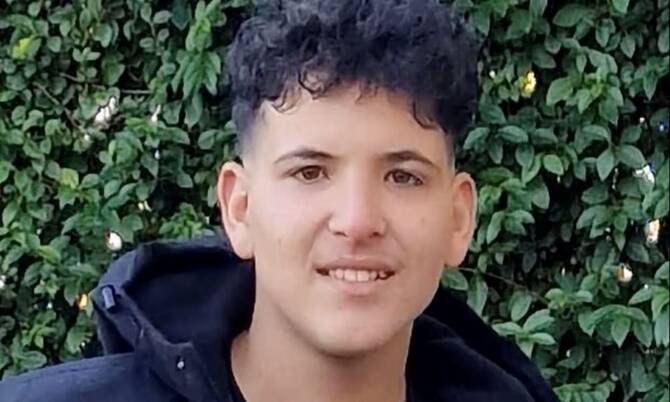

LONDON: The body of a 16-year-old Syrian refugee who was stabbed to death in the UK is being repatriated to his homeland following a local community fundraiser, The Guardian reported on Tuesday.
Locals in Huddersfield raised more than £15,000 ($19,800) after the killing of Ahmad Mamdouh Al-Ibrahim, whose family described him as “a very nice boy” who wanted to be a doctor.
He was stabbed in the neck on April 3 as he was being shown around the town center by his cousin.
Al-Ibrahim had only arrived in Huddersfield two weeks earlier after spending time at a Welsh immigration center and staying with his uncle’s family during Ramadan.
Funeral prayers were held at Omar Mosque in Huddersfield last Friday, with about 500 people attending.
Alfie Franco, 20, appeared in court two days after the killing. He was charged with murder and remanded in custody until a hearing in May.
The local fundraiser for Al-Ibrahim’s repatriation was organized by Maneer Siddique, who said he was “absolutely overwhelmed” by the response from the people of Huddersfield.
He had initially hoped to raise about £2,000, but the GoFundMe page has surpassed £15,000 and continues to climb.
“To generate that kind of money in such a short space of time is unreal,” said Siddique, who runs a tailoring business.
One benefactor delivered an envelope to be passed on to Al-Ibrahim’s uncle. “He started counting the money and there was £500 in the envelope. He was in tears,” Siddique said.
“He really wants to thank everyone. And I would like to also thank people personally because of the amount of money we’ve generated through people’s kindness.”
Al-Ibrahim’s body, accompanied by two relatives, will be taken to Damascus Tuesday evening.
They will then travel to extended family in Homs, where a second funeral will be held this week for Al-Ibrahim’s burial.
He had been injured by bomb shrapnel during the Syrian civil war, which he was fleeing when he came to Britain.
His uncle said Al-Ibrahim only knew family in Huddersfield, adding: “He was trying to make a friend, because he didn’t have friends here. I said to him, you have to go out into the town center to know (where everything is), to know where you can go shopping … plus, you’re going to make friends.”
Numerous cards were left at the site of Al-Ibrahim’s killing. Some contained messages addressed to “the lad I don’t know,” and were signed by “a stranger” and the “heartbroken Huddersfield people.”


