

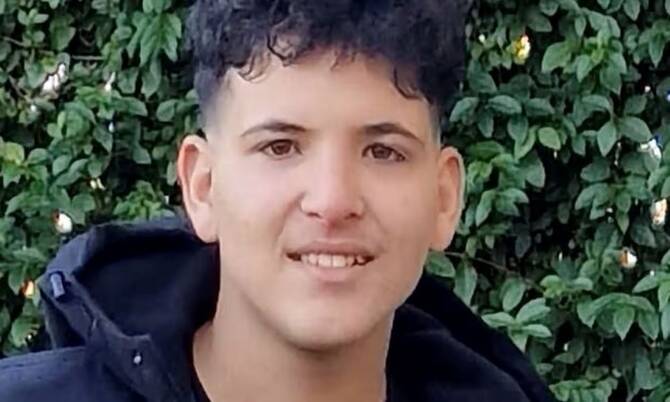
Syrian refugee killed in UK had only been in town a fortnight: Uncle

Ahmad Mamdouh Al-Ibrahim, 16, was stabbed in the neck in Huddersfield while out getting to know the area. (West Yorkshire Police)
Short Url
Updated 11 April 2025
Follow

Syrian refugee killed in UK had only been in town a fortnight: Uncle

  • Ahmad Mamdouh Al-Ibrahim, 16, was stabbed in the neck in Huddersfield
  • ‘He was a good boy. He came here (from Homs) to be a doctor, to save people’

LONDON: The uncle of a young Syrian refugee who was stabbed to death in the UK on April 3 said the boy had only lived in the town he was in for two weeks before he was killed.

Ahmad Mamdouh Al-Ibrahim, 16, was stabbed in the neck in Huddersfield while out getting to know the area. Alfie Franco, 20, was arrested and appeared in court charged with Al-Ibrahim’s murder.

Al-Ibrahim was living in Huddersfield with the family of his uncle, who told The Guardian that he had encouraged his nephew to go out and make friends following the end of Ramadan.

“He was trying to make a friend, because he didn’t have friends here. I said to him, you have to go out into the town centre to know (where everything is), to know where you can go shopping … plus, you’re going to make friends,” said his uncle, who asked to remain anonymous.

“He’d only spent a few days with my kids but they loved him so much because he was a very nice boy, very lovely and kindly with the kids. He played with them and gave them a lot of time.” 

He said rumors circulating online that his nephew was a drug dealer had caused him great distress, adding that he had not yet told his own children, all aged under 10, that their cousin is dead. They believe he is still in hospital.

“He was only 16,” he said tearfully. “He was a good boy. He went from a nice family (in Syria) to a nice family (in the UK).”

Al-Ibrahim, he said, had left behind his family in the Syrian city of Homs, where he had been a popular student with teachers and classmates, and had excelled at maths.

“That’s why he came here. He wished to be a doctor, to save people,” said his uncle, who fled the civil war in Syria.

“We’ve been eight years here — we’ve not had trouble, not had a problem. We go from work to home, school, that’s it.”

Al-Ibrahim’s uncle said when he first moved to the UK last October, his nephew had spent time in a refugee center in Swansea.

He told The Guardian that staff at the center, as well as the teenager’s social worker, were “heartbroken” by what had happened, and that they told him they had “never seen him happy like this” when they checked on his well-being after he moved to Huddersfield on March 20.

“They were crying for Ahmad, they said they loved him,” the uncle said, adding that the family had been left afraid by the killing.

“I’ve been (in Huddersfield) eight years. I thought it was a safe place. I didn’t worry before, like now.”

Many members of the local community have raised money for Al-Ibrahim’s body to be returned to his family in Syria.

Maneer Siddique, who owns a local tailoring business, launched a fundraising page that has raised over £10,000 ($12,910) for the family.

“You would want help if you were in a dire situation, so why shouldn’t you help somebody else in a dire situation,” Siddique told The Guardian.


Louvre heist probe still aims to ‘recover jewelry’, top prosecutor says

Updated 3 sec ago
Follow

Louvre heist probe still aims to ‘recover jewelry’, top prosecutor says

  • Police believe they have arrested all four thieves who carried out the brazen October 19 robbery
PARIS: French investigators remain determined to find the imperial jewels stolen from the Louvre in October, a prosecutor has said.
Police believe they have arrested all four thieves who carried out the brazen October 19 robbery, making off with jewelry worth an estimated $102 million from the world-famous museum.
“The interrogations have not produced any new investigative elements,” top Paris prosecutor Laure Beccuau said this week, three months after the broad-daylight heist.
But the case remains a top priority, she underlined.
“Our main objective is still to recover the jewelry,” she said.
That Sunday morning in October, thieves parked a mover’s truck with an extendable ladder below the Louvre’s Apollo Gallery housing the French crown jewels.
Two of the thieves climbed up the ladder, broke a window and used angle grinders to cut glass display booths containing the treasures, while the other two waited below, investigators say.
The four then fled on high-powered motor scooters, dropping a diamond-and-emerald crown in their hurry.
But eight other items of jewelry — including an emerald-and-diamond necklace that Napoleon I gave his second wife, Empress Marie-Louise — remain at large.
Beccuau said investigators were keeping an open mind as to where the loot might be.
“We don’t have any signals indicating that the jewelry is likely to have crossed the border,” she said, though she added: “Anything is possible.”
Detectives benefitted from contacts with “intermediaries in the art world, including internationally” as they pursued their probe.
“They have ways of receiving warning signals about networks of receivers of stolen goods, including abroad,” Beccuau said.
As for anyone coming forward to hand over the jewels, that would be considered to be “active repentance, which could be taken into consideration” later during a trial, she said.
A fifth suspect, a 38-year-old woman who is the partner of one of the men, has been charged with being an accomplice but was released under judicial supervision pending a trial.
Investigators still had no idea if someone had ordered the theft.
“We refuse to have any preconceived notions about what might have led the individuals concerned to commit this theft,” the prosecutor said.
But she said detectives and investigating magistrates were resolute.
“We haven’t said our last word. It will take as long as it takes,” she said.