

Pakistan says exports to Europe grew by 9.4% during FY25

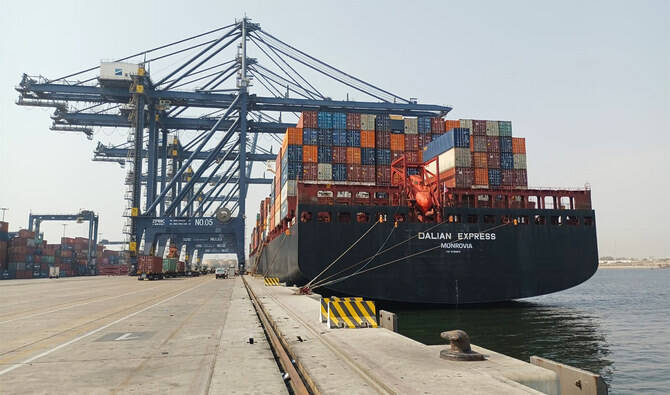
This picture taken on March 8, 2023, shows a cargo ship set to sail from a sea port in Karachi, Pakistan. (Radio Pakistan/File)
Short Url
Updated 12 April 2025
Follow

Pakistan says exports to Europe grew by 9.4% during FY25

  • Growth driven largely due to GSP Plus status, rising demand for Pakistani textiles and garments, says state media
  • European Union is Pakistan’s second-most important trading partner, accounting for over 14 percent of its total trade

ISLAMABAD: Pakistan’s exports to Europe grew by 9.41 percent during the first eight months of the current fiscal year, state-run media reported on Saturday, attributing the surge to rising demand for the country’s textile, garments and its GSP Plus status. 

The European Union (EU) is Pakistan’s second most important trading partner, accounting for over 14 percent of the country’s total trade and absorbing 28 percent of Pakistan’s total exports as per official data. Pakistani exports to the EU are dominated mostly by textiles and clothes. 

Pakistan avails the Generalized Scheme of Preferences (GSP)+ status, a special trade arrangement offered by the EU to developing economies in return for their commitment to implement 27 international conventions on human rights, environmental protection and governance.

“The demand for Pakistani products in Europe has seen a significant rise, leading to a 9.4 percent increase in exports due to the efforts of the Special Investment Facilitation Council,” state broadcaster Radio Pakistan said in a report. 

It was referring to the SIFC, a hybrid civil-military government body formed in 2023 to fast-track decisions related to international investment in Pakistan’s vital economic sectors. 

The SIFC aims to attract investment from Gulf countries, Central Asian states and regional allies in tourism, agriculture, mining and minerals, livestock and other priority sectors. 

The state media said Pakistan’s exports to Western Europe grew by 11.6 percent and while those to Northern Europe saw a “remarkable” 17.7 percent increase during the first eight months of the current fiscal year. 

“The primary reasons behind this growth are Pakistan’s GSP+ Status and the rising demand for Pakistani textiles and garments,” it added. 

The current GSP framework came to an end in December 2023 but Members of EU Parliament (MEPs) voted in October to extend the current rules on the scheme for another four years for developing countries, including Pakistan. 

Finance Minister Muhammad Aurangzeb has repeatedly stressed the importance of shifting Pakistan’s economy from an import-dependent one toward an export-led one, saying that without it sustainable economic growth is difficult to achieve.

In recent months, Pakistan has vigorously pursued economic and investment deals with Gulf countries such as Saudi Arabia, the United Arab Emirates and bilateral trade cooperation with Central Asian states, Russia and others. 


Pakistan rejects Amnesty claims of Israeli spyware use, calls reports ‘disinformation’

Updated 10 sec ago
Follow

Pakistan rejects Amnesty claims of Israeli spyware use, calls reports ‘disinformation’

  • FO denies any link with Israel, says Pakistan has “absolutely no cooperation” on surveillance tools
  • Islamabad accuses India of delaying clearance for relief aircraft bound for flood-hit Sri Lanka

ISLAMABAD: Pakistan on Friday rejected an Amnesty International report alleging the use of Israeli-made invasive spyware in the country, calling the findings speculative and misleading.

Amnesty’s investigation, published Thursday under the title Intellexa Leaks, cited the case of a Pakistan-based human rights lawyer who reported receiving a suspicious WhatsApp link in 2025. According to Amnesty International’s Security Lab, the link bore signatures consistent with Predator, a spyware product developed by Israeli manufacturer c

Foreign Office spokesperson Tahir Andrabi dismissed the suggestion that Islamabad had deployed the tool or maintained any technological cooperation with Israel.

“These are all media speculations. These are all rumor-mongering and disinformation. There is absolutely no cooperation between Pakistan and Israel on anything, let alone a spyware or these kinds of tools. So, I would reject it quite emphatically,” he said at a weekly briefing.

Andrabi also accused India of obstructing humanitarian operations, saying New Delhi delayed flight clearance for a Pakistani relief aircraft carrying aid to flood-affected Sri Lanka.

“The special aircraft carrying Pakistan’s relief goods had to wait for 48 hours, in fact more than 48 hours, around 60 hours, while the flight clearance from India was delayed,” he said.

He added that the eventual conditional flight window was too narrow to be workable.

“The partial flight clearance which eventually was given after 48 hours was operationally impractical, time-bound just for a few hours and hence not operable, severely hindering the urgent need for the relief mission for the brotherly people of Sri Lanka,” Andrabi stated.

“Humanitarian assistance is like justice, if it is delayed, it is denied.”

Responding to India’s claim that clearance was granted within four hours, he said Pakistan has documentary proof contradicting New Delhi’s version.

On a separate question about reported delays in the arrival of a Turkish delegation aimed at mediating between Islamabad and Kabul, Andrabi said Pakistan welcomed Ankara’s initiative but was unaware of the cause of postponement.

“We stand ready to receive the Turkish delegation. That delegation has not arrived as yet. And I’m not aware of any schedule. Pakistan is ready to hold negotiations, discussions,” he said, adding that the delay may be linked to coordination with the Afghan side.