JERUSALEM: Israel’s top court began a hearing on Tuesday on the hotly contested decision to sack domestic security chief Ronen Bar, with protests from government supporters and critics briefly interrupting the proceedings.
Prime Minister Benjamin Netanyahu announced last month that his government had unanimously approved a motion to dismiss the head of the Shin Bet internal security agency, citing “lack of trust” and requiring Bar to leave his post by April 10.
The hearing on Tuesday follows petitions filed by opposition parties and non-profit groups, challenging the legality of the government’s move which the Supreme Court had already frozen until a ruling was made.
Protests were held outside the Jerusalem courtroom, and inside, shouts and interruptions forced the judges to halt proceedings after only 30 minutes.
“No court in the world is run this way,” said Supreme Court President Yitzhak Amit after warning government supporters and critics who interrupted the hearing, which is broadcast live.
Amit called for a recess, during which scuffles between the sides continued outside the courtroom.
The hearing resumed about an hour later, with no audience, “to allow the right to argue without fear for all parties involved,” according to the judges.
Attorney Zion Amir, representing the government, said that “this is purely a political petition.”
The judges will likely issue a decision later in the week, according to media reports.
Bar has pushed back against the government’s move to sack him, dismissing Netanyahu’s arguments as “general, unsubstantiated accusations” motivated by “personal interest.”
Bar said the decision was meant to “prevent investigations into the events leading up to October 7 and other serious matters” being looked at by the Shin Bet, referring to the 2023 Hamas attack on Israel.
Attorney General Gali Baharav-Miara, who is due to address the court, has also cautioned that ousting Bar was “tainted by a personal conflict of interest on the part of the prime minister due to the criminal investigations involving his associates.”
Baharav-Miara was referring to a case dubbed by media as “Qatargate” involving Netanyahu’s close advisers under investigation for allegedly receiving money from Qatar.
Tomer Naor, from the Movement for Quality Government in Israel which submitted one of the petitions, told AFP that “Netanyahu is under a severe conflict of interest.”
He said the group had petitioned the court to “remind that Ronen Bar is the head of the Shin Bet (and) is in charge of the investigation into ‘Qatargate’.”
Dov Halbertal, a lawyer who came to watch the hearing, said that “Netanyahu is the ruler, he can fire whoever he wants, especially this Ronen Bar, the head of the Shin Bet that is responsible for the massacre” of October 7, 2023.
The fact that the court was hearing the petitions was “anti-democracy,” he said.
Baharav-Miara, who has often clashed with the Netanyahu administration over the independence of the judiciary, said that firing Bar could lead to the politicization of the powerful position.
Appointed Shin Bet chief in October 2021 by the previous government, led by opponents of Netanyahu, Bar has clashed with the long-serving incumbent since his return to power in late 2022.
Bar was critical of a government proposal to reform the judiciary, which drew hundreds of thousands of Israelis onto the streets in protest and was temporarily shelved when the Gaza war began with Hamas’s attack.
Bar, who was only meant to end his tenure next year, had suggested he would consider stepping down early due to his part in failing to prevent the October 7 attack, but only once the war is over and the hostages held in Gaza are freed.


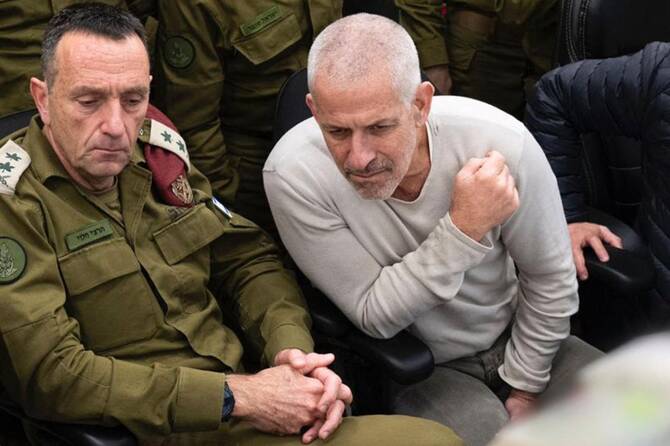
Protests, shouting as Israel court hears petitions against security chief sacking
https://arab.news/rr2pe
Protests, shouting as Israel court hears petitions against security chief sacking

- Prime Minister Benjamin Netanyahu announced last month that his government had unanimously approved a motion to dismiss the head of the Shin Bet internal security agency
- Bar has pushed back against the government’s move to sack him, dismissing Netanyahu’s arguments as “general, unsubstantiated accusations”


Iran envoy: Saudi Arabia a pivotal partner, relations ‘fortified’
- ‘Our contacts continue at all levels,’ Ambassador Alireza Enayati tells Asharq Al-Awsat
- Alireza Enayati: Iran and the Kingdom are keen on the security and stability of the region
RIYADH: A senior Iranian official said that relations with Saudi Arabia are “fortified” and cannot be undermined, highlighting both nations’ shared commitment to regional security and stability.
Alireza Enayati, Iran’s ambassador to Saudi Arabia, said in an exclusive interview with Asharq Al-Awsat that both countries are committed to preventing escalation and avoiding actions that could destabilize the region.
He added that contacts and coordination between the two countries are taking place at various levels, including visits, meetings and private discussions.
Enayati said: “We must recognize the sensitivity of the current situation amid repeated threats facing the region and the risk of sliding into unprecedented escalation.
“In Iran, we believe that regional stability serves the interests of all countries in the region, and we have repeatedly sensed this affirmation during our meetings and encounters with Saudi officials.”
A senior Saudi official had told Asharq Al-Awsat on Saturday that reports circulated by some media outlets about a change in the Kingdom’s position regarding escalation in the region were inaccurate.
The source said that Saudi Arabia supports efforts aimed at reaching a peaceful solution to all disputed issues between the US and Iran through dialogue and diplomatic means, stressing the Kingdom’s rejection of the use of its airspace or territory for any military actions against Iran.
Enayati pointed to the existence of “ongoing contacts and exchanges between the two countries at various levels, including visits and meetings — some of which are public, while others are held away from the media.”
The Iranian diplomat said that Tehran “considers Saudi Arabia a pivotal and influential state in the region,” adding that cooperation between the two countries on issues of mutual interest “contributes to strengthening the region’s security and stability.”
He said: “Iran and the Kingdom are keen on the security and stability of the region, and emphasize the need to avoid escalation and steer clear of anything that could disturb regional calm.”
Consultations are taking place between the two sides “stemming from a strategic conviction that has crystallized for both parties and serves their interests as well as those of the region as a whole,” Enayati added.
“The Kingdom views Iran as a reliable partner, while Iran regards Saudi Arabia as an important and effective state in the region, and their cooperation on issues of mutual interest helps consolidate regional security and stability.”
The ambassador said: “These relations are fortified and cannot be undermined, thanks to the leadership of both countries and their understanding of the inevitability of these relations, ensuring their continuity and growth, and the reflection of their positive effects on all.”
Enayati recalled the Saudi position in support of Tehran during its recent war with Israel, saying: “Iran welcomed the Saudi position supporting it during the war imposed on it, as Saudi Arabia strongly condemned the Israeli aggression against Iran, and we received a phone call that morning from the Saudi foreign minister. This stance was not surprising from our Saudi brothers, who stood by us during that phase.”
He added: “Second, any harm to Iran affects the security of the entire region, and this was clearly reflected in constructive positions, including that of the Kingdom. Third, the attack on Iran comes within a series of Israeli attacks that have targeted countries across the region, and no state is immune from these aggressions.”
Regarding talk of a negotiating framework taking shape between Iran and the US, Enayati said that Iran “entered the negotiations in 2015 and 2025 with full seriousness, but the US withdrew from them and dealt with them in a contradictory manner.”
He added: “If the US is serious about an equal dialogue without preconditions, Iran welcomes that, and Iranian officials have repeatedly affirmed this position.
“We recently heard statements indicating that the two sides are working to establish a framework for negotiations; however, negotiations cannot begin with predetermined outcomes. Rather, their results must emerge from the negotiating process itself, not be imposed on it in advance.”
Crown Prince Mohammed bin Salman, during a phone call he received from Iranian President Masoud Pezeshkian last week, highlighted the Kingdom’s support for any efforts aimed at resolving disputes through dialogue in a manner that enhances regional security and stability.
During the call, the Saudi crown prince stressed Riyadh’s position on respecting Iran’s sovereignty and the Kingdom’s refusal to allow the use of its airspace or territory for any military actions against Iran, or for attacks by any party, regardless of their direction.
Pezeshkian expressed his gratitude to Saudi Arabia for its respect of Iran’s sovereignty and territorial integrity, and his appreciation for the crown prince’s efforts and initiatives to achieve regional security and stability.


