US discusses tariffs, critical minerals, immigration with Pakistan

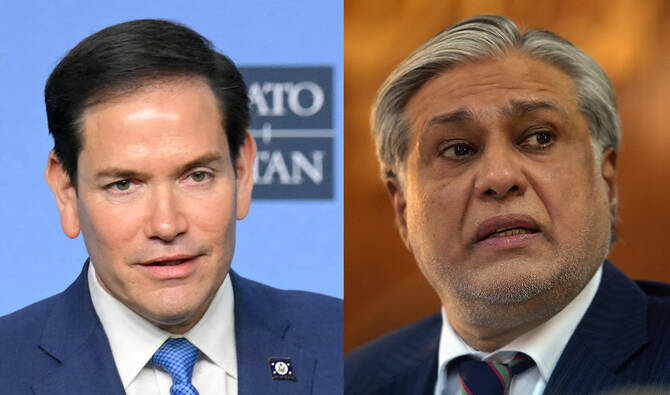
A collage of images created on April 8, 2024, shows US Secretary of State Marco Rubio (left) and Pakistan's Deputy Prime Minister and Foreign Minister Ishaq Dar. (AFP/File)
Short Url
Updated 08 April 2025
Follow

US discusses tariffs, critical minerals, immigration with Pakistan

  • US Secretary of State Marco Rubio speaks to Pakistan’s Foreign Minister Ishaq Dar over telephone
  • Both discussed making progress toward a “fair and balanced” trade relationship, says State Department

WASHINGTON: US Secretary of State Marco Rubio spoke to Pakistani Foreign Minister Ishaq Dar on Monday about tariffs, trade relations, immigration and prospects for engagement on critical minerals, the State Department and Pakistan’s foreign ministry said in separate statements.

President Donald Trump said last week that he would impose a 10 percent baseline tariff on all imports to the US and higher duties on dozens of other countries, including some of Washington’s biggest trading partners, rattling global markets and bewildering US allies. The Trump administration imposed a 29 percent tariff on Pakistan.

“They (Rubio and Dar) discussed US reciprocal tariffs on Pakistan and how to make progress toward a fair and balanced trade relationship,” the State Department said.

The US goods trade deficit with Pakistan was $3 billion in 2024, a 5.2  percent increase over 2023, according to the Office of the US Trade Representative.

“The Secretary raised prospects for engagement on critical minerals and expressed interest in expanding commercial opportunities for US companies.”

Pakistan’s foreign ministry said Rubio “reciprocated the desire to collaborate with Pakistan in trade and investment in various sectors, especially critical minerals.”

The Trump administration has also used prospects of engagement over critical minerals with other countries.

For example, it is attempting to strike an agreement over critical minerals with Ukraine as part of talks related to the Russia-Ukraine war. Washington has also said it is open to exploring critical minerals partnerships with Congo and help end a conflict raging in the African country’s east.

In the call with Dar, Rubio emphasized the importance of Pakistan’s cooperation with the US on law enforcement and addressing illegal immigration, the State Department said.

Last month, Pakistan highlighted its cooperation with Washington on countering extremism after the arrest of Mohammad Sharifullah, whom the US blames for a 2021 attack on its troops at Kabul airport, in a military operation along the border with Afghanistan.

The Pakistan foreign ministry said Rubio and Dar discussed the situation in Afghanistan.


Peshawar church attack haunts Christians at Christmas

Updated 26 December 2025
Follow

Peshawar church attack haunts Christians at Christmas

  • The 2013 suicide attack at All Saints Church killed 113 worshippers, leaving lasting scars on survivors
  • Prime Minister Shehbaz Sharif vowed to protect religious minorities on Christmas, act against any injustice

PESHAWAR: After passing multiple checkpoints under the watchful eyes of snipers stationed overhead, hundreds of Christians gathered for a Christmas mass in northwest Pakistan 12 years after suicide bombers killed dozens of worshippers.

The impact of metal shards remain etched on a wall next to a memorial bearing the names of those killed at All Saints Church in Peshawar, in the violence-wracked province of Khyber Pakhtunkhwa.

“Even today, when I recall that day 12 years ago, my soul trembles,” Natasha Zulfiqar, a 30-year-old housewife who was wounded in the attack along with her parents, told AFP on Thursday.

Her right wrist still bears the scar.

A militant group claimed responsibility for the attack on September 22, 2013, when 113 people were killed, according to a church toll.

“There was blood everywhere. The church lawn was covered with bodies,” Zulfiqar said.

Christians make up less than two percent of Pakistan’s 240 million people and have long faced discrimination in the conservative Muslim country, often sidelined into low-paying jobs and sometimes the target of blasphemy charges.

Along with other religious minorities, the community has often been targeted by militants over the years.

Today, a wall clock inside All Saints giving the time of the blast as 11:43 am is preserved in its damaged state, its glass shattered.

“The blast was so powerful that its marks are still visible on this wall — and those marks are not only on the wall, but they are also etched into our hearts as well,” said Emmanuel Ghori, a caretaker at the church.

Addressing a Christmas ceremony in the capital Islamabad, Prime Minister Shehbaz Sharif vowed to protect religious minorities.

“I want to make it clear that if any injustice is done to any member of a minority, the law will respond with full force,” he said.

For Azzeka Victor Sadiq, whose father was killed and mother wounded in the blasts, “The intensity of the grief can never truly fade.”

“Whenever I come to the church, the entire incident replays itself before my eyes,” the 38-year-old teacher told AFP.