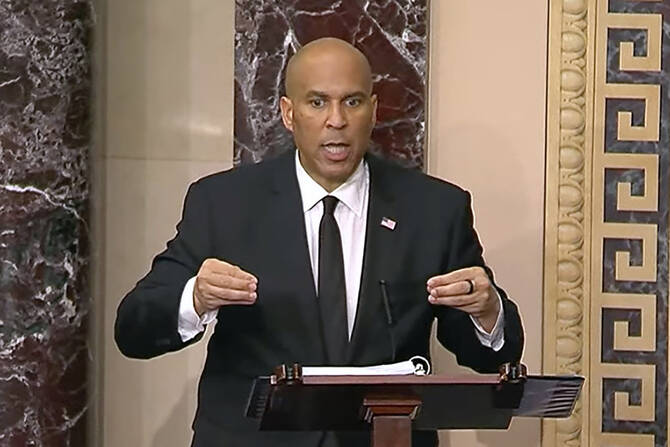

WASHINGTON: In a feat of determination, New Jersey Democratic Sen. Cory Booker held the Senate floor with a marathon speech that lasted all night and into Tuesday night, setting a historic mark to show Democrats’ resistance to President Donald Trump’s sweeping actions.
Booker took to the Senate floor on Monday evening, saying he would remain there as long as he was “physically able.” It wasn’t until 25 hours and 5 minutes later that the 55-year-old senator, a former football tight end, finished speaking and limped off the floor. It set the record for the longest continuous Senate floor speech in the chamber’s history. Booker was assisted by fellow Democrats who gave him a break from speaking by asking him questions on the Senate floor.
It was a remarkable show of stamina as Democrats try to show their frustrated supporters that they are doing everything possible to contest Trump’s agenda. Yet Booker also provided a moment of historical solace for a party searching for its way forward: By standing on the Senate floor for more than a night and day and refusing to leave, he had broken a record set 68 years ago by then Sen. Strom Thurmond of South Carolina, a segregationist and southern Democrat, to filibuster the advance of the Civil Rights Act in 1957.
“I’m here despite his speech,” said Booker, who spoke openly on the Senate floor of his roots as the descendant of both slaves and slave-owners. He added, “I’m here because as powerful as he was, the people are more powerful.”
House Democratic Leader Hakeem Jeffries, the first Black party leader in Congress, slipped into the Senate chamber to watch Booker on Tuesday afternoon. He called it “an incredibly powerful moment” because Booker had broken the record of a segregationist and was “fighting to preserve the American way of life and our democracy.”
Still, Booker centered his speech on a call for his party to find its resolve, saying, “We all must look in the mirror and say, ‘We will do better.’”
“These are not normal times in our nation,” Booker said as he began the speech Monday evening. “And they should not be treated as such in the United States Senate. The threats to the American people and American democracy are grave and urgent, and we all must do more to stand against them.”
Booker warns of a ‘looming constitutional crisis’
Shifting his feet, then leaning on his podium, Booker railed for hours against cuts to Social Security offices led by Trump adviser Elon Musk’s Department of Government Efficiency. He listed the impacts of Trump’s early orders and spoke to concerns that broader cuts to the social safety net could be coming, though Republican lawmakers say the program won’t be touched.
Booker also read what he said were letters from constituents. One writer was alarmed by the Republican president’s talk of annexing Greenland and Canada and a “looming constitutional crisis.”
Throughout the day Tuesday, Booker got help from Democratic colleagues, who gave him a break from speaking to ask him questions. Booker yielded for questions but made sure to say he would not give up the floor. He read that line from a piece of paper to ensure he did not slip and inadvertently end his speech. He stayed standing to comply with Senate rules.
“Your strength, your fortitude, your clarity has just been nothing short of amazing and all of America is paying attention to what you’re saying,” Senate Democratic Leader Chuck Schumer said as he asked Booker a question on the Senate floor. “All of America needs to know there’s so many problems, the disastrous actions of this administration.”
As Booker stood for hour after hour, he appeared to have nothing more than a couple glasses of water to sustain him. He later told reporters that he had fasted for days before the speech and stopped drinking fluids the night before.
He suffered through cramps as the day wore on, he said. Yet his voice grew strong with emotion as his speech stretched into the evening, and House members from the Congressional Black Caucus stood on the edge of the Senate floor in support
“Moments like this require us to be more creative or more imaginative, or just more persistent and dogged and determined,” Booker said.
Booker’s cousin and brother, as well as Democratic aides, watched from the chamber’s gallery. Sen. Chris Murphy accompanied Booker on the Senate floor throughout the day and night. Murphy was returning the comradeship that Booker had given to him in 2016 when the Connecticut Democrat held the floor for almost 15 hours to argue for gun control legislation.
His Senate floor speech breaks Thurmond’s record
Still hours away from breaking Thurmond’s record, Booker remarked Tuesday afternoon, “I don’t have that much gas in the tank.”
Yet as anticipation in the Capitol grew that he would supplant Thurmond, who died in 2003, as the record holder for the longest Senate floor speech, Democratic senators filled the chamber to listen and the Senate gallery filled with onlookers. The chamber exploded in applause as Schumer announced that Booker had broken the record.
Booker told reporters afterward that he had thought of Thurmond’s speech ever since he arrived in the Senate, calling it a “strange shadow to hang over this institution.”
Throughout his determined performance, Booker repeatedly invoked the civil rights leader Rep. John Lewis of Georgia on Tuesday, arguing that overcoming opponents like Thurmond would require more than just talking.
“You think we got civil rights one day because Strom Thurmond — after filibustering for 24 hours — you think we got civil rights because he came to the floor one day and said, ‘I’ve seen the light,’” Booker said. “No, we got civil rights because people marched for it, sweat for it and John Lewis bled for it.”
Booker’s speech was not a filibuster, which is a speech meant to halt the advance of a specific piece of legislation. Instead, Booker’s performance was a broader critique of Trump’s agenda, meant to hold up the Senate’s business and draw attention to what Democrats are doing to contest the president. Without a majority in either congressional chamber, Democrats have been almost completely locked out of legislative power but are turning to procedural maneuvers to try to thwart Republicans.
Can his speech rally the anti-Trump resistance?
Booker, serving his second Senate term, was an unsuccessful presidential candidate in 2020, when he launched his campaign from the steps of his home in Newark. He dropped out after struggling to gain a foothold in a packed field, falling short of the threshold to meet in a January 2020 debate.
But as Democrats search for a next generation of leadership, frustrated with the old-timers at the top, Booker’s speech could cement his status as a leading figure in the party.
On Tuesday afternoon, tens of thousands of people were watching on Booker’s Senate YouTube page, as well as on other live streams. A small group gathered outside the Capitol to cheer him on.
Booker said he was ultimately calling on all Americans to respond not just with resistance to Trump’s actions but with kindness and generosity for those in their communities.
He said, “I may be afraid — my voice may shake — but I’m going to speak up more.”