

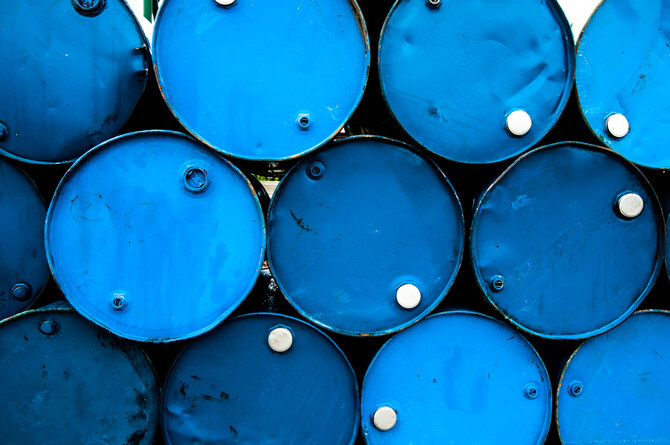
Oil Updates — crude up on weak dollar but tariff concerns cap gains

Brent futures rose 51 cents, or 0.7 percent, to $70.07 a barrel at 7:30 a.m. Saudi time. Shutterstock
Short Url
Updated 12 March 2025
Follow

Oil Updates — crude up on weak dollar but tariff concerns cap gains

SINGAPORE: Oil prices edged up on Wednesday, buoyed by a weaker dollar, but mounting fears of a US economic slowdown and the impact of tariffs on global economic growth capped gains.

Brent futures rose 51 cents, or 0.7 percent, to $70.07 a barrel at 7:30 a.m. Saudi time, while US West Texas Intermediate crude futures gained 52 cents, or 0.8 percent, to $66.77 a barrel.

Despite the weakening economic outlook, oil held steady in a positive position, said Daniel Hynes, senior commodity strategist at ANZ. “That’s a sign that near-term demand for crude remains strong.”

The dollar index, which fell 0.5 percent to fresh 2025 lows on Tuesday, boosted oil prices by making crude less expensive for buyers holding other currencies.

“Easing dollar counters the bearish bias of global economic slowdown, although this seems short-lived,” said Priyanka Sachdeva, senior market analyst at Phillip Nova.

US stock prices, which also influence the oil market, fell again on Tuesday, adding to the biggest selloff in months, with investors rattled over increased tariffs on imports and souring consumer sentiment.

“Overall sentiment remains fragile despite a slight bounce in today’s session,” said Yeap Jun Rong, market strategist at IG.

“For now, oil market sentiments are likely to stay contained, with tariff developments still lacking clarity and persistent concerns over US growth risks,” Yeap added.

US President Donald Trump’s protectionist policies have shaken global markets. He has imposed, then delayed tariffs on major oil suppliers Canada and Mexico, while also raising duties on China, prompting retaliatory measures.

Over the weekend, Trump said a “period of transition” was likely and declined to rule out a US recession.

In supply, US crude oil production is poised to set a larger record this year than prior estimates, at an average 13.61 million barrels per day, the US Energy Information Administration said on Tuesday.

Investors are waiting for US inflation data due on Wednesday for clues on the path of interest rates. They also are closely monitoring OPEC+ plans. The producer group has announced plans to increase output in April.

In the US, crude oil stockpiles rose by 4.2 million barrels in the week ended March 7, market sources said, citing American Petroleum Institute figures on Tuesday.

Markets now await government data on US stockpiles due on Wednesday for further trading cues. (Reporting by Nicole Jao in New York and Jeslyn Lerh in Singapore; Editing by Himani Sarkar and Jamie Freed)


First EU–Saudi roundtable on critical raw materials reflects shared policy commitment

Updated 16 January 2026
Follow

First EU–Saudi roundtable on critical raw materials reflects shared policy commitment

RIYADH: The EU–Saudi Arabia Business and Investment Dialogue on Advancing Critical Raw Materials Value Chains, held in Riyadh as part of the Future Minerals Forum, brought together senior policymakers, industry leaders, and investors to advance strategic cooperation across critical raw materials value chains.

Organized under a Team Europe approach by the EU–GCC Cooperation on Green Transition Project, in coordination with the EU Delegation to Saudi Arabia, the European Chamber of Commerce in the Kingdom and in close cooperation with FMF, the dialogue provided a high-level platform to explore European actions under the EU Critical Raw Materials Act and ResourceEU alongside the Kingdom’s aspirations for minerals, industrial, and investment priorities.

This is in line with Saudi Vision 2030 and broader regional ambitions across the GCC, MENA, and Africa.

ResourceEU is the EU’s new strategic action plan, launched in late 2025, to secure a reliable supply of critical raw materials like lithium, rare earths, and cobalt, reducing dependency on single suppliers, such as China, by boosting domestic extraction, processing, recycling, stockpiling, and strategic partnerships with resource-rich nations.

The first ever EU–Saudi roundtable on critical raw materials was opened by the bloc’s Ambassador to the Kingdom, Christophe Farnaud, together with Saudi Deputy Minister for Mining Development Turki Al-Babtain, turning policy alignment into concrete cooperation.

Farnaud underlined the central role of international cooperation in the implementation of the EU’s critical raw materials policy framework.

“As the European Union advances the implementation of its Critical Raw Materials policy, international cooperation is indispensable to building secure, diversified, and sustainable value chains. Saudi Arabia is a key partner in this effort. This dialogue reflects our shared commitment to translate policy alignment into concrete business and investment cooperation that supports the green and digital transitions,” said the ambassador.

Discussions focused on strengthening resilient, diversified, and responsible CRM supply chains that are essential to the green and digital transitions.

Participants explored concrete opportunities for EU–Saudi cooperation across the full value chain, including exploration, mining, and processing and refining, as well as recycling, downstream manufacturing, and the mobilization of private investment and sustainable finance, underpinned by high environmental, social, and governance standards.

From the Saudi side, the dialogue was framed as a key contribution to the Kingdom’s industrial transformation and long-term economic diversification agenda under Vision 2030, with a strong focus on responsible resource development and global market integration.

“Developing globally competitive mineral hubs and sustainable value chains is a central pillar of Saudi Vision 2030 and the Kingdom’s industrial transformation. Our engagement with the European Union through this dialogue to strengthen upstream and downstream integration, attract high-quality investment, and advance responsible mining and processing. Enhanced cooperation with the EU, capitalizing on the demand dynamics of the EU Critical Raw Materials Act, will be key to delivering long-term value for both sides,” said Al-Babtain.

Valere Moutarlier, deputy director-general for European industry decarbonization, and directorate-general for the internal market, industry, entrepreneurship and SMEs at European Commission, said the EU Critical Raw Materials Act and ResourceEU provided a clear framework to strengthen Europe’s resilience while deepening its cooperation with international partners.

“Cooperation with Saudi Arabia is essential to advancing secure, sustainable, and diversified critical raw materials value chains. Dialogues such as this play a key role in translating policy ambitions into concrete industrial and investment cooperation,” she added.