

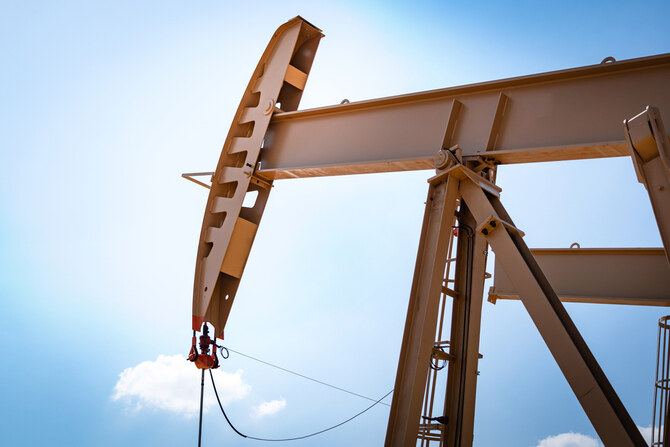
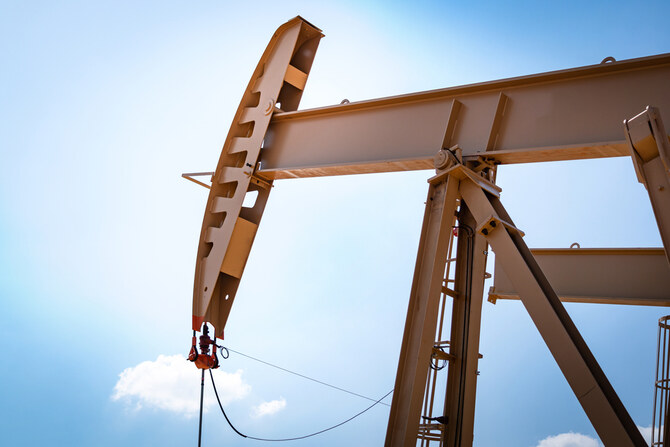
Oil Updates — prices decline as tariff uncertainty keeps investors on edge

Brent crude fell 31 cents, or 0.4 percent, to $70.05 a barrel by 7:45 a.m. Saudi time after settling up 90 cents on Friday.
Short Url
Updated 10 March 2025
Follow

Oil Updates — prices decline as tariff uncertainty keeps investors on edge

SINGAPORE: Oil prices fell on Monday as concern about the impact of US import tariffs on global economic growth and fuel demand, as well as rising output from OPEC+ producers, cooled investor appetite for riskier assets.

Brent crude fell 31 cents, or 0.4 percent, to $70.05 a barrel by 7:45 a.m. Saudi time after settling up 90 cents on Friday. US West Texas Intermediate crude was at $66.69 a barrel, down 35 cents, or 0.5 percent, after closing 68 cents higher in the previous trading session.

WTI declined for a seventh successive week, the longest losing streak since November 2023, while Brent was down for a third consecutive week after US President Donald Trump imposed then delayed tariffs on its key oil suppliers Canada and Mexico while raising taxes on Chinese goods. China retaliated against the US and Canada with tariffs on agricultural products.

“Tariff uncertainty is a key driver behind the weakness,” ING analysts said in a note, adding that oil price cuts from Saudi Arabia and deflationary signals from China also hurt sentiment.

IG analyst Tony Sycamore said other factors weighing on oil prices include concerns about US growth, the potential lifting of US sanctions on Russia, and OPEC+ opting to increase output.

“Nonetheless, with much of the bad news likely factored in, we expect weekly support around $65/$62 to hold firm before a recovery back to $72.00,” he said in a client note in reference to the WTI price.

Oil prices clawed back some loss on Friday after Trump said the US would increase sanctions on Russia if the latter fails to reach a ceasefire with Ukraine.

The US is also studying ways to ease sanctions on Russia’s energy sector if Russia agrees to end its war with Ukraine, two people familiar with the matter told Reuters.

Meanwhile, the Organization of the Petroleum Exporting Countries and allies including Russia, collectively known as OPEC+, said it will proceed with oil output hikes from April.

Russia’s Deputy Prime Minister Alexander Novak on Friday said OPEC+ could reverse the decision in the event of market imbalance.

Adding to supply concerns, Saudi Arabia cut prices for crude grades it sells to Asia for the first time in three months in April.

Last week, Trump said he wanted to negotiate a deal with OPEC member Iran to prevent the latter seeking nuclear weapons — though Iran has said it is not seeking such weapons.

Trump is pursuing a “maximum pressure” campaign against Iran under which the US on Saturday rescinded a waiver that allowed Iraq to pay Iran for electricity, a State Department spokesperson said.

Iran’s Supreme Leader Ayatollah Ali Khamenei on Saturday said his country will not be bullied into negotiations. 


Saudi Arabia’s PIF rises to 5th among world’s largest sovereign wealth funds  

Updated 11 sec ago
Follow

Saudi Arabia’s PIF rises to 5th among world’s largest sovereign wealth funds  

RIYADH: Saudi Arabia’s Public Investment Fund has climbed to fifth place among the world’s largest sovereign wealth funds, with assets under management reaching $1.15 trillion. 

According to the latest rankings from the Sovereign Wealth Fund Institute, the PIF demonstrated a strong domestic investment orientation, with 80 percent of its assets allocated within the Kingdom and 55 percent of its portfolio invested in alternative assets. 

This domestic and alternative-heavy allocation contrasts with global trends, as several top-ranked funds, such as Norges Bank Investment Management, maintain zero domestic exposure and lower allocations to alternative investments. 

The PIF recorded an increase of $226 billion in assets by December, up from $925 billion at the end of December 2024, according to a report by Argaam. 

Topping the global rankings is the Government Pension Fund of Norway, managed by Norges Bank Investment Management, with $2.04 trillion in assets. 

China’s State Administration of Foreign Exchange ranked second with $1.69 trillion, while China Investment Corp. placed third with $1.56 trillion. 

The Abu Dhabi Investment Authority ranked fourth, managing $1.18 trillion in assets. 

Established in 1971, the PIF plays a central role in Saudi Arabia’s Vision 2030 economic diversification strategy, deploying sovereign capital across sectors including technology, tourism and infrastructure. 

In December, the PIF reinforced its role as a key driver of economic transformation in the Kingdom by announcing a strategic transaction with global real estate services firm JLL. 

Under the agreement, JLL will acquire a significant stake in Saudi Facilities Management Co., known as FMTECH, a national firm launched by the fund in 2023. The PIF will retain a majority stake, with the transaction expected to close subject to customary regulatory and contractual conditions. 

FMTECH, which serves both PIF portfolio companies and clients across the public and private sectors, will leverage JLL’s global network, digital platforms, and operational expertise to enhance service delivery and operational transparency.  

In November, PIF also completed the sale of part of its stake in Umm Al Qura for Development and Construction Co. through an accelerated bookbuild offering.   

The transaction involved 48 million shares, equivalent to 3.3 percent of Masar’s share capital, and raised more than SR950 million ($253 million) at a final offer price of SR19.8 per share.