

Oil Updates — prices inch up despite tariff concerns, slowdown fears

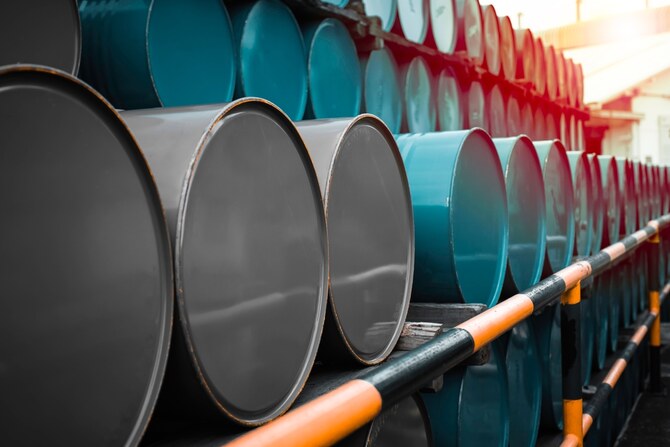
Brent futures edged up 18 cents, or 0.3 percent, to $69.46 a barrel at 9:40 a.m. Saudi time after falling in early trade. Shutterstock
Short Url
Updated 11 March 2025
Follow

Oil Updates — prices inch up despite tariff concerns, slowdown fears

SINGAPORE: Oil prices pared earlier losses to inch up during trade on Tuesday, despite concerns over a potential US recession, the impact of tariffs on global growth and as OPEC+ sets its sight on ramping up supply.

Brent futures edged up 18 cents, or 0.3 percent, to $69.46 a barrel at 9:40 a.m. Saudi time after falling in early trade. US West Texas Intermediate crude futures rose 9 cents, or 0.1 percent, to $66.12 a barrel after previous declines as well.

Despite the market noise, Brent at around $70 a barrel is quite a strong support and oil prices may look to stage a technical bounce at current levels, said Suvro Sarkar, energy sector team lead at DBS Bank, adding that the OPEC+ supply response will continue to remain flexible depending on market conditions.

“If oil prices fall below the $70 per barrel mark for an extended period, output hikes may be paused in our opinion. OPEC+ will also keep a careful eye on Trump’s Iran and Venezuela policies,” he said.

“The US has already taken back Chevron’s license to operate in Venezuela and it remains to be seen whether Iran sanctions will be intensified. However, in the interim, worries about global growth amid policy uncertainties and trade wars will dominate.”

US President Donald Trump’s protectionist policies have roiled markets across the world, with Trump imposing and then delaying tariffs on his country’s biggest oil suppliers, Canada and Mexico, while also raising duties on Chinese goods. China and Canada have responded with tariffs of their own.

Over the weekend, Trump said a “period of transition” for the economy is likely but declined to predict whether the US could face a recession amid stock market concerns about his tariff actions.

“Trump’s comments triggered a wave of selling as investors started pricing in the risk of weaker growth in demand,” Daniel Hynes, senior commodity strategist at ANZ said.

Stocks, which crude prices often follow, slumped on Monday, with all three major US indexes suffering sharp declines. The S&P 500 had its biggest one-day drop since Dec. 18 and the Nasdaq slid 4 percent, its biggest single-day percentage drop since September 2022.

US Commerce Secretary Howard Lutnick said on Sunday Trump would not let up pressure on tariffs on Mexico, Canada and China.

On the supply front, Russia’s Deputy Prime Minister Alexander Novak said on Friday the OPEC+ group agreed to start increasing oil production from April, but could reverse the decision afterwards if there were market imbalances.

In the US, crude oil stockpiles were expected to have risen last week, while distillate and gasoline inventories likely fell, a preliminary Reuters poll showed on Monday.

The poll was conducted ahead of weekly reports from industry group the American Petroleum Institute, due at 11:30 p.m. Saudi time on Tuesday, and the Energy Information Administration, the statistical arm of the US Department of Energy, at 5:30 p.m. Saudi time on Wednesday. 


First EU–Saudi roundtable on critical raw materials reflects shared policy commitment

Updated 16 January 2026
Follow

First EU–Saudi roundtable on critical raw materials reflects shared policy commitment

RIYADH: The EU–Saudi Arabia Business and Investment Dialogue on Advancing Critical Raw Materials Value Chains, held in Riyadh as part of the Future Minerals Forum, brought together senior policymakers, industry leaders, and investors to advance strategic cooperation across critical raw materials value chains.

Organized under a Team Europe approach by the EU–GCC Cooperation on Green Transition Project, in coordination with the EU Delegation to Saudi Arabia, the European Chamber of Commerce in the Kingdom and in close cooperation with FMF, the dialogue provided a high-level platform to explore European actions under the EU Critical Raw Materials Act and ResourceEU alongside the Kingdom’s aspirations for minerals, industrial, and investment priorities.

This is in line with Saudi Vision 2030 and broader regional ambitions across the GCC, MENA, and Africa.

ResourceEU is the EU’s new strategic action plan, launched in late 2025, to secure a reliable supply of critical raw materials like lithium, rare earths, and cobalt, reducing dependency on single suppliers, such as China, by boosting domestic extraction, processing, recycling, stockpiling, and strategic partnerships with resource-rich nations.

The first ever EU–Saudi roundtable on critical raw materials was opened by the bloc’s Ambassador to the Kingdom, Christophe Farnaud, together with Saudi Deputy Minister for Mining Development Turki Al-Babtain, turning policy alignment into concrete cooperation.

Farnaud underlined the central role of international cooperation in the implementation of the EU’s critical raw materials policy framework.

“As the European Union advances the implementation of its Critical Raw Materials policy, international cooperation is indispensable to building secure, diversified, and sustainable value chains. Saudi Arabia is a key partner in this effort. This dialogue reflects our shared commitment to translate policy alignment into concrete business and investment cooperation that supports the green and digital transitions,” said the ambassador.

Discussions focused on strengthening resilient, diversified, and responsible CRM supply chains that are essential to the green and digital transitions.

Participants explored concrete opportunities for EU–Saudi cooperation across the full value chain, including exploration, mining, and processing and refining, as well as recycling, downstream manufacturing, and the mobilization of private investment and sustainable finance, underpinned by high environmental, social, and governance standards.

From the Saudi side, the dialogue was framed as a key contribution to the Kingdom’s industrial transformation and long-term economic diversification agenda under Vision 2030, with a strong focus on responsible resource development and global market integration.

“Developing globally competitive mineral hubs and sustainable value chains is a central pillar of Saudi Vision 2030 and the Kingdom’s industrial transformation. Our engagement with the European Union through this dialogue to strengthen upstream and downstream integration, attract high-quality investment, and advance responsible mining and processing. Enhanced cooperation with the EU, capitalizing on the demand dynamics of the EU Critical Raw Materials Act, will be key to delivering long-term value for both sides,” said Al-Babtain.

Valere Moutarlier, deputy director-general for European industry decarbonization, and directorate-general for the internal market, industry, entrepreneurship and SMEs at European Commission, said the EU Critical Raw Materials Act and ResourceEU provided a clear framework to strengthen Europe’s resilience while deepening its cooperation with international partners.

“Cooperation with Saudi Arabia is essential to advancing secure, sustainable, and diversified critical raw materials value chains. Dialogues such as this play a key role in translating policy ambitions into concrete industrial and investment cooperation,” she added.