

Pakistan warns climate shocks threaten food security, urges water resilience at Berlin forum

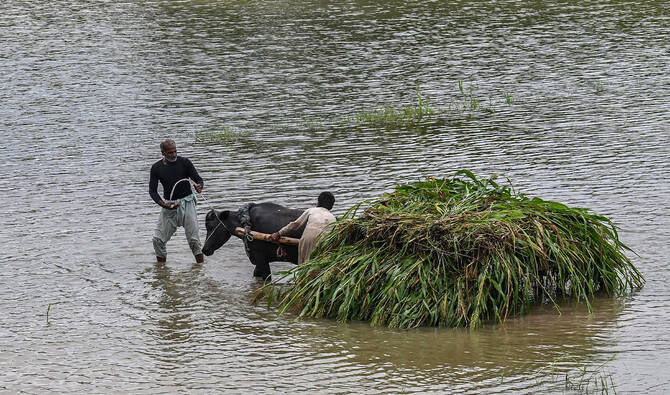
Farmers transport a heap of crops on a buffalo cart after heavy rainfall in the flood-affected area of Kasur district in Punjab province on August 24, 2025. (AFP.File)
Short Url
Updated 17 January 2026
Follow

Pakistan warns climate shocks threaten food security, urges water resilience at Berlin forum

  • Government cites floods, droughts and heat as major hits to farm output and rural livelihoods
  • Pakistan also raises concern over India’s decision to unilaterally suspend Indus Waters Treaty

KARACHI: Pakistan’s food security is under growing threat from increasingly frequent floods, droughts and extreme heat, which have sharply affected agricultural productivity and rural livelihoods, a senior minister said while addressing an international conference on Saturday, emphasizing the need to strengthen water resilience in a climate-stressed region.

Speaking at the Global Forum for Food and Agriculture (GFFA) 2026 in Berlin, Federal Minister for National Food Security and Research Rana Tanveer Hussain said climate-induced shocks had exposed the vulnerability of Pakistan’s agriculture, which relies heavily on the Indus Basin for food production and employment.

“Climate-induced shocks have severely affected agricultural productivity, rural livelihoods and national food security,” Hussain said, adding that recent floods and prolonged dry spells had reinforced the urgency of shifting toward water resilience.

Pakistan’s food system depends on the Indus river system, which supports agriculture, industry and ecosystems for more than 240 million people. Hussain said water security was fundamental to food security and stressed that cooperation over shared water resources was essential for regional stability.

Addressing transboundary water challenges, he reaffirmed Pakistan’s commitment to international water law and described the Indus Waters Treaty as a cornerstone of regional water stability. He expressed concern over India’s April 2025 announcement to unilaterally hold the treaty “in abeyance,” calling the Indus river system a lifeline for Pakistan and urging the international community to support the treaty’s full implementation.

On domestic policy, Hussain said Pakistan was pursuing reforms to improve water productivity through high-efficiency irrigation, climate-smart farming practices and drought- and heat-tolerant seed varieties, alongside ecosystem-based measures such as watershed rehabilitation and groundwater recharge.

He said Pakistan remained ready to work with international partners to advance climate-smart agriculture and inclusive food systems, aiming to transform water from a source of risk into a foundation for sustainable development and peace.


Pakistan’s president defends ongoing strikes in Afghanistan, urges Kabul to dismantle militants

Updated 02 March 2026
Follow

Pakistan’s president defends ongoing strikes in Afghanistan, urges Kabul to dismantle militants

  • Afghanistan on Thursday launched attacks in retaliation for Pakistani airstrikes the previous Sunday
  • Pakistan’s military says it is only targeting Afghan military installations to avoid civilian casualties

ISLAMABAD: Pakistan’s president on Monday defended his country’s ongoing military strikes in neighboring Afghanistan, saying Islamabad tried all forms of diplomacy before targeting militants operating from Afghan territory, and called on the Taliban government in Kabul to disarm groups responsible for attacks in Pakistan.

Pakistan earlier said it is in “open war” with Afghanistan, alarming the international community. The border area remains a stronghold for militant organizations including Al-Qaeda and the Daesh (Islamic State) group.

“(The Afghan Taliban) must choose to dismantle the terror groups that survive on conflict and its war economy,” Asif Ali Zardari said during a speech to lawmakers, adding that “no state accepts serial attacks on its soil.”

Afghanistan on Thursday launched attacks in retaliation for Pakistani airstrikes the previous Sunday. Since then, Pakistan has carried out operations along the border, with Information Minister Attaullah Tarar claiming the killing of 435 Afghan forces and the capture of 31 Afghan positions.

Kabul has denied such claims.

In Afghanistan, the deputy government spokesman Hamdullah Fitrat said Pakistan’s military fired mortar shells at a refugee camp in eastern Kunar province, killing three children and injuring three others.

Afghanistan’s defense ministry said Afghan forces carried out strikes targeting a Pakistani military facility near Paktia province, causing “substantial losses and heavy casualties.”

Pakistan’s military did not respond to questions. It has said Pakistan is only targeting Afghan military installations to avoid civilian casualties.

Pakistan has witnessed a surge of violence in recent months and blames it on the outlawed Pakistani Taliban, known as Tehreek-e-Taliban Pakistan or TTP. It operates both inside Pakistan and from Afghan territory.
Islamabad accuses Afghanistan’s Taliban government of providing safe havens for the TTP, which Kabul denies.

The latest cross-border fighting ended a ceasefire brokered by Qatar and Turkiye in October. The two sides failed to reach a permanent agreement during talks in Istanbul.

Zardari reiterated Pakistan’s call for talks, saying, “We have never walked away from dialogue.”

The Pakistani leader again accused Afghanistan of acting as a proxy for India by sheltering militant groups.

“Stop being used by another country as a battlefield for their ambitions,” he said.

Zardari cited a recent report from the United Nations Security Council’s monitoring team that described the presence of militant groups in Afghanistan as an extra-regional threat.