

Syrians flee sectarian killing into Lebanon

1 / 3
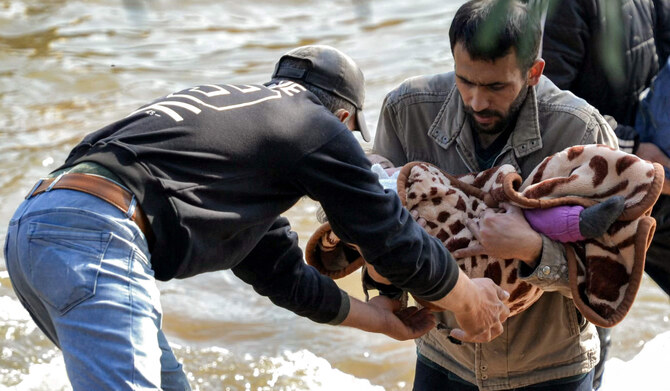
A man receives a blanketed child from another crossing the Nahr al-Kabir river, forming the border between Syria's western Latakia province and northern Lebanon in the Hekr al-Daher area on March 11, 2025. (AFP)
2 / 3
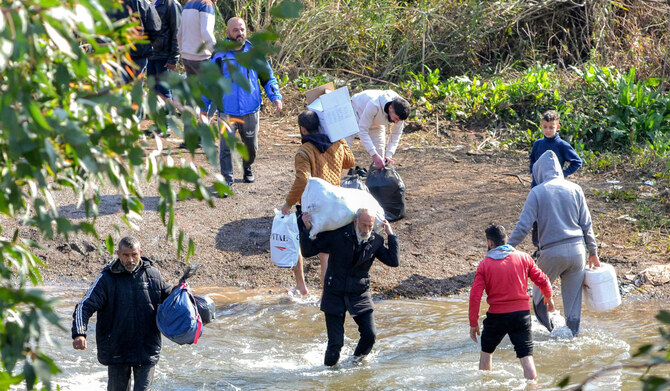
Alawite Syrians, who fled the violence in western Syria, walk in the water of the Nahr El Kabir River, after the reported mass killings of Alawite minority members, in Akkar, Lebanon March 11, 2025. (REUTERS)
3 / 3
Families of Syria's Alawite minority and cross the Nahr al-Kabir river, forming the border between Syria's western Latakia province and northern Lebanon in the Hekr al-Daher area on March 11, 2025, to enter Lebanon while fleeing from sectarian violence in the Alawite heartland on Syria's Mediterranean coast. (AFP)
Short Url
Updated 12 March 2025
Follow

Syrians flee sectarian killing into Lebanon

  • More than 350 families had made the same journey into Lebanon in recent days, according to local Lebanese authorities, fleeing the violence in which the UN human rights office said entire families including women and children had been killed

MASOUDIYEH, Lebanon: Fearing for their lives, Syrian men, women and children waded through a river to safety in Lebanon on Tuesday, among hundreds of people who have fled to the neighboring country to escape sectarian killing targeting their Alawite community.
A woman who made the crossing on Sunday said she’d seen the bodies of seven slain people in her village. Another said she’d spent three days trapped at home by heavy gunfire. A man said militants had threatened to kill all the people in his village because they are members of the minority Alawite community.
Days after the killing began in Syria’s coastal region, the steady stream of refugees continued: Reuters reporters saw more than 50 cross the knee-high waters of the Nahr El Kabir River into Lebanon during a half-hour period on Tuesday, carrying children and whatever possessions they could gather.
Nada Mohammed, who crossed into Lebanon on Sunday, said her village near the border, Karto, was woken up by a phone call at 4 a.m. from relatives telling her the militants had arrived in the village and she should pack her things.
“We saw seven people they slaughtered,” she said.
Her daughter, Sally Rajab Abboud, described bearded foreigners with long hair who spoke formal Arabic rather than Syrian dialect.
More than 350 families had made the same journey into Lebanon in recent days, according to local Lebanese authorities, fleeing the violence in which the UN human rights office said entire families including women and children had been killed.
Violence began to spread through the coastal region, home to many Alawites, on Thursday, when Syria’s Sunni Islamist-led government said its forces were attacked by remnants of the regime of Syria’s ousted leader Bashar Assad, an Alawite.
Security forces poured into the region to crush the insurrection, while mosques in areas loyal to the government issued calls for jihad, or holy struggle. During violence that followed, the Syrian Observatory for Human Rights says more than 1,200 civilians were killed, the vast majority of them Alawites.
Syria’s interim President Ahmed Al-Sharaa on Monday promised to punish those responsible, including his own allies if necessary. Sharaa said he could not yet say whether forces from the defense ministry — which has merged former rebels into one structure — were involved in the sectarian killings.
Abou Jaafar Sakkour, who fled to Lebanon from the village of Khirbet Al-Hamam near the Lebanese border, said militants had threatened to slaughter its residents because they are Alawites, whose faith is an offshoot of Shiite Islam.
Some of the militants were Syrian while others were foreign, he said. The attackers had ordered the women to leave the village, and declared that it belonged to them.
“What are we guilty of? We want international protection, whether it’s Israel, Russia, from France. Anything that will protect us,” Sakkour said.
Lebanese from nearby Alawite villages assisted the Syrian refugees as they crossed the river into Lebanon on Tuesday.
Lebanon received more than a million Syrian refugees after the eruption of the Syrian conflict in 2011 as people fled Assad’s rule.
Crossing the river with her two children on Tuesday, a woman said she had fled her home in the city of Tartous after being trapped indoors for three days by heavy gunfire.
“We didn’t go out, we didn’t even stand in front of the windows, we shut the curtains, and we didn’t go out at all, all the doors were locked, but we haven’t slept for three nights,” she said, declining to give her name.
“There’s fear.”


Palestinian coach gets hope, advice from mum in Gaza tent

Updated 5 sec ago
Follow

Palestinian coach gets hope, advice from mum in Gaza tent

DOHA: Coach Ehab Abu Jazar is guiding a national team that carries on its shoulders all the hopes and sorrows of Palestinian football, but it is his mother, forced by war to live in a Gaza tent, who is his main inspiration and motivation.
The war that broke out following Hamas’s unprecedented attack on Israel on October 7, 2023 put an end to Palestinian league matches, and left athletes in exile fearing for their loved ones in Gaza.
But Abu Jazar’s mother refuses to let the conflict overshadow the sporting dreams of her son, to whom she feeds tactical advice from the rubble of the Palestinian territory by phone.
“She talks to me about nothing but the team. She wants the focus to remain solely on the tournament,” the 45-year-old manager told AFP.
“My mother asks me about the players, who will play as starters and who will be absent, about the tactics, the morale of the players and the circumstances surrounding them.”
The manager, himself a former left-back, says he wants his players to convey the spirit of his mother and Gazans like her.
“We always say that we are a small Palestinian family representing the larger family,” he said.
“Undoubtedly, it puts pressure on us, but it’s positive pressure.”
The Palestinian team are 96th in the FIFA rankings, and their hope of playing in their first World Cup vanished this summer.
But the squad, most of whom have never set foot in Gaza, is within reach of the Arab Cup quarter-finals, keeping their message of resilience alive.
Palestine play Syria in their final Arab Cup group match Sunday, where a draw would be enough to achieve an unprecedented feat for the team.
He said progress would show the world that the Palestinians, if given the right conditions, can “excel in all fields.”

- ‘Genes of resilience’ -

Abu Jazar finished his playing career in 2017 before managing the Palestinian U-23 team and eventually taking the top job last year.
After the war broke out, his family home was destroyed, displacing his mother in Gaza, like most of the territory’s population during the height of the conflict.
He now feels pressure to deliver for them after witnessing from exile the horrors of the war, which came to a halt in October thanks to a fragile US-backed ceasefire.
“At one point, it was a burden, especially at the beginning of the war,” he said.
“We couldn’t comprehend what was happening. But we possess the genes of resilience.
“If we surrender and give in to these matters, we as a people will vanish.”
In her maternal advisory role, Abu Jazar’s mum, who goes by the traditional nickname Umm Ehab, is only contactable when she has power and signal.
But she works around the clock to find a way to watch the team’s matches from Al-Mawasi camp.
“My mother and siblings... struggle greatly to watch our matches on television. They think about how to manage the generator and buy fuel to run it and connect it to the TV,” he said.
This determination is pushing him to give Gazans any respite from the reality of war.
“This is what keeps us standing, and gives us the motivation to bring joy to our people,” he said.
“All these circumstances push us to fight on the field until the last breath.”