

European leaders show support for Zelensky after Trump clash; top diplomat says ‘free world needs new leader’

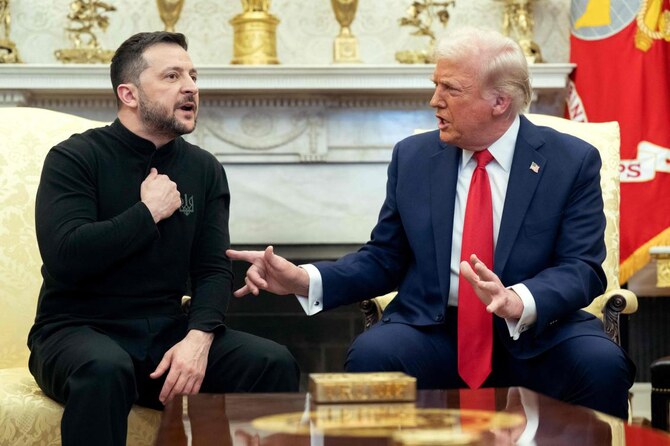
US President Donald Trump and Ukraine’s President Volodymyr Zelensky meet in the Oval Office of the White House in Washington, Feb. 28, 2025. (AFP)
Short Url
Updated 01 March 2025
Follow

European leaders show support for Zelensky after Trump clash; top diplomat says ‘free world needs new leader’

  • “It’s up to us, Europeans, to take this challenge,” Kallas wrote on social media
  • Support comes from all corners of continent, with only Hungarian PM Orban backing Trump

BRUSSELS: European leaders lined up to show solidarity with Ukrainian President Volodymyr Zelensky on Friday, after he came under attack from US President Donald Trump and Vice President JD Vance in a stunning White House shouting match.
Within a short time, prime ministers and presidents from the north, south, east and west of the continent posted on social media in support of Zelensky and Ukraine in the war against Russia’s invasion, following the extraordinary clash.
While they did not directly criticize the US president, their comments made clear they stood by Kyiv — highlighting a major rift between traditional allies the United States and Europe over the war since Trump returned to office.
“There is an aggressor: Russia. There is a people who are under attack: Ukraine,” French President Emmanuel Macron, who visited Trump this week, posted on X.

“Respect to those who, since the beginning, have been fighting. Because they are fighting for their dignity, their independence, for their children and for the security of Europe,” Macron added.
Earlier, Trump had accused Zelensky of disrespecting the United States. The two leaders had been expected to conclude a deal on exploiting Ukraine’s mineral resources but Zelensky left the White House without signing the agreement.
Trump also said Zelensky was not ready for peace.
Polish Prime Minister Donald Tusk was among the first to show his support for Zelensky and Ukraine on social media, telling them: “You are not alone.”
European Commission President Ursula von der Leyen and European Council President Antonio Costa — the European Union’s two top officials — told Zelensky in a joint post: “Your dignity honors the bravery of the Ukrainian people.”
“Be strong, be brave, be fearless. You are never alone,” they said. “We will continue working with you for a just and lasting peace.”

German Chancellor Olaf Scholz said: “Nobody wants peace more than the Ukrainians do.”
German conservative leader Friedrich Merz, Scholz’s likely successor after his party won last Sunday’s general election, posted: “We stand with #Ukraine in good and in testing times. We must never confuse aggressor and victim in this terrible war.”
The European Union’s foreign policy chief, Kaja Kallas — a former prime minister of Estonia — was blunt in her comments.
“Today, it became clear that the free world needs a new leader. It’s up to us, Europeans, to take this challenge,” she said.
“We will step up our support to Ukraine so that they can continue to fight back the aggressor.”

Leaders from Belgium, Croatia, the Czech Republic, Ireland, Finland, Latvia, Lithuania, Luxembourg, the Netherlands, Portugal, Slovenia, Spain and Sweden were also among those expressing support for Ukraine.
By contrast, Hungarian nationalist Prime Minister Viktor Orban, a Trump ally, backed the US president.
“Strong men make peace, weak men make war,” he posted on X. “Today President @realDonaldTrump stood bravely for peace. Even if it was difficult for many to digest. Thank you, Mr. President!”


Treason trial of South Sudan’s suspended VP is further eroding peace deal, UN experts say

Updated 5 sec ago
Follow

Treason trial of South Sudan’s suspended VP is further eroding peace deal, UN experts say

  • The experts said forces from both sides are continuing to confront each other across much of the country
  • “Years of neglect have fragmented government and opposition forces alike,” the experts said

UNITED NATIONS: The treason trial of South Sudan’s suspended vice president is further eroding a 2018 peace agreement he signed with President Salva Kiir, UN experts warned in a new report.
As Riek Machar’s trial is taking place in the capital, Juba, the experts said forces from both sides are continuing to confront each other across much of the country and there is a threat of renewed major conflict.
UN peacekeeping chief Jean-Pierre Lacroix told the UN Security Council last month that the crisis in South Sudan is escalating, “a breaking point” has become visible, and time is running “dangerously short” to bring the peace process back on track.
There were high hopes when oil-rich South Sudan gained independence from Sudan in 2011 after a long conflict, but the country slid into a civil war in December 2013 largely based on ethnic divisions, when forces loyal to Kiir, an ethnic Dinka, battled those loyal to Machar, an ethnic Nuer.
More than 400,000 people were killed in the war, which ended with the 2018 peace agreement that brought Kiir and Machar together in a government of national unity. But implementation has been slow, and a long-delayed presidential election is now scheduled for December 2026.
The panel of UN experts stressed in a report this week that the political and security landscape in South Sudan looks very different today than it did in 2018 and that “the conflict that now threatens looks much different to those that came before.”
“Years of neglect have fragmented government and opposition forces alike,” the experts said, “resulting in a patchwork of uniformed soldiers, defectors and armed community defense groups that are increasingly preoccupied by local struggles and often unenthused by the prospect of a national confrontation. ”
With limited supplies and low morale, South Sudan’s military has relied increasingly on aerial bombings that are “relatively indiscriminate” to disrupt the opposition, the experts said.
In a major escalation of tensions in March, a Nuer militia seized an army garrison. Kiir’s government responded, charging Machar and seven other opposition figures with treason, murder, terrorism and other crimes.
The UN experts said Kiir and his allies insist that, despite having dismissed Machar, implementation of the peace agreement is unaffected, pointing to a faction of the opposition led by Stephen Par Kuol that is still engaged in the peace process.
Those who refused to join Kuol and sided with Machar’s former deputy, Natheniel Oyet, “have largely been removed from their positions, forcing many to flee the country,” the experts said in the report.
The African Union, regional countries and the Intergovernmental Authority on Development, or IGAD, have all called for Machar’s release and stressed their strong support for implementation of the 2018 agreement, the panel said.
According to the latest international assessment, 7.7 million people — 57 percent of the population — face “crisis” levels of food insecurity, with pockets of famine in some communities most affected by renewed fighting, the panel said.