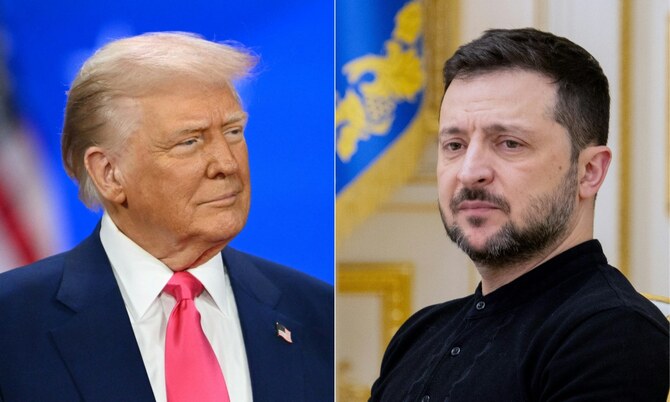
Washington: A week ago Donald Trump branded Volodymyr Zelensky a dictator. On Friday he will host the Ukrainian president at the White House and sign a deal granting Washington access to Ukraine’s rare minerals.
The extraordinary turnaround caps a week of frantic international diplomacy centered on Washington, as Kyiv seeks to shore up support despite Trump’s recent pivot toward Russia.
Trump upended years of US policy on Ukraine two weeks ago when he spoke to Russian President Vladimir Putin and started talks on ending the three-year-old war — without Kyiv.
He also alarmed allies as he appeared to turn on Zelensky, berating him as a “dictator without elections” and blaming Ukraine for Russia’s February 2022 invasion.
But Trump’s tone has softened in recent days after visits by French President Emmanuel Macron and British Prime Minister Keir Starmer.
“I have a lot of respect for him,” Trump said of Zelensky on Thursday. “We’re going to get along really well.”
Trump also backtracked on the “dictator” broadside he launched on social media at Zelensky last week — a jibe he had previously refused to retract even as he declined to call Putin a dictator too.
“Did I say that? I can’t believe I said that,” Trump responded when asked about the Zelensky comment by journalists during a meeting with Starmer.
The dictator outburst was sparked in particular by Zelensky’s initial rejection of the deal to give Washington preferential access to Ukrainian natural resources, including oil, gas and rare earth metals.
Zelensky demanded US security guarantees as part of any deal but Trump has refused to give any commitments.
’Dig, dig, digging’
Trump, a billionaire real estate tycoon, insisted the deal was necessary for Washington to recoup the billions of dollars it has given Ukraine in military and other aid.
Finally, Zelensky relented and agreed to come to the White House to sign it.
The deal would give the United States a share in much of Ukraine’s mineral wealth.
“We’ll be dig, dig, digging” for Ukraine’s resources, Trump told reporters Thursday.
Few details of the minerals deal have emerged. Zelensky told reporters this week that it would act as framework for broader deals.
Further discussions between US and Ukrainian officials would determine the nature of security guarantees for Ukraine and the exact sums of money at stake in the accord, he said.
But Trump has repeatedly refused to commit to any guarantees.
Britain and France have both offered peacekeepers in the event of a deal to end the Ukraine war but say there must be a US “backstop” — including American intelligence and possibly air power.
The US president told Starmer Thursday he was “open to many things” in terms of security guarantees but that he wanted to get a Russia-Ukraine deal in place first.
Trump added that there had been a “lot of progress” toward a deal but then added: “It’ll either be fairly soon or it won’t be at all.”
US and Russian officials met on Thursday in Istanbul in a new round of talks.
Putin and Trump said after their February 12 phone call that they had agreed to meet personally — but they have not finalized any meeting yet.


![]()

Zelensky, Trump to sign minerals deal at White House
Short Url
https://arab.news/g4frh
Zelensky, Trump to sign minerals deal at White House
- Trump upended years of US policy on Ukraine two weeks ago when he spoke to Russian President Vladimir Putin and started talks on ending the three-year-old war
Latest updates


© 2026 SAUDI RESEARCH & PUBLISHING COMPANY, All Rights Reserved And subject to Terms of Use Agreement.