



LONDON: The UK’s capital, London, was illuminated with festive lights to celebrate the Muslim holy month of Ramadan for the third consecutive year this week.
Mayor Sadiq Khan switched on over 30,000 LED bulbs to celebrate Ramadan, which is set to start on Friday evening, bringing joy to residents and curious tourists on Coventry Street, off London’s Piccadilly Circus.
The vibrant center of the British metropolis was illuminated with a sign that read “Happy Ramadan,” alongside shapes of stars and crescent moons. This festive display will shine brightly from 5 p.m. to 5 a.m. until March 29. After that date, it will change to convey the message “Happy Eid,” which will be displayed until April 6.
For the residents of the Big Smoke, who have endured weeks of bitter cold and near-zero temperatures, Ramadan lights provided respite between Christmas and the anticipation of Easter.
Eric, a London resident, was enchanted by the interactive Ramadan lights in Leicester Square, near the Mary Poppins statue. He wanted to “learn more” about the Muslim holy month and celebrate the multicultural atmosphere of London. He was carrying a battery-operated cardboard lantern, a symbol of Ramadan since the Egyptians used it in the 10th century to brighten the path for the Muslim Caliph.
London was the first major European city to adorn its central streets with Ramadan lights, a trend later embraced by Frankfurt in 2024. This is the third year the Aziz Foundation has organized the fasting month lights, which has become part of the city’s calendar over the years alongside Hanukkah and Diwali.
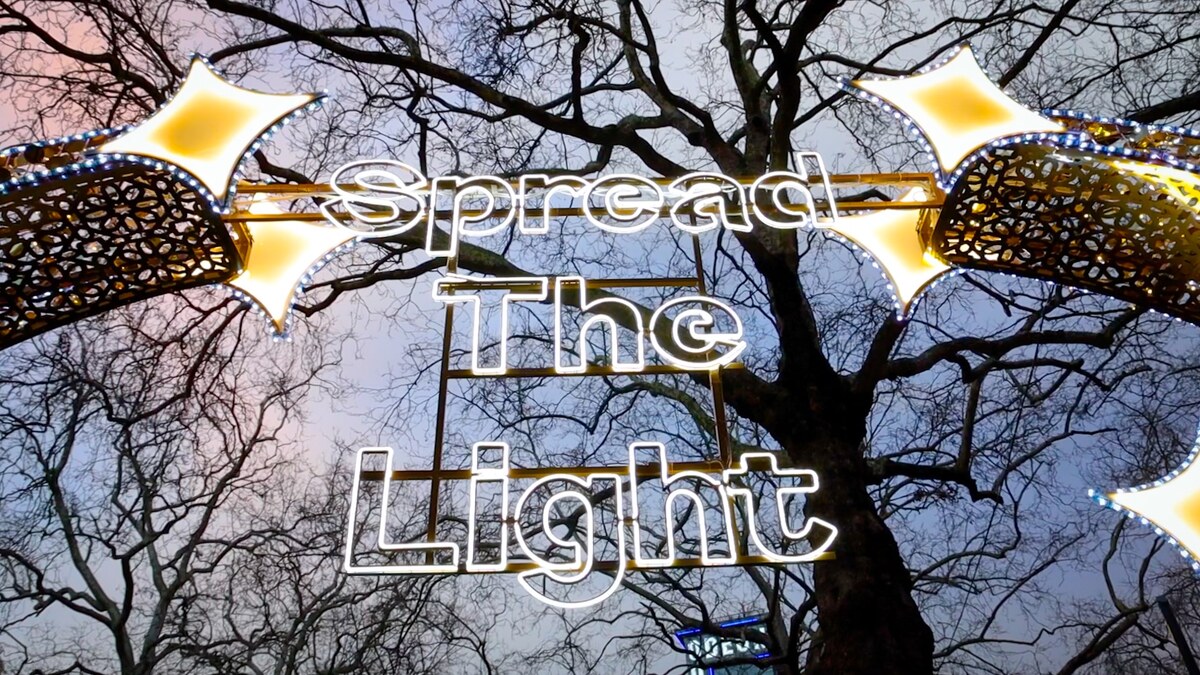
Ramadan lights installation in Leicester Square features the message “Spread the Light” that shines when pressed. (Arab News\Bahar Hussain)
Rahima Aziz BEM, a trustee at the Aziz Foundation, told Arab News that the interactive Ramadan lights installation in Leicester Square is a new addition featuring the message “Spread the Light” that shines when pressed.
“This is our message for this year. We really want Muslims to feel involved in the whole process. You come to (London’s) West End not just to see the (Ramadan) lights but also to immerse yourself in the experience,” she said.
Councillor Robert Rigby, the lord mayor of Westminster, led a lantern parade of schoolchildren in Leicester Square before jointly switching on the lights of the interactive installation on Wednesday afternoon. Not far away, King Charles III and Queen Camilla were doing their part to mark the upcoming Ramadan period by helping to pack food donation parcels at an Indian restaurant in Soho.
Rigby expressed his pride in seeing Westminster, Britain’s political and cultural center, as a diverse and welcoming city. “We are home to many different faiths, Muslims included, and we are very grateful for any visitors coming to this wonderful city ... from all over the world,” he told Arab News.
The crowd gathered on Coventry Street in the early evening to watch Khan switch on the lights.
Hatem Al-Shammari, a tourist from Hail in Saudi Arabia, was passing by with a friend when they paused to admire the lights. This was his second visit to London, and he was surprised to discover that all the festivities were in celebration of Ramadan. He told Arab News that in the past, such an event in a European city was unheard of.
“You could see people (from various faiths) celebrating together, not just Muslims; this is something beautiful, and the vibes are very nice. May Allah bless us in Ramadan,” he said.
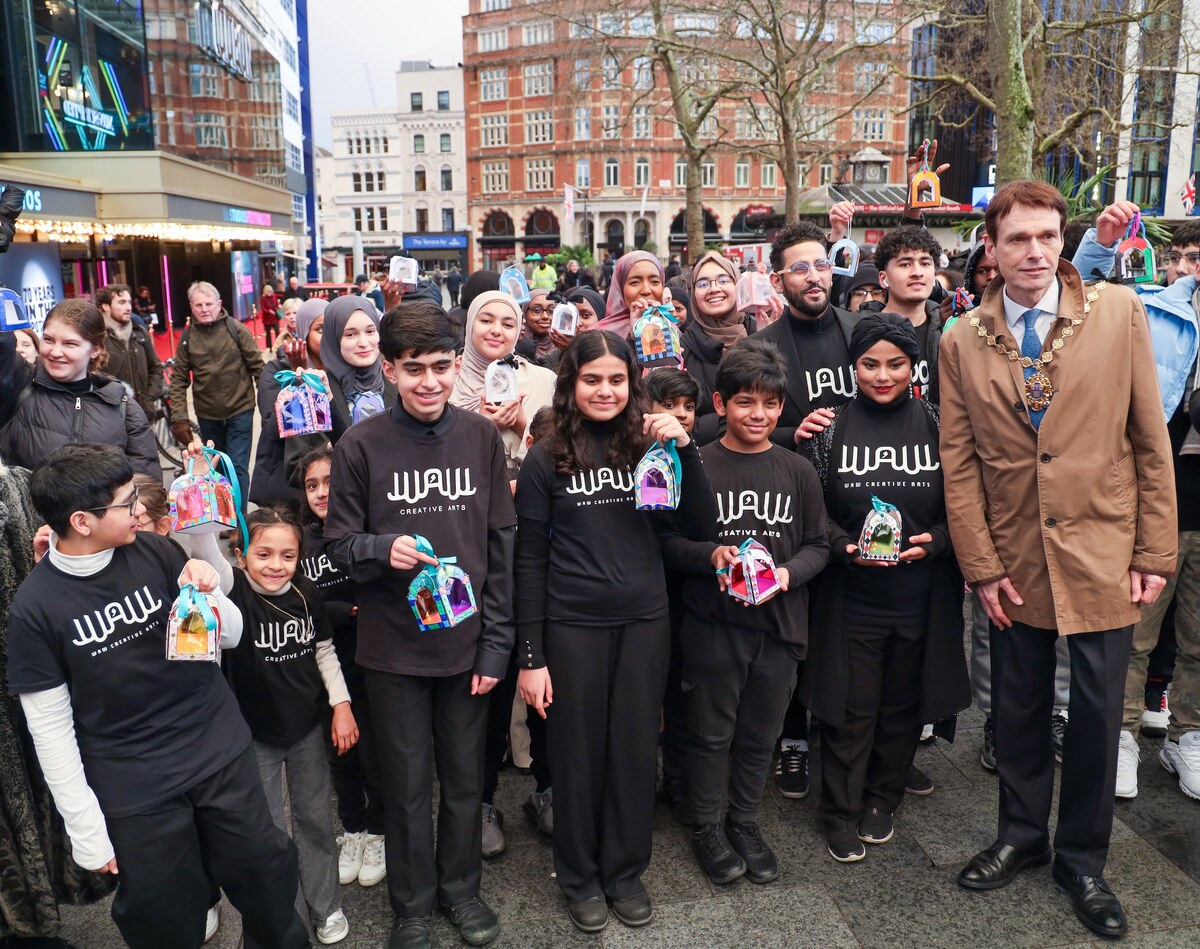
The lord mayor of Westminster led a lantern parade of schoolchildren in Leicester Square before switching on the lights of the interactive installation. (Arab News\Bahar Hussain)
Fasting during Ramadan is one of the five pillars of Islam, alongside the Shahada, a profession of faith, prayer, giving alms, and performing Hajj. This March, British Muslims are expected to fast for approximately 13 hours each day, from sunrise to sunset. However, when Ramadan occurs in the summer, the fasting period can last nearly 19 hours, and these hours vary between countries. Starting from this Saturday’s sunrise, Muslims will refrain from food, drink, and some activities, such as sex and smoking, during daylight for 30 days as a way to reflect on religion, life, and empathize with the poor.
Sara, a university student, believes that Ramadan brings the British Muslim community closer and helps them connect with their faith. She told Arab News that she is excited about the events at her university, including the bring your dish iftar meals.
For Yousef, one of the schoolchildren who illuminated the “Spread the Light” interactive installation, Ramadan is about coming together despite the long hours of fasting. He said that exams are approaching at his school, and although he will feel hungry during the day, what matters most to him is “breaking the fast at iftar with family and friends.”



