Iraqi Kurdistan can start oil flows within days on Turkish approval, minister says

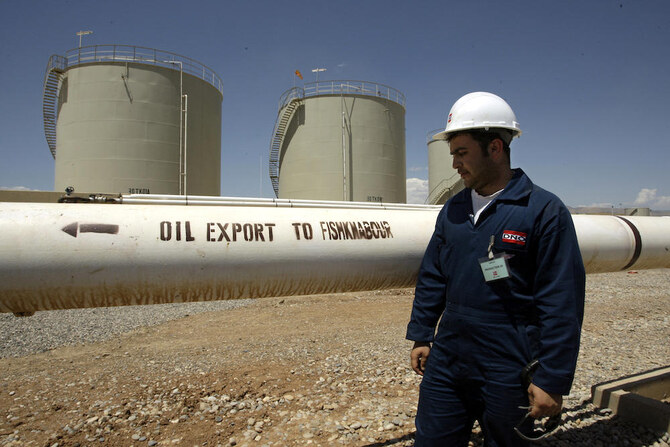
Above, the Tawke oil refinery near the village of Zacho in the autonomous Iraqi region of Kurdistan on May 31, 2009. (AFP file photo)
Short Url
Updated 24 February 2025
Follow

Iraqi Kurdistan can start oil flows within days on Turkish approval, minister says

  • Iraqi Kurdistan authorities have agreed with the federal oil ministry to restart Kurdish crude exports based on available volumes
  • A speedy resumption of exports from semi-autonomous Kurdistan region would help to offset a potential fall in Iranian oil exports

BAGHDAD: Iraq is waiting for Turkiye’s approval to restart the oil flows from the Iraqi Kurdistan region, the Iraqi oil minister said on Monday, adding that Kurdish oil exports will hopefully be ready in two days.
Asked if resuming Kurdish oil exports will affect Iraq’s OPEC compliance, Hayan Abdel-Ghani told reporters that Baghdad is committed to the OPEC+ decisions and exported volumes under the control of the Iraqi oil ministry.
Iraqi Kurdistan authorities have agreed with the federal oil ministry to restart Kurdish crude exports based on available volumes, Kurdistan’s regional government said on Sunday.
The pipeline was halted by Turkiye in March 2023 after the International Chamber of Commerce (ICC) ordered Ankara to pay Baghdad $1.5 billion in damages for unauthorized exports between 2014 and 2018.
US President Donald Trump’s administration is putting pressure on Iraq to allow Kurdish oil exports to restart or face sanctions alongside Iran, sources have told Reuters. An Iraqi official later denied pressure or the threat of sanctions.
A speedy resumption of exports from Iraq’s semi-autonomous Kurdistan region would help to offset a potential fall in Iranian oil exports, which Washington has pledged to cut to zero as part of Trump’s “maximum pressure” campaign against Tehran.
Asked if the northern oil exports through neighboring Turkiye’s Ceyhan port will include crude oil produced from Iraq’s Kirkuk fields, Hayan Abdel-Ghani told reporters: “Production from Kirkuk fields will be for local use.”


Syria nears anniversary of Assad’s fall amid renewed ‘deeply troubling’ abuses, UN warns

Updated 22 sec ago
Follow

Syria nears anniversary of Assad’s fall amid renewed ‘deeply troubling’ abuses, UN warns

  • Early steps by interim leadership ‘encouraging but only the beginning’ of long process of accountability, human rights chief says
  • Concern that rising hate speech, both online and on the streets, has intensified violence against Alawite, Druze, Christian, Bedouin communities 

NEW YORK: Syria is days away from marking the first anniversary of the fall of President Bashar Assad’s regime, but the country’s interim authorities face mounting criticism over continuing abuses and a fragile security environment, the UN human rights chief said. 

In a statement on Friday, UN High Commissioner for Human Rights Volker Turk said early steps by the interim leadership, including the creation of national commissions for transitional justice and missing persons, and investigative bodies examining violence in coastal areas and in Suweida, were “encouraging but only the beginning” of a long process of accountability. 

Trials for suspects linked to last year’s coastal violence have begun, and a draft law on transitional justice has been announced. But Turk said the human rights situation remains deeply troubling. 

According to the UN, hundreds of people have been killed over the past year in summary executions, arbitrary killings, and abductions. Victims include members of minority communities and individuals accused of ties to the former government. Deaths were attributed to gunfire, stabbings, blunt-force attacks, shelling, hand grenades and explosive remnants of war. 

The UN said perpetrators include security forces under the interim authorities, armed groups aligned with them, remnants of the former government’s forces, local militias, and unidentified armed actors. 

Investigators also documented reports of sexual violence, arbitrary detention, looting, destruction of homes, forced evictions, and property confiscations, along with restrictions on free expression and peaceful assembly. 

Turk warned that rising hate speech, both online and on the streets, had intensified violence against Alawite, Druze, Christian, and Bedouin communities. 

The past year has also seen repeated Israeli military operations inside Syrian territory, including incursions and the occupation of additional areas. The UN said it had received reports of civilian casualties in a recent Israeli strike near Damascus, along with arrests and home searches carried out during military actions. 

Turk expressed concern that former armed groups have been integrated into new security forces without adequate human rights checks, raising the risk of repeat violations. 

“Proper vetting and comprehensive security sector reform are essential to prevent individuals responsible for serious abuses from entering the security forces,” he said. 

He urged Syria’s interim authorities to ensure independent and transparent investigations into all violations, past and present, and to hold those responsible to account. 

“Accountability, justice, peace, and the security of all Syrians are absolute prerequisites for a successful transition,” Turk said, adding that victims must have access to remedies and reparation. 

The UN Human Rights Office said its Damascus program is supporting efforts to advance inclusive transitional justice and strengthen the rule of law as Syria navigates a post-Assad transition.