

Pakistan highlights economic reforms at Davos, eyes cooperation in AI, IT and minerals

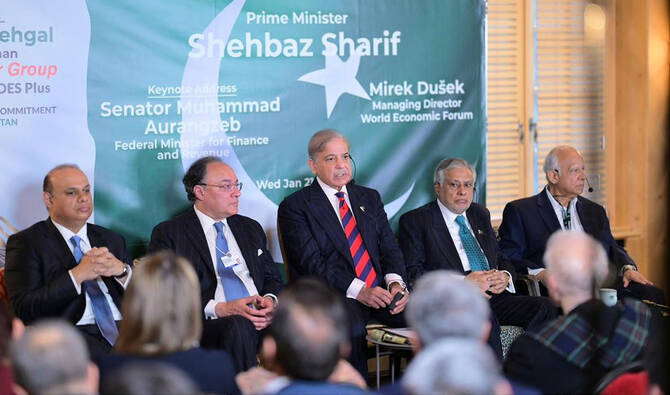
Prime Minister Shehbaz Sharif (center) addresses the Pakistan Pavilion on the sidelines of the ongoing World Economic Forum (WEF) summit in Davos, Switzerland, on January 21, 2026. (PID)
Short Url
Updated 21 January 2026
Follow

Pakistan highlights economic reforms at Davos, eyes cooperation in AI, IT and minerals

  • Prime Minister Shehbaz Sharif speaks at breakfast event in Davos at sidelines of World Economic Forum summit
  • Pakistan, rich in gold, copper reserves, has sought cooperation with China, US, Gulf countries in its mineral sector

ISLAMABAD: Prime Minister Shehbaz Sharif highlighted Pakistan’s recent economic reforms during the sidelines of the ongoing World Economic Forum (WEF) summit in Davos on Wednesday, saying that his country was eyeing greater cooperation in mines and minerals, information technology, cryptocurrency and artificial intelligence with other states. 

The Pakistani prime minister was speaking at the Pakistan Pavilion in Davos on the sidelines of the WEF summit at a breakfast event. Sharif arrived in Switzerland on Tuesday to attend the 56th annual meeting of the WEF, which brings together global business leaders, policymakers and politicians to speak on social, economic and political challenges. 

Pakistan has recently undertaken several economic reforms, which include removing subsidies on energy and food, privatization of loss-making state-owned enterprises and expanding its tax base. Islamabad took the measures as part of reforms it agreed with the International Monetary Fund (IMF) in exchange for a financial bailout package. 

“We are now into mines and minerals business in a big way,” Sharif said at the event. “We have signed agreements with American companies and Chinese companies.”

Islamabad has sought to attract foreign investment in its critical minerals sector in recent months. In April 2025, Pakistan hosted an international minerals summit where top companies and government officials from the US, Saudi Arabia, China, Türkiye, the UK, Azerbaijan, and other nations attended.

Pakistan is rich in gold, copper and lithium reserves as well as other minerals, yet its mineral sector contributes only 3.2 percent to the countrys GDP and 0.1 percent to global exports, according to official figures.

Sharif said Pakistan has been blessed with infinite natural resources which are buried in its mountains in the northern Gilgit-Baltistan, Khyber Pakhtunkhwa, Azad Kashmir and southwestern Balochistan regions. 

“But we have now decided to go forward at lightning speed,” he said. “And we are also moving speedily in the field of crypto, AI, IT.”

He said the government’s fiscal and economic measures have reduced inflation from nearly 30 percent a few years ago to single-digit figures, adding that its tax-to-GDP ratio had also increased from 9 to 10.5 percent. 

The prime minister admitted Pakistan’s exports face different kinds of challenges collectively, saying the country’s social indicators needed to improve. 

“But the way forward is very clear: that Pakistan has to have an export-led growth,” he said. 

SHARIF MEETS IMF MANAGING DIRECTOR

Separately, Sharif met IMF Managing Director Kristalina Georgieva on improvements in Pakistan’s macroeconomic indicators, efforts toward stability and progress on institutional reforms, a statement from Sharif’s office said.

He emphasized Pakistan’s commitment to fiscal discipline, revenue mobilization and sustainable development, it added. 

The IMF managing director acknowledged and appreciated Pakistan’s reform efforts, the Prime Minister’s Office (PMO) said.

“Both sides exchanged views on the global economic outlook, challenges facing emerging economies, and the importance of multilateral cooperation in safeguarding economic stability,” the PMO said. 


Pakistan’s ‘Air Punjab’ faces scrutiny over Gulfstream jet purchase

Updated 6 sec ago
Follow

Pakistan’s ‘Air Punjab’ faces scrutiny over Gulfstream jet purchase

  • Punjab government calls luxury jet part of planned airline awaiting regulatory approval
  • Aviation experts question the viability of the 17-seat aircraft for commercial operations

ISLAMABAD: Aviation experts and an official on Saturday questioned the commercial viability of the move as the Punjab government said it had acquired a Gulfstream luxury aircraft as part of “Air Punjab,” an upcoming airline registered with the Securities and Exchange Commission of Pakistan (SECP) but yet to secure key regulatory approvals.

The development comes months after the federal government moved ahead with the privatization of Pakistan International Airlines (PIA), citing its inability to sustainably run the debt-ridden national carrier.

Air Punjab (Private) Limited was incorporated with the SECP on July 24, 2025, under registration number 0302317. The concept was first introduced by Punjab Chief Minister Maryam Nawaz in April 2025, with plans to launch operations within a year using leased aircraft. The provincial cabinet subsequently approved the airline’s establishment. However, an official told Arab News that the project remains at a preliminary stage.

“They have not got their license yet,” the official in the aviation department told Arab News on condition of anonymity, adding the airline still has to go through processes to be able to start operations.

The aircraft in question, a Gulfstream G500, registration N144S, arrived in Lahore from North America in December 2025 and began local flight operations on February 6, 2026. Online flight records show the jet was used at least 15 times between February 9 and February 18 for short trips to cities including Lahore, Rawalpindi, Sialkot, Dera Ghazi Khan and Faisalabad, with flight durations ranging from 14 to 37 minutes. It frequently used the call sign “Punjab 2.”

Responding to criticism that the aircraft had been inducted for the Punjab chief minister, the provincial information minister Azma Bukhari on Friday defended the purchase.

“For our ‘Air Punjab,’ we are buying various aircraft and some we will take on lease,” she said. “This means we have to build a fleet which will have all kinds of planes, and this is a part of that same link. Right now, as soon as the matters on this are finalized, I will definitely tell you.”

The aviation official said the aircraft was a 17-seater and couldn’t be used for commercial flights.

“The smallest aircraft used for commercial operations now is the ATR, which has around 48 [ATR 42-500] to 70 [ATR 72-500] seats. How can an airline be operated with a Gulfstream jet that is configured for VIP travel and has previously been used for executive flights? It is not commercially viable,” he said.

Speaking about the technical aspects, Afsar Malik, an independent aviation expert, said the provincial minister had probably been mistaken when she said the aircraft was for the upcoming airline.

“The Gulfstream is state aircraft and state aircraft cannot be used for commercial purpose,” he said. “Secondly, it’s not commercially viable. If Punjab information minister has said it, it would either be a slip of the tongue or ignorance.”

The planned launch of the provincial carrier comes as Pakistan’s aviation sector tries to recover from its deepest crisis in decades. The industry’s decline was interrupted in late 2025 by the federal government’s sale of the debt-ridden national carrier, Pakistan International Airlines (PIA), to a private consortium after the state could not sustain losses exceeding 800 billion rupees ($2.8 billion).

The private sector has proven equally volatile. Regulators recently suspended the license of Serene Air after its entire five-aircraft fleet was deemed “unserviceable,” leaving it with zero operational capacity.

“Twelve airlines have shut down since the sector’s inception,” said aviation consultant Irshad Ghani, noting that Serene Air joined a long list of failed carriers including Shaheen Air and Bhoja Air.

High capital requirements and rising airfares have hollowed out the domestic market, leaving ventures like Air Punjab facing immense skepticism in an industry Ghani describes as “fragile.”

Ghani, who heads an aviation consultancy firm, said PIA had operated 19-seater ATR turboprop aircraft in the past, particularly to serve smaller airports such as Sargodha where larger jets could not land. However, he drew a distinction between turboprops designed for commercial routes and executive jets.

“As far as the Gulfstream jet is concerned, it has been operated as a chartered aircraft, and it can also be used for charter operations by an airline. However, that would typically be the case for a well-established or large airline,” Ghani said.

He questioned the broader logic of the project.

“The question arises: when the federal government has just sold the national airline, acknowledging that the government could not successfully run it, how logical is it for a provincial government to operate its own airline?” he asked.

Ghani said he doubted it will be run successfully.

“If Punjab had the capacity to operate a public airline, why didn’t it consider purchasing PIA instead,” he wondered.

Minister Bukhari did not respond to Arab News queries regarding the Gulfstream and Air Punjab.