

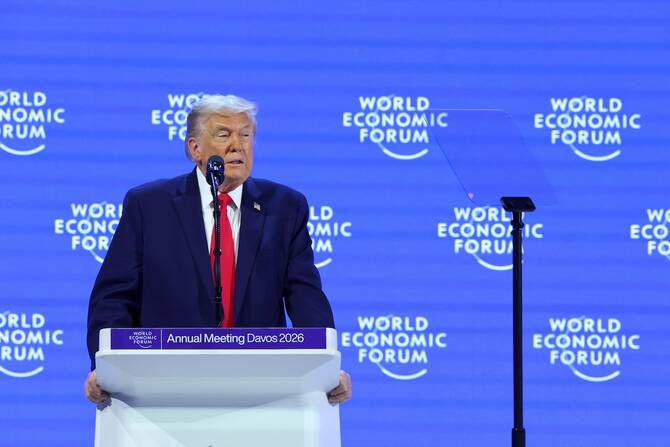

DAVOS: Iran is no longer the “bully of the Middle East,” thanks to US military strikes against Tehran’s nuclear facilities last year, President Donald Trump told the World Economic Forum on Wednesday.
“If we didn’t take them out, they would have had a nuclear weapon within two months,” Trump said regarding the strikes in June.
The attack on Iran’s atomic program had paved the way for the Gaza peace deal that followed in September, he added, largely ending Israel’s two-year war on the territory.
While he said the US actions had brought “peace in the Middle East,” Trump urged Hamas to comply with the agreement and give up its weapons, or risk being “blown away.”
His comments came during a “fireside chat” after delivering a wide-ranging, much-anticipated address at the forum’s annual meeting in Davos, Switzerland, that focused largely on Europe, Greenland and NATO.
Asked whether he thought the world would now see the reconstruction of Gaza and billions of US dollars invested in the process, Trump highlighted the progress so far of the Gaza agreement.
The US announced last week that the deal had entered its second phase, which includes the demilitarization of all armed factions in the territory, the establishment of a transitional administration, and the start of reconstruction efforts.
Trump said that the next three weeks would reveal whether Hamas was going to agree to hand over its weapons.
“If they don’t do it, they’ll be blown away very quickly,” he added.
Fifty-nine countries are part of the peace deal, the president said, some of which are not anywhere near the Middle East yet they still want to “come in and take out Hamas.”
He acknowledged that this represents a significant challenge given that Hamas fighters “were born with a weapon in their hand,” but said that this was what nations had agreed to when they signed up to the 20-point peace deal.
The agreement was reached after the war in Gaza had escalated into a wider regional conflict last year, particularly between Israel and Iran. After the two countries had attacked one another for a week, the US intervened on June 21 on the side of its ally, Israel, and bombed three key sites linked to Iran’s nuclear program.
“They were very close to having the nuclear weapon, and we hit them hard,” Trump said. “They may try again but they’re gonna have to try from a different area because that area was obliterated.”
He added: “They (Iran) were the bully of the Middle East. They’re not the bully of the Middle East anymore.”
Trump did not directly refer to his “Board of Peace,” which has emerged from the Gaza ceasefire agreement as a possible international body for the resolution of conflicts. He is expected to announce the board’s first charter at Davos on Thursday.
Instead, the president spent much of his speech talking about Greenland and the Washington’s NATO allies. He said he would not use force to take control of the semiautonomous Danish territory, but insisted that the US should be running it.
He demanded immediate negotiations to acquire Greenland from Denmark, saying the US wanted to take control of the territory “including right, title and ownership.”
He added: “We probably won’t get anything unless I decide to use excessive strength and force, where we would be, frankly, unstoppable. But I won’t do that, OK? I don’t have to use force.”
He insisted his designs on Greenland were for the good of “world protection” and warned NATO: “You can say ‘yes,’ and we will be very appreciative. Or you can say ‘no,’ and we will remember.”
Trump’s stated intention for the US to take control of Greenland, a vast arctic island that has become an increasingly strategic territory as ice flows melt, has resulted in a major split within the NATO alliance.
European leaders reacted with deep concern over the Trump administration’s insistence that it takes the territory, and Washington threatened punitive tariffs in response to their objections.
Trump used his speech in Davos to deliver pointed criticisms of Europe and Canada, describing the former as economically and politically weak while the US is booming under his leadership.
“I want to see Europe go good but it’s not heading in the right direction,” he said, adding, “We want strong allies, not seriously weakened ones."
He also expressed doubt over whether NATO would come to the aid of the US if it were needed.
Asked about the war between Russia and Ukraine, Trump said a peace deal was “reasonably close” after months of diplomacy from his administration with the aim of ending the conflict.
He said that while he is in Davos he would meet the Ukrainian president, Volodymyr Zelensky, and added that both of the warring sides would be “stupid” if they failed to reach a peace agreement.
“I believe they’re at a point now where they can come together and get a deal done,” he said.
With the November midterm elections on the horizon in the US, Trump also attempted to inject some domestic issues into a speech largely focused on foreign policy.
He touted his efforts to ease the financial burdens on American voters, including a 10 percent cap on credit card interest rates, and a ban on corporate investors buying up family homes.


