

Lebanese leaders urge congressional delegation for US pressure on Israel to leave occupied areas

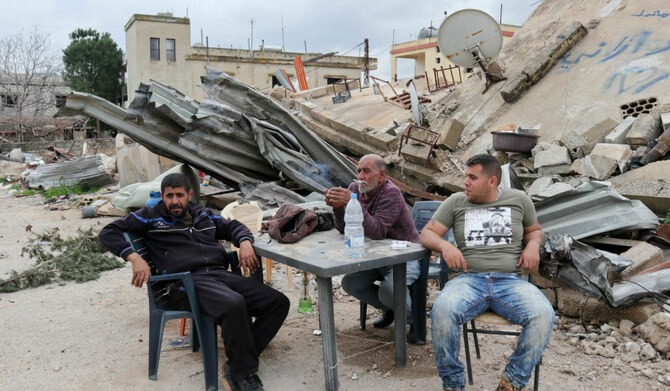
Men sit around a table in front of their destroyed house in the southern Lebanese border village of Wazzani after Israeli forces pulled out, on February 19, 2025. (AFP)
Short Url
Updated 21 February 2025
Follow

Lebanese leaders urge congressional delegation for US pressure on Israel to leave occupied areas

  • PM: Lebanon is committed to restoring its position among Arab states
  • Security meetings held in preparation for funeral processions

BEIRUT: Lebanon’s President Joseph Aoun and Prime Minister Nawaf Salam on Friday emphasized the need for the US to exert pressure on Israel for a prompt and complete withdrawal from the territories it continues to occupy.

Salam made the remarks during his meeting at the Grand Serail with a delegation from the US Congress led by Rep. Darrell Issa.

“There is no military or security justification for Israel’s occupation of these points,” Salam said.

“This is a continued violation of the ceasefire arrangements, Resolution 1701, international law, and Lebanon’s sovereignty.”

FASTFACT

Prime Minister Nawaf Salam briefed members of the Arab diplomatic corps, led by Palestinian Ambassador to Lebanon Ashraf Dabbour, on the discussions he had with various Arab officials to apply diplomatic pressure on Israel to withdraw from all Lebanese territories as soon as possible.

According to Salam’s office, the US delegation reaffirmed its support for Lebanon and the Lebanese army.

President Aoun received a phone call from US National Security Adviser Michael Waltz two days earlier.

Waltz assured Aoun that the US administration was keeping track of developments in southern Lebanon following Israel’s “incomplete withdrawal and its continued occupation of several border points.”

He commended the Lebanese army’s role in deploying to the positions vacated by the Israelis.

He highlighted the US commitment to Lebanon to solidify the ceasefire and resolve outstanding issues diplomatically.

Salam briefed members of the Arab diplomatic corps, led by Palestinian Ambassador to Lebanon Ashraf Dabbour, on the discussions he had with various Arab officials to apply diplomatic pressure on Israel to withdraw from all Lebanese territories as soon as possible.

He emphasized “the importance of a unified Arab stance in facing common challenges, especially the plan to displace Palestinians.”

Salam informed the diplomatic delegation that the “ministerial statement prepared by his government, which is currently pending parliamentary approval, commits to restoring Lebanon’s standing among its Arab neighbors and ensuring that Lebanon does not serve as a platform for attacking Arab and friendly nations.”

Salam called on Arab communities to return to investing in and engaging in tourism in Lebanon in light of the new government and the favorable conditions it aims to create.

Meanwhile, the European Commissioner for the Mediterranean Dubravka Suica held meetings with President Aoun and Salam.

The European Commission confirmed that it has allocated a €1 billion ($1.045 billion) package for Lebanon, with an additional €500 million to be provided.

However, this extra funding depends on specific conditions, including restructuring the banking sector and reaching an agreement with the International Monetary Fund.

A security meeting was held at the presidential palace two days before Hezbollah is set to hold the funeral for its former Secretary-General Hassan Nasrallah and his successor Hashem Safieddine.

Aoun presided at the meeting.

Defense Minister Michel Menassa, Interior Minister Ahmad Hajjar, Acting Army Commander Maj. Gen. Hassan Audi and senior officers from security agencies attended the talks.

Preparations are being made at Sports City, located at the southern entrance of Beirut, to accommodate mourners in the stadium and nearby areas.

Hezbollah expects attendees to exceed the stadium’s capacity of around 60,000 people.

Large posters of Nasrallah, Safieddine, and Lebanese flags were displayed on the outer walls.

The Lebanese army and Internal Security Forces will ensure safety in the surrounding areas and streets, while Hezbollah members will oversee the discipline and organization of the event.

During a security meeting at the Interior Ministry, the protocols and measures for maintaining order and ensuring the safety of attendees and citizens were reviewed.

The measures also aim to ensure the smooth flow of traffic, according to Interior Minister Ahmad Al-Hajjar Hussein Fadlallah, head of the funeral organizing committee.

He provided details about the logistical arrangements for the event at a press conference.

“We have secured 50 parking lots and set up giant screens along the roads to broadcast the funeral for those unable to attend in person,” Fadlallah said.

“Both the presidency and parliament of Lebanon will be participating in the funeral.”


Sudan’s prime minister takes his peace plan to the UN, but US urges humanitarian truce now

Updated 23 December 2025
Follow

Sudan’s prime minister takes his peace plan to the UN, but US urges humanitarian truce now

  • Sudan’s prime minister is proposing a wide-ranging peace initiative to end a nearly 1,000-day war with a rival paramilitary force
  • It seems unlikely the RSF would support the proposal, which would essentially give government forces a victory and take away their military power

UNITED NATIONS: Sudan’s prime minister on Monday proposed a wide-ranging peace initiative to end a nearly 1,000-day war with a rival paramilitary force, but the United States urged both sides to accept the Trump administration’s call for an immediate humanitarian truce.
Kamil Idris, who heads Sudan’s transitional civilian government, told the Security Council his plan calls for a ceasefire monitored by the United Nations, African Union and Arab League, and the withdrawal of paramilitary forces from all areas they occupy, their placement in supervised camps and their disarmament.
Sudan plunged into chaos in April 2023 when a power struggle between the military and the powerful paramilitary Rapid Support Forces exploded into open fighting, with widespread mass killings and rapes, and ethnically motivated violence. This has amounted to war crimes and crimes against humanity, according to the UN and international rights groups.
It seemed highly unlikely the RSF would support the prime minister’s proposal, which would essentially give government forces a victory and take away their military power.
In an indirect reference to the truce supported by the US and key mediators Saudi Arabia, Egypt and the United Arab Emirates, known as the Quad, Idris stressed to the UN Security Council that the government’s proposal is “homemade — not imposed on us.”
In early November, the Rapid Support Forces agreed to a humanitarian truce. At that time, a Sudanese military official told The Associated Press the army welcomed the Quad’s proposal but would only agree to a truce when the RSF completely withdraws from civilian areas and gives up their weapons — key provisions in the plan Idris put forward on Monday.
Idris said unless the paramilitary forces were confined to camps, a truce had “no chance for success.” He challenged the 15 members of the Security Council to back his proposal.
“This initiative can mark the moment when Sudan steps back from the edge and the international community — You! You! — stood on the right side of history,” the Sudanese prime minister said. He said the council should “be remembered not as a witness to collapse, but as a partner in recovery.”
US deputy ambassador Jeffrey Bartos, who spoke to the council before Idris, said the Trump administration has offered a humanitarian truce as a way forward and “We urge both belligerents to accept this plan without preconditions immediately.”
Bartos said the Trump administration strongly condemns the horrific violence across Darfur and the Kordofan region — and the atrocities committed by both the Sudanese Armed Forces and the Rapid Support Forces, who must be held accountable.
UAE Ambassador Mohamed Abushahab, a member of the Quad, said there is an immediate opportunity to implement the humanitarian truce and get aid to Sudanese civilians in desperate need.
“Lessons of history and present realities make it clear that unilateral efforts by either of the warring parties are not sustainable and will only prolong the war,” he warned.
Abushahab said a humanitarian truce must be followed by a permanent ceasefire “and a pathway toward civilian rule independent of the warring parties.”
UN Assistant Secretary-General for political affairs Khaled Khiari reflected escalating council concerns about the Sudan war, which has been fueled by the continuing supply of increasingly sophisticated weapons.
He criticized unnamed countries that refuse to stop supplying weapons, and both government and paramilitary forces for remaining unwilling to compromise or de-escalate.
“While they were able to stop fighting to preserve oil revenues, they have so far failed to do the same to protect their population,” Khiari said. “The backers of both sides must use their influence to help stop the slaughter, not to cause further devastation.”
The devastating war in Sudan has killed more than 40,000 people according to UN figures, but aid groups say the true number could be many times higher. The conflict has created the world’s largest humanitarian crisis, with over 14 million people displaced, disease outbreaks and famine spreading in parts of the country.