

Turkiye expects second phase of Gaza ceasefire to start early 2026

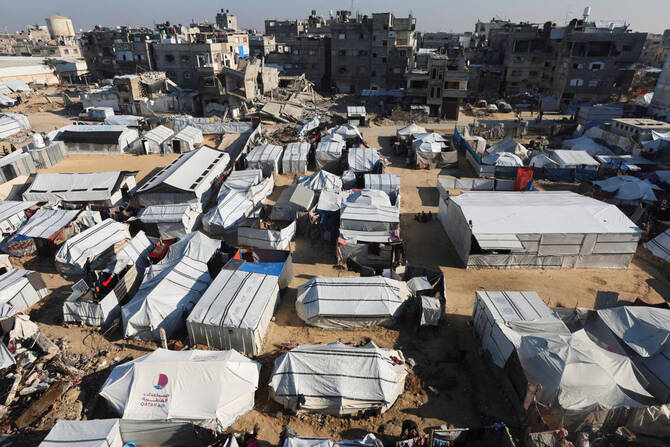
Tents sheltering displaced Palestinians amid harsh winter conditions, in Khan Younis, southern Gaza Strip. (Reuters)
Short Url
Updated 22 December 2025
Follow

Turkiye expects second phase of Gaza ceasefire to start early 2026

  • Foreign Minister Hakan ‌Fidan says priority is for Gaza’s governance to be taken over by a Palestinian-led group
  • Mediators the US, Egypt, Qatar and Turkiye met over the weekend in Miami to discuss progress

ANKARA: Turkiye expects the second phase ​of a Gaza ceasefire deal to begin early in 2026, ‌Foreign Minister Hakan ‌Fidan ‌said ⁠on ​Monday, ‌following talks with US, Qatari and Egyptian officials in Miami over ⁠the weekend.
Speaking at ‌a press ‍conference ‍in Damascus, ‍Fidan said the discussions focused on obstacles to ​advancing the deal to its next ⁠phase, adding that the priority was for Gaza’s governance to be taken over by a Palestinian-led group.
Representatives from the United ​States, Egypt, Qatar and Turkiye met on Friday in Miami to ‌review ‌the ‌next ⁠steps ​on ‌the Gaza ceasefire plan, according to a joint statement issued on ⁠Saturday by US ‌envoy Steve Witkoff.

A ceasefire took effect on Oct. 10 after a two-year Israeli offensive on Gaza, but the truce has been under intense pressure.

Israel has killed more than 400 people in the territory since it took effect and Hamas has also been accused of violating the agreement.

Along with a cessation of hostilities, the first phase of the truce deal included a ramping-up of much-needed aid supplies, and the return of Israeli hostages, including the deceased, and Palestinian prisoners.

The second phase is meant to see Israeli troops withdraw further, the establishing of an interim authority to govern the territory, the deployment of an international security force, and the disarming of Hamas.

The statement on Saturday from the mediating countries said the first phase of the agreement has led to progress in distributing humanitarian supplies, the return of hostages, partial force withdrawals, and a reduction in hostilities.

The talks on the second phase focussed on the new governing body in Gaza “to protect civilians and maintain public order,“ trade with neighboring countries, and infrastructure development.

The war, which started after a Hamas attack on southern Israel, led to an Israeli military campaign that killed more than 60,000 Palestinians and sparked a vast humanitarian crisis.

*With Reuters and AFP

Arab and Islamic states reject Israel’s recognition of Somaliland

Updated 28 December 2025
Follow

Arab and Islamic states reject Israel’s recognition of Somaliland

  • Israel formally recognized Somaliland as an “independent and sovereign state” on Friday
  • Saudi Arabia on Friday expressed full support for sovereignty, unity, territorial integrity of Somalia

A group of foreign ministers from Arab and Islamic countries, alongside the Organisation of Islamic Cooperation (OIC), have firmly rejected Israel’s announcement of its recognition of the Somaliland region within Somalia.

In a joint statement issued on Saturday, the ministers condemned Israel’s decision, announced on December 26, warning that the move carries “serious repercussions for peace and security in the Horn of Africa and the Red Sea region” and undermines international peace and security, the Jordan News Agency reported.

The statement described the recognition as an unprecedented and flagrant violation of international law and the charter of the United Nations, which uphold the principles of state sovereignty, unity and territorial integrity, JNA added.

Israel formally recognized Somaliland as an “independent and sovereign state” and signed an agreement to establish diplomatic ties, as the region’s leader hailed its first-ever official recognition.

The ministers reaffirmed their full support for the sovereignty of Somalia, rejecting any measures that would undermine its unity or territorial integrity.

They warned that recognizing the independence of parts of states sets a dangerous precedent and poses a direct threat to international peace and security.

The statement also reiterated categorical opposition to any attempt to link the move with plans to displace the Palestinian people outside their land, stressing that such proposals are rejected “in form and substance.”

Alongside the Jordanian foreign ministry, the joint statement was issued by the foreign ministers of Egypt, Algeria, Comoros, Djibouti, The Gambia, Iran, Iraq, Kuwait, Libya, Maldives, Nigeria, Oman, Pakistan, Palestine, Qatar, Somalia, Sudan, Turkiye and Yemen, as well as the OIC.

Saudi Arabia on Friday expressed full support for the sovereignty, unity, and territorial integrity of Somalia, and expressed its rejection of the declaration of mutual recognition between Israel and Somaliland.