Is the United States after Venezuela’s oil?

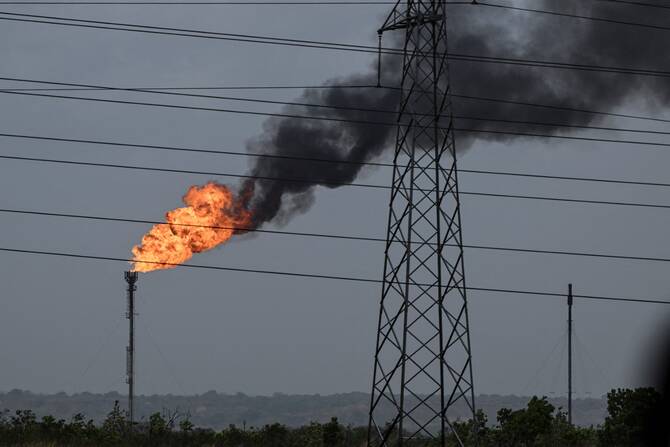
The flame from a chimney at an oil refinery is seen along the highway between El Furrial and Maturin in Monagas state, Venezuela, April 7, 2023. (AFP)
Short Url
Updated 23 December 2025
Follow

Is the United States after Venezuela’s oil?

  • Companies from the US have pumped Venezuelan crude from the first discoveries there in the 1920s
  • Venezuela exports about 500,000 barrels per day on the black market, mainly to China and other Asian countries

CARACAS: As US forces deployed in the Caribbean have zoned in on tankers transporting sanctioned Venezuelan oil, questions have deepened about the real motivation for Donald Trump’s pressure campaign on Caracas.
Is the military show of force really about drug trafficking, as Washington claims? Does it seek regime change, as Caracas fears? Could it be about oil, of which Venezuela has more proven reserves than any other country in the world?
“I don’t know if the interest is only in Venezuela’s oil,” Brazil’s leftist President Luiz Inacio Lula da Silva, who has offered to mediate in the escalating quarrel, said last week.
The US president himself has accused Venezuela of taking “all of our oil” and said: “we want it back.”
What we know:

- Oil ties -

Companies from the United States, now the world’s leading oil producer, have pumped Venezuelan crude from the first discoveries there in the 1920s.
Many US refineries were designed, and are still geared, specifically for processing the kind of heavy crude Venezuela has in spades.
Until 2005, Venezuela was one of the main providers of oil to the United States, with some monthly totals reaching up to 60 million barrels.
Things changed dramatically after socialist leader Hugo Chavez took steps in 2007 to further nationalize the industry, seizing assets belonging to US firms.

- And now? -

Down from a peak of more than three million barrels per day (bpd) in the early 2000s, Venezuela today produces about a million barrels per day — roughly two percent of the global total.
US firm Chevron extracts about 10 percent of the total under a special license.
Chevron is the only company authorized to ship Venezuelan oil to the United States — an estimated 200,000 barrels per day, according to a Venezuelan oil sector source.
The South American country’s domestic industry has declined sharply due to corruption, under-investment and US sanctions in place since 2019.
Analysts say the high investment required to rebuild Venezuela’s crumbling oil rigs would be unappetizing for US firms, given the steady global supply and low prices.
According to Carlos Mendoza Potella, a Venezuelan professor of petroleum economics, Washington’s actions were likely “not just about oil” but rather about the United States “claiming the Americas for itself.”
“It’s about the division of the world” between the United States and its rivals, Russia and China,” he added.
Venezuela exports about 500,000 barrels per day on the black market, mainly to China and other Asian countries, according to Juan Szabo, a former vice president of state oil company PDVSA.

- Blockade -

Trump on December 16 announced a blockade of sanctioned oil vessels sailing to and from Venezuela.
Days earlier, US forces seized the M/T Skipper, a so-called “ghost” tanker transporting over a million barrels of Venezuelan oil, reportedly destined for Cuba.
Washington has said it intends to keep the oil, valued at between $50 and $100 million.
Over the weekend, the US Coast Guard seized the Centuries, identified by monitoring site TankerTrackers.com as a Chinese-owned and Panama-flagged tanker.
An AFP review did not find the Centuries on the US Treasury Department’s sanctions list, but the White House said it “contained sanctioned PDVSA oil” — some 1.8 million barrels of it.
On Sunday, officials said the Coast Guard was pursuing a third tanker, identified by news outlets as the Bella 1 — under US sanctions because of alleged ties to Iran.
The PDVSA insists its exports remain unaffected by the blockade.
This was critical, according to Szabo, as the company only has capacity to store oil for several days if exports stop.

- Impact -

Whatever Trump’s goal with Venezuelan oil, the blockade, if it continues, is likely to scare off shipping companies and push up freight rates.
Szabo expects Venezuela’s oil exports will fall by nearly half in the coming months, slashing critical foreign currency income from Venezuela’s black market sales.
This would asphyxiate the already struggling economy of Venezuela, piling more pressure on Nicolas Maduro.
The Trump administration has tip-toed around explicitly demanding for Maduro to leave.
While Trump has said he does not anticipate “war” with Venezuela, he did say Maduro’s days “are numbered.”
US Homeland Security Secretary Kristi Noem told Fox News on Monday that the oil tanker seizures send “a message around the world that the illegal activity that Maduro’s participating in cannot stand, he needs to be gone.”


US signs new health deals with 9 African countries that mirror Trump’s priorities

A pharmacist counts HIV medicine inside a clinic in Ha Lejone, Lesotho, July 16, 2025. (AP)
Updated 4 sec ago
Follow

US signs new health deals with 9 African countries that mirror Trump’s priorities

  • US aid cuts have crippled health systems across the developing world, including in Africa, where many countries relied on the funding for crucial programs, including those responding to outbreaks of disease
  • The agreements signed so far, with Kenya, Nigeria and Rwanda among others, are the first under the new global health framework, which makes aid dependent on negotiations between the recipient country and the US

JOHANNESBURG: The US government has signed health deals with at least nine African countries, part of its new approach to global health funding, with agreements that reflect the Trump administration’s interests and priorities and are geared toward providing less aid and more mutual benefits.
The agreements signed so far, with Kenya, Nigeria and Rwanda among others, are the first under the new global health framework, which makes aid dependent on negotiations between the recipient country and the US.
Some of the countries that have signed deals either have been hit by US aid cuts or have separate agreements with the Trump administration to accept and host third-country deportees, although officials have denied any linkage.
The Trump administration says the new “America First” global health funding agreements are meant to increase self-sufficiency and eliminate what it says are ideology and waste from international assistance. The deals replace a patchwork of previous health agreements under the now-dismantled United States Agency for International Development.
US aid cuts have crippled health systems across the developing world, including in Africa, where many countries relied on the funding for crucial programs, including those responding to outbreaks of disease.
The new approach to global health aligns with President Donald Trump’s pattern of dealing with other nations transactionally, using direct talks with foreign governments to promote his agenda abroad. It builds on his sharp turn from traditional US foreign assistance, which supporters say furthered American interests by stabilizing other countries and economies and building alliances.
A different strategy
The deals mark a sharp departure from how the US has provided health care funding over the years and mirrors the Trump administration’s interests.
South Africa, which has lost most of its US funding — including $400 million in annual support — due in part to its disputes with the US, has not signed a health deal, despite having one of the world’s highest HIV prevalence rates.
Nigeria, Africa’s most populous country, reached a deal but with an emphasis on Christian-based health facilities, although it has a slight majority Muslim population. Rwanda and Uganda, which each have deportation deals with the US, have announced the health pacts.
Cameroon, Eswatini, Lesotho, Liberia and Mozambique also are among those that have signed health deals with the US
According to the Center for Global Development, a Washington think tank, the deals “combine US funding reductions, ambitious co-financing expectations, and a shift toward direct government-to-government assistance.”
The deals represent a reduction in total US health spending for each country, the center said, with annual US financial support down 49 percent compared with 2024.
A faith-based deal in Nigeria, a lifeline for several others

Under its deal, Nigeria, a major beneficiary of USAID funds, would get support that has a “strong emphasis” on Christian faith-based health care providers.
The US provided approximately $2.3 billion in health assistance to Nigeria between 2021 and 2025, mostly through USAID, official data shows. The new five-year agreement will see US support at over $2 billion, while Nigeria is expected to raise $2.9 billion to boost its health care programs.
The agreement “was negotiated in connection with reforms the Nigerian government has made to prioritize protecting Christian populations from violence and includes significant dedicated funding to support Christian health care facilities,” the State Department said in a statement.
The department said “the president and secretary of state retain the right to pause or terminate any programs which do not align with the national interest,” urging Nigeria to ensure “that it combats extremist religious violence against vulnerable Christian populations.”
For several other countries, the new deals could be a lifeline after US aid cuts crippled their health care systems and left them racing to fill the gaps.
Under its deal, Mozambique will get US support of over $1.8 billion for HIV and malaria programs. Lesotho, one of the poorest countries in the world, clinched a deal worth over $232 million.
In the tiny kingdom of Eswatini, the US committed to provide up to $205 million to support public health data systems, disease surveillance and outbreak response, while the country agreed to increase domestic health expenditures by $37 million.
No deal for South Africa after disputes
South Africa is noticeably absent from the list of signatories following tensions with the Trump administration.
Trump has said he will cut all financial assistance to South Africa over his widely rejected claims that it is violently persecuting its Afrikaner white minority.
The dismantling of USAID resulted in the loss of over $436 million in yearly financing for HIV treatment and prevention in South Africa, putting the program and thousands of jobs in the health care industry at risk.
Health compacts with countries that signed deportation deals
At least four of the countries that have reached deals previously agreed to receive third-country deportees from the US, a controversial immigration policy that has been a trademark of the Trump administration.
The State Department has denied any linkage between the health care compacts and agreements regarding accepting third-country asylum seekers or third-country deportees from the United States. However, officials have said that political considerations unrelated to health issues may be part of the negotiations.
Rwanda, one of the countries with a deportation deal with the US, signed a $228 million health pact requiring the US to support it with $158 million.
Uganda, another such country, signed a health deal worth nearly $2.3 billion in which the US will provide up to $1.7 billion. Also Eswatini, which has started receiving flights with deported prisoners from the US