


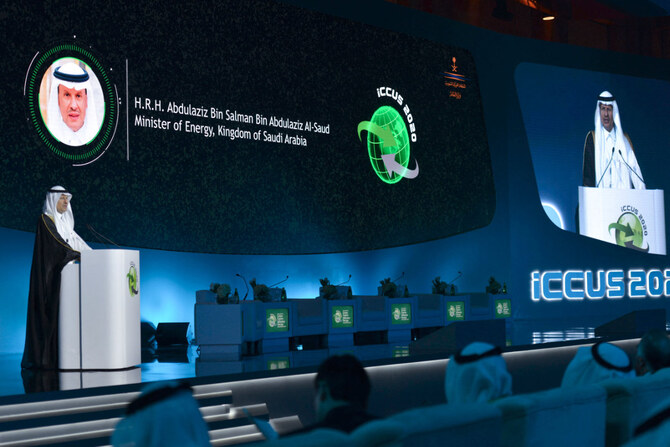

RIYADH: Saudi Arabia’s oil and gas industry is increasingly adopting carbon capture technologies to reduce industrial emissions while enhancing oil recovery. This approach addresses environmental concerns while supporting global demand for cleaner, more reliable energy.
Carbon capture technologies are methods to trap and store carbon dioxide — or CO2 — emissions before they reach the atmosphere, helping to reduce greenhouse gases from industrial processes, power plants and other sources.
As a leading oil producer, Saudi Arabia acknowledges its responsibility to combat climate change while maintaining energy security. Its efforts align with Vision 2030, which prioritizes economic diversification and reducing reliance on oil, paving the way to net-zero emissions by 2060.

And in line with this target, the Kingdom aims to reach 44 million tonnes per annum of carbon capture, use and storage capacity by 2035.
To this end, institutions such as the King Abdullah University of Science and Technology are making significant advancs in carbon capture and storage, driving innovation in sustainable energy solutions.
“Saudi Arabia’s investment in carbon capture technologies is driven by its Vision 2030 strategy, which aims to diversify its economy and reduce its reliance on oil,” William L. Roberts, professor of mechanical engineering at KAUST and member of the Clean Energy Research Platform, told Arab News.
“Carbon capture enables Saudi Arabia to reduce emissions from its hydrocarbon sector while supporting global demand for cleaner, affordable, reliable energy.”
Opinion
This section contains relevant reference points, placed in (Opinion field)
KAUST has partnered with major industry stakeholders, including the Saudi Electricity Company, the Ministry of Energy and NEOM, to develop innovative carbon capture solutions, including a 30-tonne-per-day CO2 capture initiative at the Duba power plant.
The pilot project, launched in 2022, aims to capture 30 tonnes of CO2 daily from SEC’s Green Duba Integrated Solar Combined Cycle power plant at NEOM.
The integration of captured CO2 for enhanced oil recovery offers an important opportunity for the oil and gas sector. In this process, supercritical CO2 is injected into reservoirs, changing the physical properties of residual oil and making extraction easier.
This not only boosts production efficiency but also supports a more sustainable approach to energy extraction.
The Carbon Dioxide Enhanced Oil Recovery Demonstration Project at the Uthmaniyah oil field is a prime example of this technique. Located in the Eastern Province, the large-scale project captures and stores about 800,000 tonnes of CO2 annually from a natural gas production facility, with CO2 transported via a 85-km pipeline to the injection site.
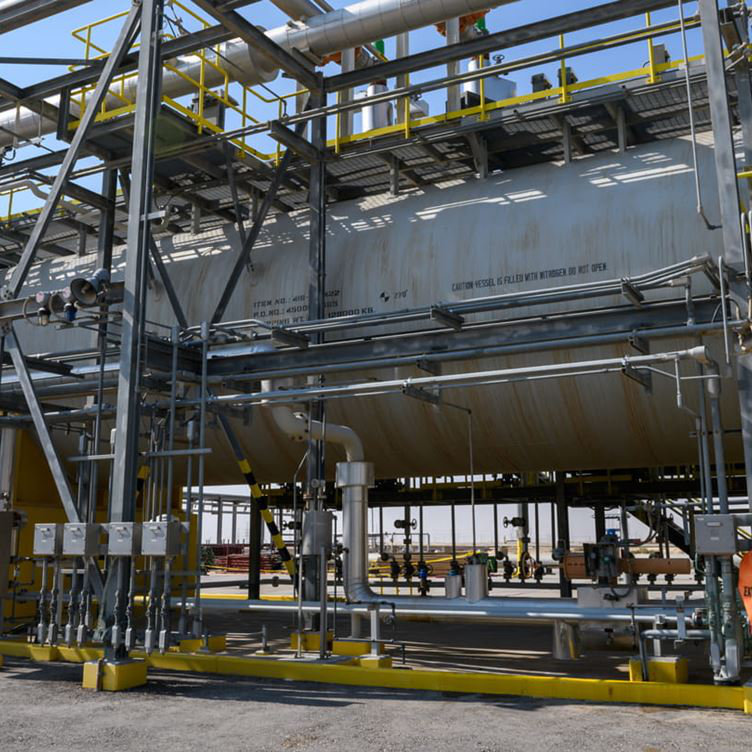
Saudi Aramco's project at the Uthmaniyah oil field in Al-Ahsa captures and stores about 800,000 tonnes of CO2 annually from a natural gas production facility. (Aramco photo)
Roberts of KAUST stressed the importance of careful management in these projects. “Monitoring CO2 injection to prevent leakage and optimizing injection rates is crucial for balancing production efficiency with environmental safety,” he said.
And although the potential benefits of carbon capture are clear, the industry faces significant challenges, including high costs and scalability.
A 2025 study published in the Carbon Capture Science and Technology journal shows that the average CO2 capture cost is $69 per tonne, with significant variability across industries. Ammonia production is the most cost-efficient, at $11 per tonne, due to its high CO2 concentration, while smaller-scale operations can face costs as high as $189 per tonne.
Emphasizing the need for a collective effort to overcome challenges, Roberts said that “collaborative research and pilot projects help to drive innovation and enable scalable, economically viable solutions for industrial carbon capture applications.”
Looking ahead, further advances in carbon capture technologies are on the horizon.
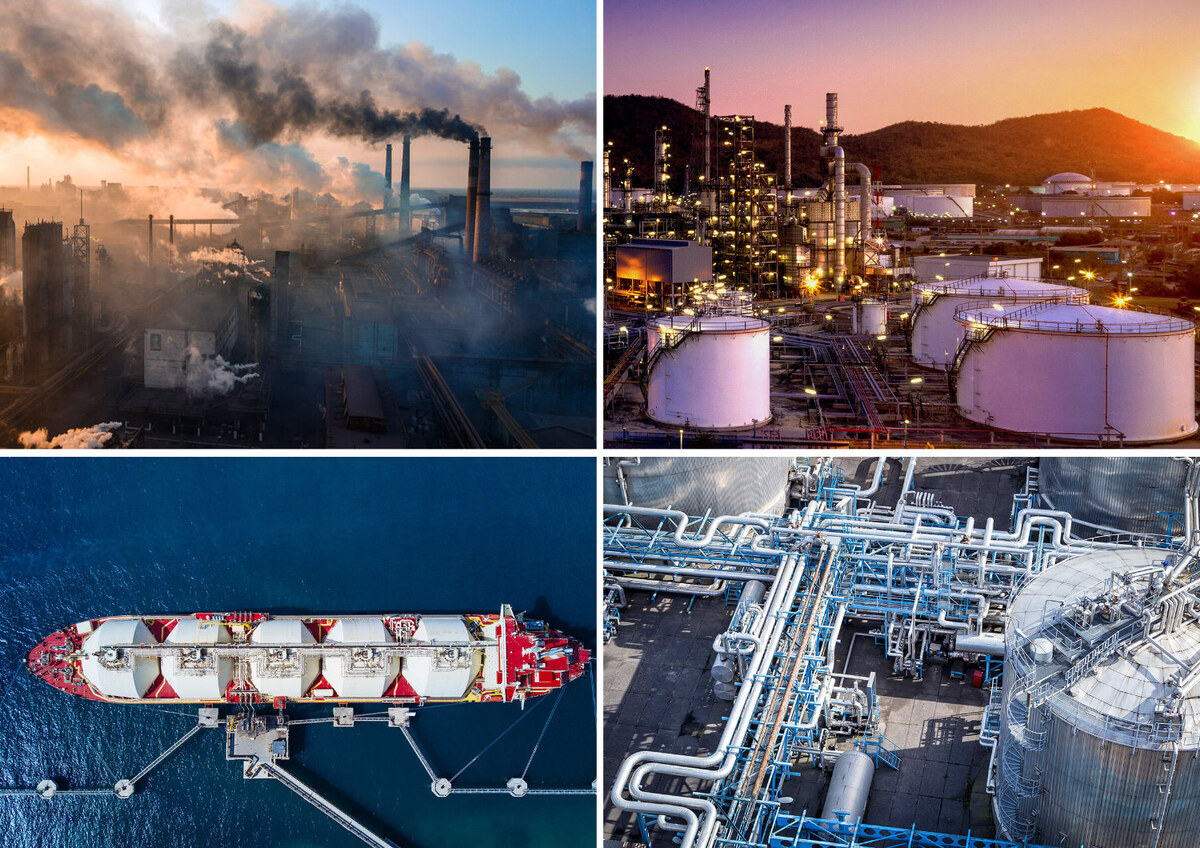
KAUST’s cryogenic carbon capture project is a promising technology that removes CO2 at low temperatures, offering high efficiency and scalability. (KAUST photos)
KAUST’s research group is actively exploring cryogenic carbon capture, a promising technology that removes CO2 at low temperatures, offering high efficiency and scalability.
Roberts said that relying on a single technology would not be enough to meet ambitious environmental goals.
“A diverse portfolio of solutions — including cryogenic capture, direct air capture, advanced membranes and chemical absorption — will be necessary to address emissions across various sectors,” he said.
This approach will lead to more flexible, cost-effective and sustainable carbon capture solutions, significantly reducing CO2 emissions.
KAUST plays a crucial role in educating the next generation of engineers and scientists to advance carbon capture technologies. The university offers specialized programs in sustainability and carbon capture, equipping students with the skills needed to address key challenges in CO2 capture, storage and use.
DID YOU KNOW?
• Industrial sources are responsible for nearly 30 percent of global greenhouse gas emissions.
• Carbon capture can reduce up to 90 percent of CO2 emissions from industrial sources.
•. Saudi Arabia aims for 44 million tonnes of carbon capture, use and storage capacity a year by 2035.
Roberts said that a holistic approach was key to fostering innovation and ensuring the successful implementation of carbon capture solutions.
“While carbon capture is essential for reducing industrial emissions, it must be part of a broader, multi-technology strategy to meet global emissions reduction targets,” he said.
Roberts advises policymakers and industry leaders to “focus on a technology-driven approach that prioritizes scalability, efficiency and cost-effectiveness.”
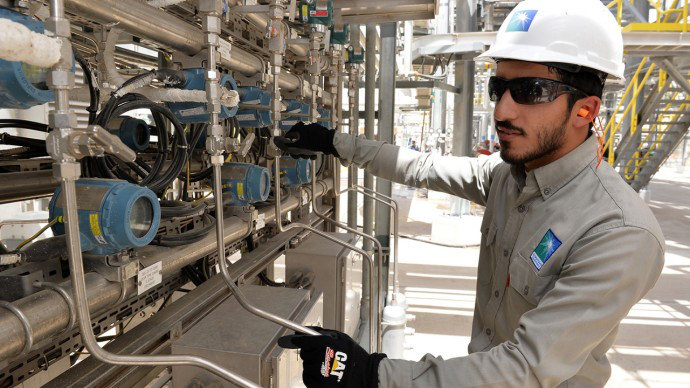
As a leading oil producer, Saudi Arabia acknowledges its responsibility to combat climate change while maintaining energy security. (Aramco photo)
He also emphasized the need for investment in experimentation and predictive modeling to avoid potential pitfalls at large scale and called for continued support for research into innovative CO2 capture methods.
“There isn’t one answer, and we need to identify as many solutions as possible,” he said.
Roberts advocates using pilot projects as platforms to optimize technologies before large-scale implementation.
He stressed the need for collaboration between research institutions, industry and government to align policies with technological advancements.
In addition, he said that establishing clear regulatory frameworks that incentivized carbon capture deployment was crucial to making these technologies economically viable and integrating them into industrial practices.


