

How Saudi Arabia is preserving its precious freshwater resources

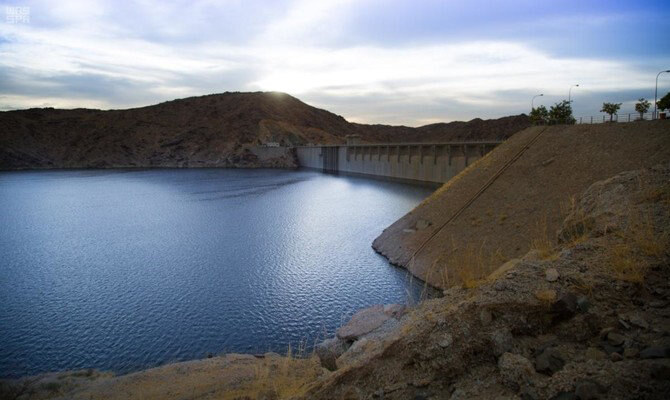
King Fahd Dam, located in Bisha governorate, Asir province, is one of the largest concrete dams in the Middle East. Saudi Arabia is increasing the amount of rainwater harvesting through new dams and efficiently managing existing dams to allocate water to agriculture. ()SPA)
Short Url
Updated 01 February 2025
Follow

How Saudi Arabia is preserving its precious freshwater resources

  • Vision 2030 prioritizes sustainable water management through conservation programs, advanced irrigation, and public awareness initiatives
  • US firm Ecolab partners with Saudi companies like Aramco to develop water-saving technologies and improve resource management

RIYADH: Water scarcity is a pressing issue in Saudi Arabia, significantly impacting the country’s socio-economic development as well as its environmental sustainability.

As one of the hottest and driest regions in the world, the Kingdom faces many challenges owing to its limited natural freshwater sources and high rates of evaporation.

These harsh realities have forced the country to rely on limited groundwater and desalination plants, where 75 percent of the country’s water supply comes from.

However, the nature of the desalination process raises concerns about environmental sustainability and carbon emissions due to the amount of energy used by these technologies.

In addition, the over-extraction of groundwater for agricultural and domestic use could exhaust natural aquifers and deteriorate water quality.

This realization has pushed officials to explore solutions to develop the water sector in order to meet the needs of the Kingdom’s growing population.

Opinion

This section contains relevant reference points, placed in (Opinion field)

Saudi Arabia’s Vision 2030 reform agenda emphasizes green development, and sustainable water sources are a key aspect of the plan.

To achieve this objective, the Kingdom is collaborating with foreign companies including the US firm Ecolab to mitigate the severity of water loss.

Christophe Beck, chairman and CEO of Ecolab, outlined some of the company’s strategies to preserve water while reducing energy usage.

“In 2024, we helped preserve enough water for 800 million people, and we are on the path to 1 billion by 2030,” Beck told Arab News.

“We have built our capabilities around the world because of the science we have at our disposal. We have 3,000 people in research and development and digital technology.



Ecolab has been operating in Saudi Arabia for 47 years, collaborating with local firms in managing water supplies, combating potential pollutants and infections, and on human and natural resource protection. (Supplied)



Ecolab employs around 3,000 people in research and development and digital technology to run its operations in 40 different industries across 172 countries. (Supplied)

Ecolab operates in 40 different industries across 172 countries, managing water supplies, combating potential pollutants and infections, and focusing on human and natural resource protection.

The company has been operating in Saudi Arabia for 47 years, collaborating with local firms such as Saudi Aramco, SABIC, and Almarai.

“This country has a lot of natural resources and a lot of ambition. But one thing is missing — water. There are no lakes, no rivers, but there is a lot of sea around us. However, this is not freshwater. That’s a big challenge,” said Beck.
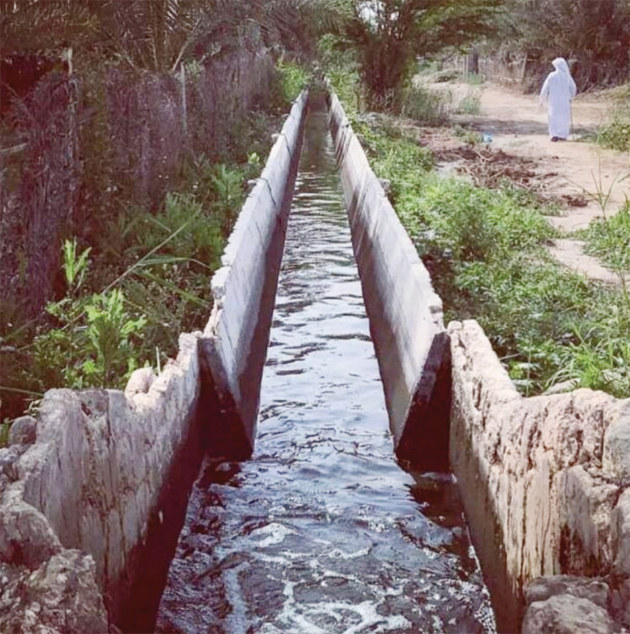


In the oases of Al-Ahsa in Saudi Arabia’s Eastern Province, scientists have found that traditional farming techniques stretching back centuries helped preserve one of the region’s green gems. (Supplied)

The necessity to preserve freshwater has led the Kingdom to introduce water conservation programs, along with promoting efficient irrigation technologies and enhancing public awareness about water usage.

In addition, the National Water Co. has completed several operations to ensure easy access to fresh water for all in any location within Saudi Arabia, including rural areas.

NWC distributed more than 3.7 billion cubic meters of water during the past year in various regions of the Kingdom and treated more than 2.1 billion cubic meters of wastewater during the same year.

DID YOUKNOW?

• Ecolab operates in 172 countries, including Singapore, Saudi Arabia, South Korea, and Taiwan.

• 10% of animal species rely on freshwater ecosystems, according to Nature Conservancy Canada.

• Two-thirds of the world’s population experiences water shortages at least once a year, according to WWF.

However, achieving water security will require a holistic approach that integrates technology, media, and community engagement.

“Awareness helps, as does realizing that no one can solve it alone,” said Beck.

“When I think about Saudi Arabia, I think we have all we need. The natural resources, the industries, the means, and the ambition. But we don’t have water, and we have too few water experts who know how to reuse or recycle water to power the future industries of the Kingdom.

“What I hope to accomplish in Saudi Arabia, and again, we’ve been here for 47 years, is really thinking in the long term, to turn Saudi Arabia into an example of a country that can grow without using more water at the same time.
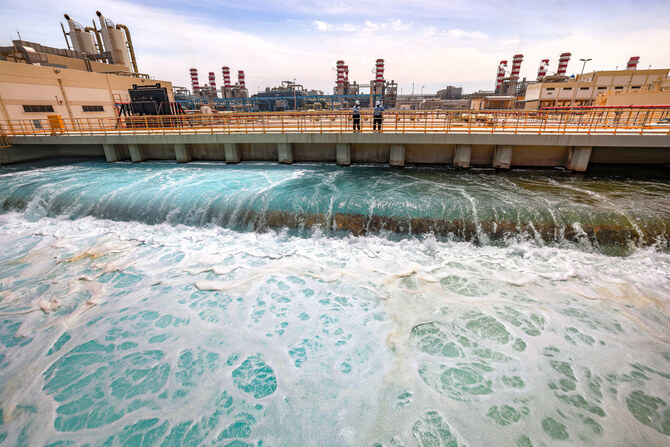


General view of the Ras al-Khair water desalination plant, owned by the Saudi government's Saline Water Conversion Corporation, along the Gulf coast in eastern Saudi Arabia. (AFP)

“And if Saudi Arabia can do it, many countries around the region can do it, and around the world as well.”

Addressing water scarcity is crucial for ensuring the long-term viability of Saudi Arabia’s economy and overall quality of life.

Without significant and immediate action, the challenges associated with water scarcity and with the increasing heat conditions and drought worldwide, are likely going to intensify not only for Saudi Arabia but for several other countries in the region in the coming years.


Surviving the sands: The battle to save Arabian wolves

Updated 13 December 2025
Follow

Surviving the sands: The battle to save Arabian wolves

  • Exploring the wolf’s role in Arabia’s heritage and ecosystem

RIYADH: Wolves are often portrayed in Western stories and films as dangerous, unpredictable predators. In contrast, Arabic perspectives offer a more nuanced view. 

In Saudi Arabia, wolves are admired for their resilience, intelligence, and role in the natural environment. The Arabian wolf, or Canis lupus arabs, is one of the Peninsula’s iconic native predators. 

For centuries, it shaped both ecological and cultural landscapes across Saudi Arabia. However, its population declined in recent decades. Today, conservation efforts led by the National Center for Wildlife aim to protect and restore this species.

Saudi regulations now make it illegal to display, sell, or transport wolves without authorization. NCW’s initiatives include studying wolf genetics, developing breeding programs to restore wild populations, raising public awareness, and imposing fines of up to SR80,000 ($22,000) for unlicensed hunters.

The Arabian wolf, or Canis lupus arabs, is one of the Arabian Peninsula’s iconic native predators. (SPA)

The Arabian wolf is a symbol of the desert and an important component of the Kingdom’s biodiversity. Historically, it inhabited deserts, mountains, and valleys across Saudi Arabia, Yemen, and Oman. Unlike wolves from colder regions, it evolved to survive extreme heat, scarce water, and fluctuating prey populations.

“Saudi Arabia’s vast and diverse ecosystems have enabled many wildlife species to thrive, including the Arabian wolf,” NCW notes. The wolf historically helped control populations of rodents, small mammals, and weak or diseased animals, maintaining a balanced ecosystem.

However, the shift from nomadic life to urban settlements and agriculture, alongside expanding human activity, put increasing pressure on the species. 

Habitat loss, conflicts with herders, and hunting practices significantly reduced their natural range. NCW records show numerous cases of injured wolves rescued and rehabilitated, highlighting the challenges they face today.

DID YOU KNOW?

• In Saudi Arabia, hunting wolves without a proper license can result in fines of up to SR80,000.

• Mexican wolves, locally known as ‘El Lobo,’ are critically endangered, despite ongoing reintroduction efforts.

• While recent figures for Saudi Arabia’s wolf population are not available, a 2004 report estimated their numbers at 500-600.

Culturally, the Arabian wolf is admired and feared in equal measure. In Bedouin tradition, it symbolizes independence and intelligence, appearing in poetry and oral stories.

“Two cultures in the world share a similar view of the wolf: Native American and Arab cultures,” said Obaid Alouni, a Saudi environmentalist. “They admired wolves and respected wolves. For example, when they see a wolf and someone has a gun, they don’t kill it even though they could,” he added.

Alouni explained that despite being predators, wolves coexisted with humans in the Arabian Peninsula: “There was a kind of coexistence in the Arabian Peninsula.” Yet livestock owners often feared wolves for preying on sheep and goats, creating a tense relationship between humans and wolves.

This dual perception shaped the wolf’s role in cultural metaphors: it was seen as a mirror of the desert itself — tough, resilient, and adaptable. “Arabs have always sought positive qualities in wolves. For example, one of their characteristics is that wolves understand their pack and sacrifice themselves for them. They do not betray their pack and fight for it, in addition to their loyalty to it,” Alouni explained.

Protecting wolves is crucial for maintaining healthy ecosystems. Their presence influences herbivore behavior, supporting a balanced environment. (SPA)

Physically, the Arabian wolf is one of the smallest gray wolf subspecies, adapted to desert life. It weighs 18-25 kilograms and measures 100-110 cm in length. Its large ears reduce heat, a light sandy-gray coat reflects sunlight and camouflages it in the desert, and its diet includes small mammals, birds, and occasionally livestock.

Sadly, the Arabian wolf is classified as endangered due to habitat loss, human conflict, and historical hunting. Alouni noted that hybridization has further reduced the population of purebred Arabian wolves: “Unfortunately, a species is now being circulated that is not the true size of the Arabian wolf. The National Center for Wildlife is currently conducting extensive research to learn more about the Arabian wolf and its true size. The species currently prevalent is shorter in stature.”

Other wolf subspecies include the Gray Wolf, found in North America, Europe, and Asia. It weighs 30–80 kilograms, measures up to 180 cm in length, and is known for its complex social packs. 

Opinion

This section contains relevant reference points, placed in (Opinion field)

The Arctic Wolf, native to Arctic Canada and Greenland, has a thick white coat, short snout and ears, and survives extreme cold, preying on musk oxen, Arctic hares, and caribou. 

The Indian Wolf, scientifically known as Canis lupus pallipes, inhabits South and West Asia, weighs 20-30 kilograms, and forms small, stealthy packs. 

Finally, the Ethiopian wolf is fox-like, inhabits highlands above 3,000 meters, weighs 13–18 kilograms, and has a reddish coat with white markings. It is one of the world’s rarest wolves, with fewer than 500 individuals in the wild.

Protecting wolves is crucial for maintaining healthy ecosystems. As apex predators, they regulate prey populations, prevent overgrazing, maintain plant diversity, and reduce disease spread by feeding on sick or weak animals. Their presence influences herbivore behavior, supporting a balanced environment.

The Arabian wolf is more than a desert predator. It is a cultural symbol, a survivor of harsh landscapes, and a vital component of Saudi Arabia’s ecological identity. The work of the NCW is essential: protecting the Arabian wolf means conserving biodiversity, preserving heritage, and sustaining ecological systems across the Arabian Peninsula.