

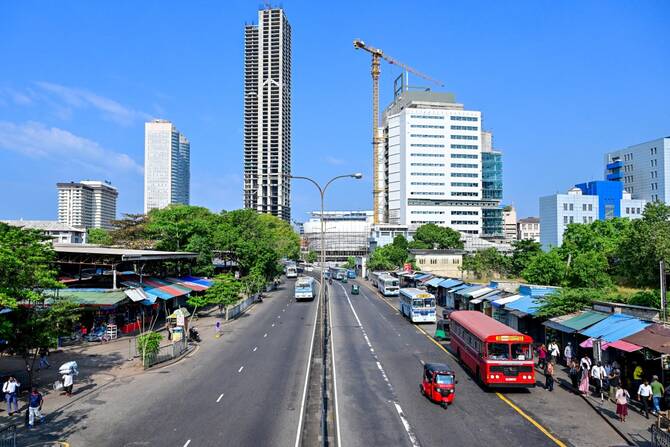

Colombo: Sri Lanka’s public‑sector workers stayed home on Wednesday as the government introduced a mid‑week break to help manage fuel shortages triggered by the US‑Israeli war on Iran.
The new workweek was announced on Monday by the Commissioner General of Essential Services Prabath Chandrakeerthi and applies to sectors such as education, administration and public transportation. State institutions providing essential services such as healthcare will operate normally.
Chandrakeerthi told reporters after an emergency Cabinet meeting that the government will ask the private sector to “follow suit and declare every Wednesday a holiday from now on.”
Sri Lanka imports all of its oil, and supplies have been disrupted after the US and Israel attacked Iran on Feb. 28, leading to the effective closure of the Strait of Hormuz — the main gateway for Asia’s fuel imports from the Middle East.
The mid-week break follows the introduction of weekly fuel rations under a QR code system, allowing 15 liters for cars and 5 liters for motorcycles to prevent hoarding.
Authorities picked Wednesday instead of Friday so that government offices would not be closed for three days in a row.
“Practically, we will get a holiday after every two working days,” Shrini Seneviratne, a ministry employee, told Arab News.
While for her it was convenient as with fuel caps, “taxis are charging exorbitant fares,” those working in the education sector were already noticing a problem.
“Students are used to a continuous five-day week, and an in-between holiday may disrupt their routine,” said Silmiya Yousuf, a schoolteacher in Colombo.
“It is necessary for the government to enforce this holiday to conserve fuel stocks, but a mid-week break will inevitably affect workflow, children’s studies, and their daily schedule.”
It is not the first time the island nation of 22 million gets an additional day off to conserve energy. A similar measure was introduced in 2022, with Fridays designated as a public holiday, when Sri Lanka defaulted and ran out of its foreign reserves needed to buy crude.
While not ideal, the additional holiday is a way to fend off the initial shock from the situation in the Middle East.
“Policy space is extremely limited. In that context, measures like declaring Wednesdays as holidays, while imperfect, have a clear rationale,” Murtaza Jafferjee, economist and chairman of the Advocata Institute think tank, told Arab News.
“Sri Lanka is facing a perfect storm driven by external shocks. Fuel alone accounts for about 15 percent of current account outflows, while exposure to the Middle East is deep — about 35 percent of tea exports, 70 percent of remittances, and a significant share of tourism flows depend on the region.”
Sri Lanka already has one of the highest numbers of public holidays — around 23 annually —and adding Wednesdays as partial holidays further increases the total and will affect the economic outlook.
“Over the next month, the calendar is further crowded by major festivals — Eid, Easter, and Sinhala and Tamil New Year,” Jafferjee said.
“The result is a clear drag on economic activity, with first-quarter growth set to come in lower than it otherwise would have.”


