

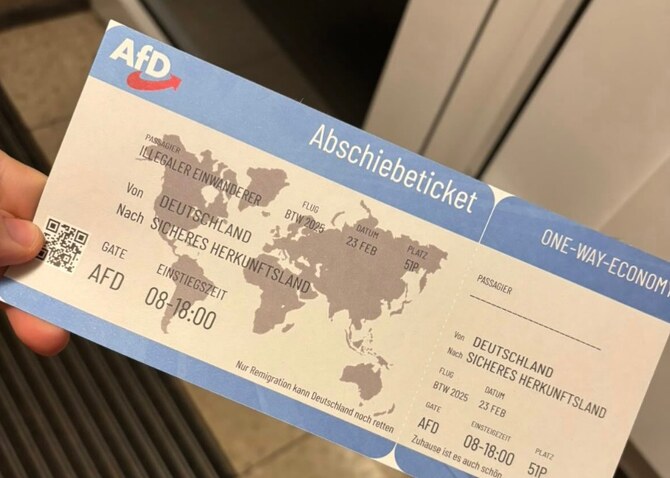
Germany's far-right AfD sends out mock plane tickets for migrants

German police said Tuesday they are investigating after the far-right AfD distributed election campaign flyers in the style of one-way plane tickets to send migrants home. (X/@clashreport)
Short Url
Updated 14 January 2025
Follow

Germany's far-right AfD sends out mock plane tickets for migrants

  • The flyers are labelled "Deportation Ticket" and feature the passenger’s name as "Illegal Immigrant" and the destination as "Safe Country of Origin"
  • Several migrants have posted on social media about receiving the tickets over the past few days

BERLIN: German police said Tuesday they are investigating after the far-right AfD distributed election campaign flyers in the style of one-way plane tickets to send migrants home.
The flyers are labelled "Deportation Ticket" and feature the passenger’s name as "Illegal Immigrant" and the destination as "Safe Country of Origin".
AfD campaign demands -- such as cutting benefits for non-Germans and an end to "Islamisation" -- are also listed on the flyers distributed in the southwestern city of Karlsruhe.
Several migrants have posted on social media about receiving the tickets over the past few days, although the AfD has denied specifically sending them to foreigners.
The campaign has sparked a backlash in Germany, with critics comparing the stunt to the one-way tickets to Jerusalem that were distributed by the Nazis in the 1930s.
A Karlsruhe police spokesman told AFP an investigation had been launched into the possible charge of incitement to hatred after a tip-off from a member of the public.

The AfD in Karlsruhe has said in a statement that the flyers were being distributed in the city "in as large a number as possible and without any special requirements or restrictions".
"It is intended to bring our demands in this area, which are fully in line with the law, to the attention of the voters," it said.
The AfD has been buoyed ahead of Germany's election on February 23 after winning the endorsement of US tech billionaire Elon Musk.
One survey at the weekend had the party polling at 22 percent, just eight points behind the CDU/CSU conservatives who are widely expected to lead the next government.
Emboldened by the support of Musk, the imminent return of Donald Trump to the White House and events in neighbouring Austria -- where the far right is on the brink of power -- the AfD has been sharpening its rhetoric as the election campaign heats up.
At a party congress last weekend, the AfD's top candidate Alice Weidel explicitly called for the "remigration" of foreigners.
Marcel Bauer, a parliamentary candidate for the far-left Die Linke, accused the AfD of using "fascist methods to incite hatred".
"This threat against our fellow citizens must have consequences," he said.


Youth voters take center stage in Bangladesh election after student-led regime change

Updated 38 min 40 sec ago
Follow

Youth voters take center stage in Bangladesh election after student-led regime change

  • About 45% of Bangladeshis eligible to vote in Thursday’s election are aged 18-33
  • Election follows 18 months of reforms after the end of Sheikh Hasina’s 15-year rule

DHAKA: When he goes to the polls on Thursday, Atikur Rahman Toha will vote for the first time, believing that this election can bring democratic change to Bangladesh.

A philosophy student at Dhaka University, Toha was already eligible to vote in the 2024 poll but, like many others, he opted out.

“I didn’t feel motivated to even go to vote,” he said. “That was a truly one-sided election. The election system was fully corrupted. That’s why I felt demotivated. But this time I am truly excited to exercise my voting rights for the first time.”

The January 2024 vote was widely criticized by both domestic and international observers and marred by a crackdown on the opposition and allegations of voter fraud.

But the victory of the Awami League of ex-Prime Minister Sheikh Hasina was short-lived, as a few months later the government was ousted by a student-led uprising, which ended the 15-year rule of Bangladesh’s longest-serving leader.

The interim administration, led by Nobel laureate Muhammad Yunus, took control in August 2024 and prepared a series of reforms to restructure the country’s political and institutional framework and organize the upcoming vote.

About 127.7 million Bangladeshis are eligible to cast their ballots, according to Election Commission data, with nearly a third of them, or 40.4 million, aged 18-29. Another 16.9 million are 30-33, making it a youth–dominated poll, with the voters hopeful the outcome will help continue the momentum of the 2024 student-led uprising.

“We haven’t yet fully transitioned into a democratic process. And there is no fully stable situation in the country,” Toha said. “After the election we truly hope that the situation will change.”

For Rawnak Jahan Rakamoni, also a Dhaka University student, who is graduating in information science, voting this time meant that her voice would count.

“We are feeling that we are heard, we will be heard, our opinion will matter,” she said.

“I think it is a very important moment for our country, because after many years of controversial elections, people are finally getting a chance to exercise their voting rights and people are hoping that this election will be more meaningful and credible. This should be a fair election.”

But despite the much wider representation than before, the upcoming vote will not be entirely inclusive in the absence of the Awami League, which still retains a significant foothold.

The Election Commission last year barred Hasina’s party from contesting the next national elections, after the government banned Awami League’s activities citing national security threats and a war crimes investigation against the party’s top leadership.

The UN Human Rights Office has estimated that between July 15 and Aug. 5, 2024 the former government and its security and intelligence apparatus, together with “violent elements” linked to the Awami League, “engaged systematically in serious human rights violations and abuses in a coordinated effort to suppress the protest movement.”

It estimated that at least 1,400 people were killed during the protests, with the majority shot dead from military rifles.

Rezwan Ahmed Rifat, a law student, wanted the new government to “ensure justice for the victims of the July (uprising), enforced disappearances, and other forms of torture” carried out by the previous regime.

The two main parties out of the 51 contesting Thursday’s vote are the Bangladesh Nationalist Party and Jamaat-e-Islami. Jamaat, which in 2013 was banned from political participation by Hasina’s government, heads an 11-party alliance, including the National Citizen Party formed by student leaders from the 2024 movement.

“I see this election as a turning point of our country’s democratic journey … It’s not just a normal election,” said Falguni Ahmed, a psychology student who will head to the polls convinced that no matter who wins, it will result in the “democratic accountability” of the next government.

Ahmed added: “People are not voting only for their leaders; they are also voting for the restoration of democratic credibility. That’s why this election is very different.”