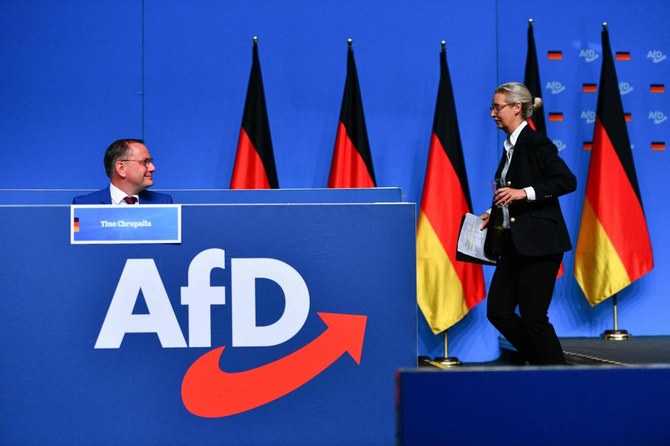
ESSEN, Germany: Clashes between hooded demonstrators and police on Saturday marked the start of a party congress of Germany’s far-right AfD, weeks after it scored record EU election results despite multiple scandals.
About 1,000 police deployed in the western city of Essen as around 600 delegates began a two-day meeting with authorities expecting up to 80,000 people to join demonstrations.
“Several disruptive violent actions occurred in the Ruettenscheld quarter. Demonstrators, some of them hooded, attacked security forces. Several arrests were made,” the police of North Westphalia, where Essen is located, said on X.
A top regional official had warned that “potentially violent far-left troublemakers” could be among the protesters.
“We are here and we will stay,” said AfD co-president Alice Weidel, opening the congress and drawing sustained applause.
“We have the right like all political parties — to hold a congress,” she added.
Adding to the security forces’ headache is the Euro 2024 football tournament, with the last 16 clash between hosts Germany and Denmark taking place Saturday in Dortmund — not far from Essen.
In early June the Alternative for Germany (AfD) notched up its best European Union election result since its creation in 2013, winning 16 percent of the vote to take second place.
It was behind the main conservative CDU-CSU opposition bloc but ahead of Chancellor Olaf Scholz’s Social Democrats (SPD), which is in power at the head of a troubled three-party coalition.
Buoyed by a surge in immigration and a weak performance by Europe’s top economy, the party hit as high as 22 percent in opinion polls in January.
However their support faltered amid a welter of scandals that mainly implicated their top EU election candidate, Maximilian Krah.
“I believe that the party has learnt a lot in recent months and will be very careful when we put forward leading candidates in the future,” party co-president Weidel, who is standing for re-election, told the Politico news outlet Thursday.
Krah initially faced allegations of suspicious links to Russia and China.
He then sparked widespread anger by telling an Italian newspaper that not every member of the Nazis’ notorious SS was “automatically a criminal.”
The comments prompted the AfD’s expulsion from its far-right group, Identity and Democracy (ID), in the European Parliament, in which France’s National Rally (RN) and Italy’s League had been its partners.
While the AfD has sought to shift the blame for all its recent woes onto Krah, there were signs of problems even before.
The RN had already distanced itself from the AfD after reports emerged in January that the German party had discussed the expulsion of immigrants and “non-assimilated” citizens at a meeting with extremists.
The reports caused shock in Germany and triggered weeks of mass protests.
Following the EU polls, the AfD ejected Krah from the delegation it sends to Brussels but the ID group does not seem ready to re-admit them, leaving the party searching for new partners.
At the congress, delegates will be asked to vote on a motion proposing an end to the practice of having two party co-presidents.
Instead, there will be just one president alongside a general secretary.
If the motion is approved, then Tino Chrupalla — the party’s second co-president alongside Weidel — could lose his position, German media have reported.
He has been highly critical of Krah, meaning he could be targeted by the disgraced politician’s supporters.
Both Chrupalla and Weidel have backed introducing the post of secretary general as they believe it could help professionalize the AfD ahead of Germany’s 2025 parliamentary elections.
The congress comes ahead of three key elections in September in states that once formed part of communist East Germany, and where the AfD has been topping opinion polls.


![]()

Clashes, arrests mark start of German far-right AfD congress
Short Url
https://arab.news/b936k
Clashes, arrests mark start of German far-right AfD congress
- Around 600 AfD delegates began a two-day meeting with authorities expecting up to 80,000 people to join demonstrations
- AfD notched up its best EU election result since its creation in 2013, winning 16% of the vote to take second place


Latest updates


© 2026 SAUDI RESEARCH & PUBLISHING COMPANY, All Rights Reserved And subject to Terms of Use Agreement.