

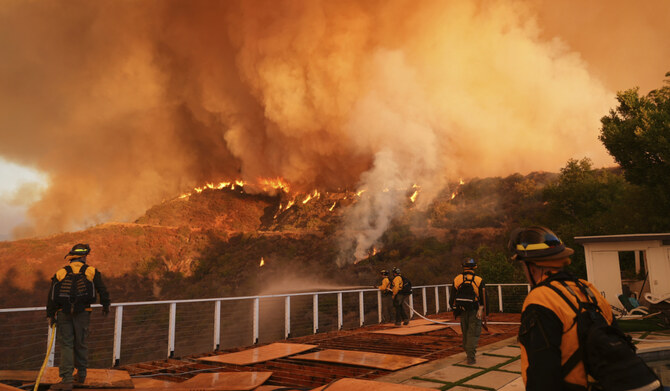
US wildfires pose fresh threat despite winds easing

Fire crews monitor the Palisades Fire in Mandeville Canyon on Saturday, Jan. 11, 2025, in Los Angeles. (AP)
Short Url
Updated 11 January 2025
Follow

US wildfires pose fresh threat despite winds easing

  • The National Weather Service said that conditions in the Los Angeles area would improve through the weekend, with sustained winds slowing to about 20 mph, gusting between 35 mph and 50 mph

LOS ANGELES: The largest of the raging wildfires that have devastated parts of Los Angeles this week was reported to have shifted direction on Saturday, triggering more evacuation orders and posing a new challenge to exhausted firefighters.

Six simultaneous blazes that have ripped across Los Angeles County neighborhoods since Tuesday have killed at least 11 people and damaged or destroyed 10,000 structures. The toll is expected to mount when firefighters are able to conduct house-to-house searches.
The fierce Santa Ana winds that fanned the infernos eased on Friday night. But the Palisades Fire on the city’s western edge was heading in a new direction, prompting another evacuation order as it edged toward the Brentwood neighborhood and the San Fernando Valley foothills, the Los Angeles Times reported.

HIGHLIGHTS

• Death toll rises to 11 with more fatalities expected.

• 10,000 structures burned as neighborhoods turn to ash.

• Thousands homeless, public health emergency declared.

• Insurers face billions in claims, Biden vows support.

“The Palisades fire has got a new significant flare-up on the eastern portion and continues to northeast,” LA Fire Department Captain Erik Scott told local station KTLA, according to a report on the LA Times website.
The fire, the most destructive in the history of Los Angeles, has razed whole neighborhoods to the ground, leaving just the smoldering ruins of what had been people’s homes and possessions.
Some 153,000 people remained under evacuation orders and another 166,800 faced evacuation warnings with a curfew in place for all evacuation zones, Los Angeles County Sheriff Robert Luna said.
Seven neighboring states, the federal government and Canada have rushed aid to California, bolstering aerial teams dropping water and fire retardant on the flaming hills and crews on the ground attacking fire lines with hand tools and hoses.
The National Weather Service said that conditions in the Los Angeles area would improve through the weekend, with sustained winds slowing to about 20 mph, gusting between 35 mph and 50 mph.
Officials have declared a public health emergency due to the thick, toxic smoke.
Pacific Palisades residents who ventured back to their devastated neighborhoods on Friday were shocked to find brick chimneys looming over charred waste and burnt-out vehicles as acrid smoke lingered in the air.
“This was a house that was loved,” Kelly Foster, 44, said while combing through the rubble where her house once stood.
Foster’s 16-year-old daughter, Ada, said she tried to get inside but “I just became sick. I just couldn’t even ... Yeah, it’s hard.”
In Rick McGeagh’s Palisades neighborhood, only six of 60 homes survived, and all that remained standing at his ranch house was a statue of the Virgin Mary.
“Everything else is ash and rubble,” said McGeagh, 61, a commercial real estate broker who, along with his wife, raised three children at their home.
On Friday morning, hundreds of people streamed into a parking lot near the Rose Bowl stadium in Pasadena for donated clothing, diapers and bottled water.
Denise Doss, 63, said she was anxious to return to her destroyed home in Altadena to see if anything was salvageable, but officials stopped her due to safety concerns.
“At least to say goodbye until we can rebuild. I will let God lead me,” Doss said.
Many Altadena residents said they were worried government resources would go to wealthier areas and that insurers might short-change those who cannot afford to contest denials of fire claims.
Beyond those who lost their homes, tens of thousands remained without power, and millions of people were exposed to poorer air quality, as the fires lofted traces of metals, plastics and other synthetic materials.
Private forecaster AccuWeather estimated the damage and economic loss at $135 billion to $150 billion, portending an arduous recovery and soaring homeowners’ insurance costs.
President Joe Biden has declared the fires a major disaster and said the US government would reimburse 100 percent of the recovery for the next six months.


What Bangladesh’s election means for India, China and Pakistan ties

Bangladesh Nationalist Party supporters gather for a rally ahead of the upcoming national election, in Sylhet on Jan. 22, 2026.
Updated 08 February 2026
Follow

What Bangladesh’s election means for India, China and Pakistan ties

  • Bangladeshis will vote on Feb. 12, almost two years after the 2024 student-led uprising
  • After nearly 2 years of tensions, experts expect a thaw with India under elected government

DHAKA: As Bangladesh prepares to hold its first elections since the 2024 ouster of Sheikh Hasina, its longest-serving prime minister, the outcome will define Dhaka’s relations with the most important regional powers — China, India, and Pakistan.

Nearly 128 million Bangladeshis will head to the polls on Feb. 12 to bring in new leadership after an 18-month rule of the current caretaker administration.

The interim government, led by Nobel laureate Muhammad Yunus, took control following a student-led uprising that ended 15 years in power of Hasina and her Awami League party.

The two main parties out of the 51 competing for power are the Bangladesh Nationalist Party and Jamaat-e-Islami. The Awami League, which for decades has had close ties with India, was excluded from the election ballot over its role in the deadly crackdown on the 2024 student-led protests, in which 1,400 people were killed.

While Bangladesh’s relationship India has deteriorated since the fall of Hasina, who has been in self-exile in New Delhi, the period of diplomatic strain is expected to ease when the new government takes office.

“Whoever comes to power in Bangladesh, due to domestic pressure in the country, relationships with India need a resetting,” Humayun Kabir, former ambassador to the US, told Arab News.

“It’s anticipated that India will also engage with the new government, but they will protect their interests, and we also have to do the same. It’s most likely that the India-Bangladesh relationship will be normalized under the new, elected, government.”

Since 2024, India has suspended key transshipment access that allowed Bangladeshi exports to go via Indian ports and airports. It also put on hold most normal visa services for Bangladeshis, who were among its largest groups of medical tourists.

From Hasina’s heavy pro-India orientation, the interim government has tried to rebalance Bangladesh’s foreign policy toward the two other key regional players — China and Pakistan — who at the same time are India’s main rivals. 

If New Delhi regains its importance, it should not deal a blow to the newly expanded relations with Pakistan, with whom Bangladesh has recently increased exchanges, especially economic, and last month resumed direct flights — after a 14-year gap.

Since the relations have been expanded under the caretaker government, Prof. Delwar Hossain from the International Relations Department at Dhaka University forecast that they would only further improve, no matter who comes to power, and there is no likelihood of a sudden change.

“For Pakistan, any political coalition — whether BNP or Jamaat — will be positive. The BNP has a long history of having good relations with Pakistan during their rule ... Jamaat also has a strong and very positive influence in Pakistan,” he said.

“For Pakistan, the new regime or new government is not the issue. The issue is what the (India) policy of the new government would be and to what extent it would actually support Pakistan’s view.”

Both the BNP and Jamaat have repeatedly said they wanted friendly relations with India, and Hossain expected that they would, at the same time, continue the balanced approach introduced by the caretaker administration.

“India is a reality as a neighbor. At the same time, India is also showing interest in mending relations or adopting a more cooperative approach after the vote, with the government that will be elected ... I think there will be pragmatism from both sides,” he said.

“I don’t see there is a long-term threat to Bangladesh-India relations ... When China and Pakistan were trying to create a trilateral cooperative system or some kind of coalition — China, Bangladesh and Pakistan — we have seen that Bangladesh opted out. It seems that Bangladesh is going to continue its policy of maintaining a balance among these great powers.”

Bangladesh’s relations with China have not changed since the ouster of Hasina, whose government signed several economic agreements with Beijing. Yunus’s administration has continued this cooperation, and China was among the very few countries he officially visited during his term.

During the visit, he secured about $2.1 billion in Chinese investments, loans and grants, including funding for infrastructure like Mongla Port and a special economic zone in Chattogram — Bangladesh’s largest port. China has also eased visa rules for Bangladeshi businesspeople, medical travelers and tourists.

According to Munshi Faiz Ahmed, Bangladesh’s former ambassador to Beijing, China’s importance for Bangladesh cannot be substituted by any other country, especially as over the past few years it has emerged not only as its key investor, but also the largest trade partner.

In the fiscal year 2024-25, Bangladesh’s trade with China was over $21.3 billion, according to National Board of Revenue data. With India, it was about $11.5 billion.

The trade — especially import — dependence on Beijing started long before the regime change. In terms of trade volume, China overtook India already in 2018.

“Even when people thought that we had very close relations with India, our relations with China continued to grow in terms of trade and commerce ... Our trade with China has surpassed India’s, and China is a much bigger investor in Bangladesh’s development projects,” Ahmed said.

“Bangladesh will continue to cooperate with China for a long time to come because what China can provide, no other country can.”