
JEDDAH: Saudi Arabia’s aviation sector reached new heights over the past 12 months, marked by a surge in passenger numbers, a fleet expansion with new jet acquisitions, and strategic global partnerships.
These advancements are part of a broader vision to establish the Kingdom as a global aviation hub and a top-tier destination for travelers worldwide.
Saudi Arabia is investing billions of dollars as part of its Vision 2030 plan to diversify its economy away from fossil fuels, boosting its private sector, and enhancing connectivity, as well as solidifying its role in the global aviation industry.
As part of this plan, aviation goals for the Kingdom include delivering seamless experiences to 330 million passengers across over 250 destinations, and the transportation of 4.5 million tons of air cargo by 2030.
“This transformative strategy offers lucrative opportunities for the private sector to contribute to the realization of the country’s ambitions,” said President of the General Authority of Civil Aviation Abdulaziz bin Abdullah Al-Duailej.
He added that among these opportunities are the privatization potential of 27 airports, which are currently in preparation for transfer to private ownership.
“Moreover, numerous aircraft requests and destination openings have been approved, providing further avenues for private sector involvement in the sector’s growth and development.” Al-Duailej added.
Passenger numbers and air freight volume surges
Between January and September, Saudi Arabia’s aviation sector achieved record growth, with passenger numbers reaching 94 million, accounting for a 15 percent increase.
The number of flights also saw a 10 percent rise compared to 2023, while air freight volumes approached 1 million tonnes, reflecting a 52 percent increase.
These achievements were announced at GACA’s 14th Steering Committee Meeting for activating the National Strategy for the Aviation Sector, held in October in Dammam.
GACA President Abdulaziz bin Al-Duailej highlighted the expansion of air connectivity during this period, with flights departing to over 150 destinations weekly.
Saudi business aviation soars with Vision 2030 growth
Saudi Arabia’s business aviation sector is booming, driven by the Kingdom’s expanding economy, major government infrastructure investments, and a rising influx of high-net-worth individuals.
Valued at $1.2 billion in 2023, the sector is expected to grow at a compound annual rate of 8.88 percent from 2025 to 2029.
The growth was highlighted in the GACA’s roadmap, unveiled at Riyadh’s Future Aviation Forum in May.
Global firms tapped for King Salman Airport expansion
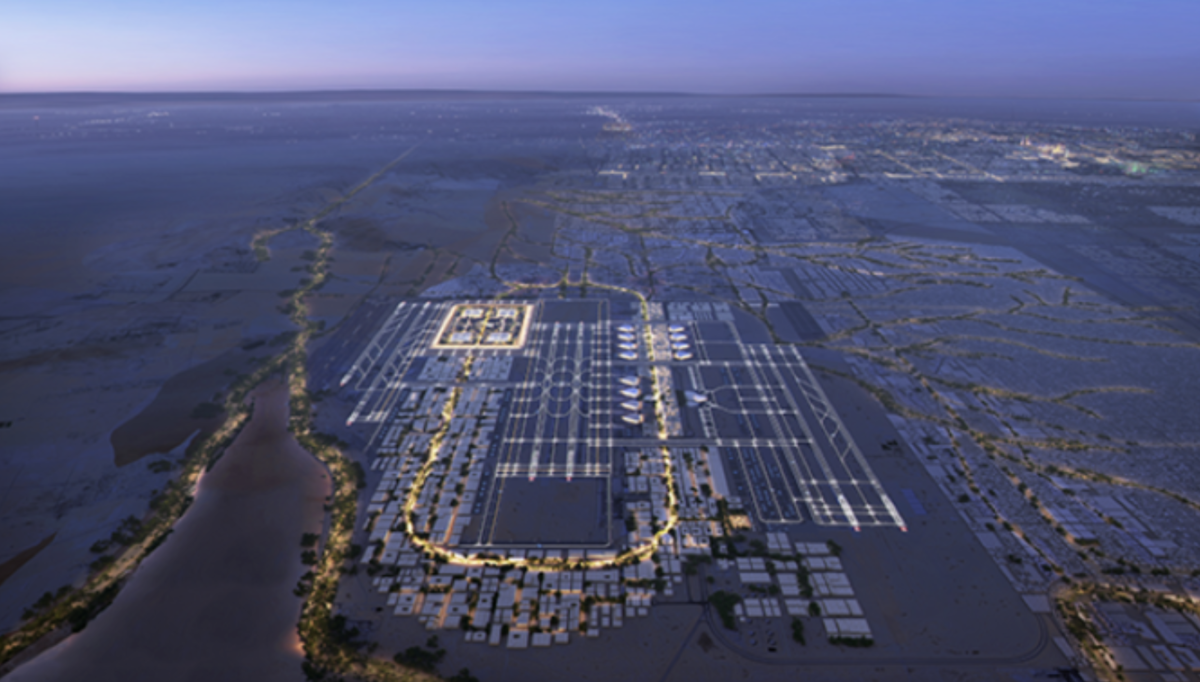
An image of how King Salman International Airport will look after it has been developed. File
In 2024, global firms such as Foster & Partners, Jacobs Engineering, Mace, and Nera were selected for the next phase of King Salman International Airport’s development in Riyadh.
Led by the King Salman International Airport Development Co., a subsidiary of the Kingdom’s Public Investment Fund, the collaborations will support the airport’s expansion, positioning it as a key hub for tourism and transportation.
Riyadh Air expands fleet, partnerships ahead of 2025 launch
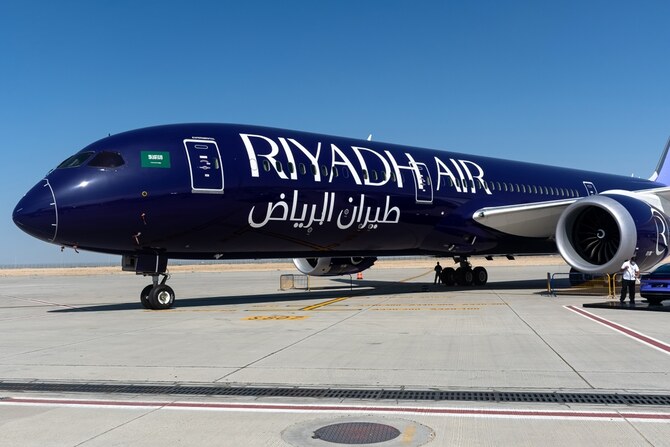
In October, Riyadh Air signed an agreement to purchase 60 Airbus A321neo single-aisle aircraft as it plans to commence its operations in 2025.
The deal was signed at the 8th Future Investment Initiative in Riyadh.
In the same month the company said that it had plans to order wide-body aircraft capable of seating more than 300 passengers in 2025.
In August, the new airline announced it had secured a multi-year agreement to become the official airline partner of Concacaf, the FIFA Confederation for North, Central America, and the Caribbean.
The deal aims to enhance the airline’s presence in global sports and support Concacaf’s national and club competitions across the Americas.
In June, Riyadh Air signed agreements with Singapore Airlines and Air China, to establish strategic partnerships and expand its global network.
The agreements focus on interline connectivity, codeshare, frequent flyer programs, cargo services, customer experience, and digital innovation.
The company partnered with China Eastern Airlines to enhance connectivity and digital transformation and with Delta Air Lines to expand North American routes.
In April, the carrier announced a partnership with Artefact to build a data analytics platform and develop AI solutions, enabling hyper-personalization, improved guest experiences, and optimized operations.
The collaboration aims to revolutionize Saudi aviation through advanced artificial intelligence applications.
“Through AI integration, we aim to redefine travel standards, offering personalized, seamless digital-first experience to our guests ahead of our maiden flight in 2025,” Abe Dev, the airline’s vice president of digital and innovation said.
In May, the airline said it had plans to bolster its aircraft lineup through additional orders, as it requires “a very large fleet” to establish itself alongside regional giants, according to its CEO Tony Douglas.
This move comes as the Kingdom’s second flag carrier ordered 39 Boeing 787-9 jets in 2023, with options for 33 more. “We’re going to make a number of additional orders,” Douglas said.
The airline’s initial destinations will include major cities in Europe, the US East Coast, and Canada, with the inaugural flight scheduled to depart by June 2025.
Saudia boosts aviation with key partnerships, fleet growth

The signing ceremony was attended by French President Emmanuel Macron, Saudi Arabian Airlines Corp. Chairman Saleh Al-Jasser, Saudia Group Director Gen. Ibrahim Al-Omar, and several other dignitaries and ministers. SPA
In December, Saudia entered a strategic partnership with Air France-KLM to expand and localize its maintenance, repair, and overhaul capabilities. This collaboration aims to enhance the Kingdom’s aviation infrastructure and contribute to its economic growth.
In July, the Saudia Group and German aerospace company Lilium NV, developer of fully electric vertical takeoff and landing aircraft, entered into an agreement to purchase 50 confirmed Lilium Jets, with an option for an additional 50 aircraft. The deal will make the Saudi carrier the first airline in the region to invest in sustainable air mobility.
In May, Saudia and Riyadh Air signed an agreement during the Future Aviation Forum to collaborate on training aviation professionals.
During the same event, Saudia Group announced a $19 billion order for 105 A320neo family aircraft, the largest Airbus deal in Saudi history. The planes, including A320neo and A321neo models, will be split between Saudia and its low-cost carrier flyadeal, with deliveries starting in early 2026.
Flyadeal receives first owned plane, aims for 100 by 2030
In 2024, Saudia’s low-cost airline flyadeal took delivery of its first wholly-owned aircraft, an Airbus A320neo.
Announcing the milestone in June, the airline revealed plans to expand its fleet to around 50 aircraft by the end of 2025, doubling to 100 by 2030. As part of its growth strategy, flyadeal also launched seven weekly flights between Riyadh and Sarajevo, utilizing an Airbus A320.
Looking ahead, the airline announced the addition of three new domestic routes starting January. Services from Dammam to Najran and four weekly flights to Tabuk commenced on Jan. 1, followed by three weekly flights to Yanbu starting from Jan. 2.
Flynas secures 280-aircraft deal amid record growth
Flynas, named the Best Low-Cost Airline in the Middle East for the seventh consecutive year, reported a 47 percent rise in passenger numbers, exceeding 7 million in the first half of 2024.
In November, the airline announced new African routes, with flights from Riyadh to Entebbe, Uganda, and Jeddah to Djibouti starting Jan. 8, 2025, under its “We Connect the World to the Kingdom” initiative.
In July, Flynas signed a deal at the Farnborough Airshow to purchase 160 Airbus aircraft, doubling its orders to 280 planes, including 30 wide-body A330neo and 130 narrow-body A320 models. The carrier also celebrated receiving its 53rd A320neo as part of a SR32 billion ($8.5 billion) order for 120 planes.