

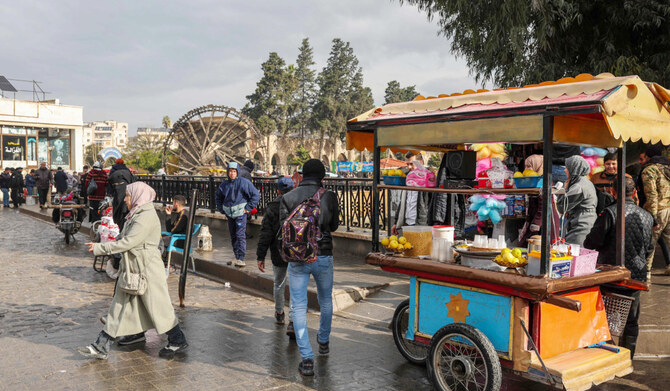

DAMASCUS: In Damascus, the streets were buzzing with excitement Tuesday as Syrians welcomed in a new year that seemed to many to bring a promise of a brighter future after the unexpected fall of Bashar Assad’s government weeks earlier.
While Syrians in the capital looked forward to a new beginning after the ousting of Assad, the mood was more somber along Beirut’s Mediterranean promenade, where residents shared cautious hopes for the new year, reflecting on a country still reeling from war and ongoing crises.
War-weary Palestinians in Gaza who lost their homes and loved ones in 2024 saw little hope that 2025 would bring an end to their suffering.
The last year was a dramatic one in the Middle East, bringing calamity to some and hope to others. Across the region, it felt foolish to many to attempt to predict what the next year might bring.
In Damascus, Abir Homsi said she is optimistic about a future for her country that would include peace, security and freedom of expression and would bring Syrian communities previously divided by battle lines back together.
“We will return to how we once were, when people loved each other, celebrated together whether it is Ramadan or Christmas or any other holiday — no restricted areas for anyone,” she said.
But for many, the new year and new reality carried with it reminders of the painful years that came before.
Abdulrahman Al-Habib, from the eastern Syrian city of Deir Ezzor, had come to Damascus in hopes of finding relatives who disappeared after being arrested under Assad’s rule. He was at the capital’s Marjeh Square, where relatives of the missing have taken to posting photos of their loved ones in search of any clue to their whereabouts.
“We hope that in the new year, our status will be better ... and peace will prevail in the whole Arab world,” he said.
In Lebanon, a tenuous ceasefire brought a halt to fighting between Israel and the Hezbollah militant group a little over a month ago. The country battered by years of economic collapse, political instability and a series of calamities since 2019, continues to grapple with uncertainty, but the truce has brought at least a temporary return to normal life.
Some families flocked to the Mzaar Ski Resort in the mountains northeast of Beirut on Tuesday to enjoy the day in the snow even though the resort had not officially opened.
“What happened and what’s still happening in the region, especially in Lebanon recently, has been very painful,” said Youssef Haddad, who came to ski with his family. “We have great hope that everything will get better.”
On Beirut’s seaside corniche, Mohammad Mohammad from the village of Marwahin in southern Lebanon was strolling with his three children.
“I hope peace and love prevail next year, but it feels like more (challenges) await us,” he said.
Mohammad was among the tens of thousands displaced during more than a year of conflict between Hezbollah and Israel. Now living in Jadra, a town that was also bombarded during the conflict, he awaits the end of a 60-day period, after which the Israeli army is required to withdraw under the conditions of a French and US-brokered ceasefire.
“Our village was completely destroyed,” Mohammad said. His family would spend a quiet evening at home, he said. This year “was very hard on us. I hope 2025 is better than all the years that passed.”
In Gaza, where the war between Hamas and Israel has killed more than 45,500 Palestinians, brought massive destruction and displaced most of the enclave’s population, few saw cause for optimism in the new year.
“The year 2024 was one of the worst years for all Palestinian people. It was a year of hunger, displacement, suffering and poverty,” said Nour Abu Obaid, a displaced woman from northern Gaza.
Obaid, whose 10-year-old child was killed in a strike in the so-called “humanitarian zone” in Muwasi, said she didn’t expect anything good in 2025. “The world is dead,” she said. “We do not expect anything, we expect the worst.”
The war was sparked by the Oct. 7, 2023 Hamas-led attack on southern Israel in which militants killed around 1,200 people and abducted some 250 others.
Ismail Salih, who lost his home and livelihood, expressed hopes for an end to the war in 2025 so that Gaza’s people can start rebuilding their lives.
The year that passed “was all war and all destruction,” he said. “Our homes are gone, our trees are gone, our livelihood is lost.”
In the coming year, Salih said he hopes that Palestinians can “live like the rest of the people of the world, in security, reassurance and peace.”


