

In Syrian military housing, new rulers take the homes of Assad officers

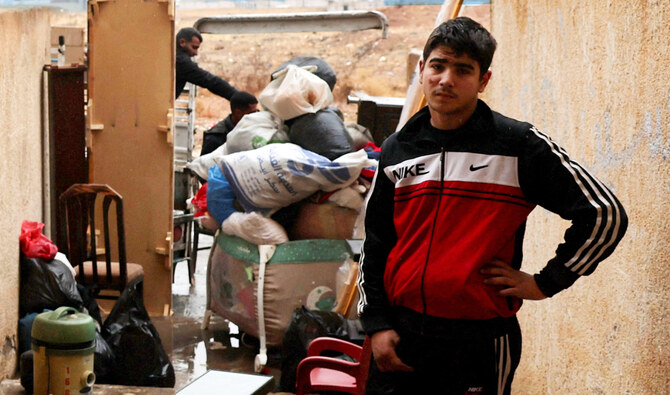
A young man near Damascus waits for workers to move his family’s belongings following evacuation orders. (Reuters)
Short Url
Updated 31 December 2024
Follow

In Syrian military housing, new rulers take the homes of Assad officers

  • HTS moves will be closely watched in a country where millions have been displaced since 2011 civil war

DAMASCUS: Families of military officers who served under Syria’s ousted Bashar Assad are being evicted from their subsidized housing at a compound outside Damascus to make way for victorious former rebels and their families, residents and fighters there said.

The Muadamiyat Al-Sham compound housing hundreds of people in over a dozen buildings is one of several such areas set aside for officers under Assad’s rule.

As the military is being restructured around the former rebel forces, with Assad-era officers demobilized, the evictions from military housing are not a surprise.

But their rapid replacement in the accommodation by fighters who spent years in impoverished, rural rebel-held territory shows the sudden reversal of fortune for supporters of each side in the conflict.

Names of rebel factions under the main victorious group Hayat Tahrir Al-Sham, which captured the capital on Dec. 8, are scrawled in spray paint on the entrances to buildings, apparently marking them out for fighters from each entity.

Three fighters at the compound, four women who have been residing there and a local official providing documents to those leaving said officers’ families had been given five days to go.

“We will start moving our children’s schools, starting our lives over. I am very sad, my heart is broken, it’s our lives, my children’s lives,” said Budour Makdid, 38, the wife of a former military intelligence officer living in Muadamiyat Al-Sham.

Makdid’s husband, who has signed papers recognizing the new authorities and handed over his gun, has already returned to his family home in Latakia province, a former Assad stronghold, and Makdid and their children would join him there, she said.

Like other families leaving the area, she needed a document from the municipal authorities to say the family was leaving the accommodation and giving permission to remove their belongings.

Local administrator Khalil Al-Ahmad, 69, said families had started approaching him several days ago seeking the document and that around 200 requests for one had been made so far.

Ahmad said he had not been officially contacted by the new administration about the change, and was only made aware of it when residents began to ask him for the documents.

A spokesman for HTS did not immediately respond to requests for comment.

Any sign of how Syria’s new administration intends to handle former Assad officers, as well as property rights, will be closely watched in a country where millions of people have been displaced since civil war erupted in 2011.

Earlier this month, HTS leader Ahmad Al-Sharaa was filmed requesting the residents of his family’s former home in Damascus to leave and allow his own family to move back.

Some former military families living near the Muadamiyat Al-Sham compound but not in the subsidized units from which officers are being evicted are also leaving.

Eidye Zaitoun, 52, was packing her belongings into black plastic bags as she prepared to leave her two-room apartment for the coast. She said her son in the military had moved to the coast too and there was no reason for her to stay.

HTS fighters at the compound were not sympathetic.

“We were displaced out of homes, out of our regions on a moonless night with only the clothes we were wearing. Thank God they are now allowed to take out their belongings,” one said. 


Iraqi lawmakers to elect president Tuesday, PM appointment next

Updated 25 January 2026
Follow

Iraqi lawmakers to elect president Tuesday, PM appointment next

  • Parliamentary speaker Haibat Al-Halbussi announced on Sunday that the new parliament will convene on Tuesday to elect a president

BAGHDAD: Iraq’s parliament will meet on Tuesday to elect the country’s new president, who will then appoint a prime minister expected to be Nouri Al-Maliki after he was endorsed by the largest Shiite bloc.
By convention, a Shiite Muslim holds the post of prime minister, the parliament speaker is Sunni and the largely ceremonial presidency goes to a Kurd.
Parliamentary speaker Haibat Al-Halbussi announced on Sunday that the new parliament will convene on Tuesday to elect a president, according to the official INA press agency.
The president will then have 15 days to appoint a prime minister, who is usually nominated by the largest Shiite bloc formed through post-election alliances.
On Saturday, the Coordination Framework alliance — whose Shiiite factions have varying links to Iran — endorsed former prime minister and powerbroker Al-Maliki as the country’s next premier.
The alliance, to which Al-Maliki belongs, spoke of his “political and administrative experience and his record in running the state.”
Kurdish parties have yet to agree on a presidential candidate, who must be endorsed by other blocs and win a two-thirds majority in parliament.
The presidency is usually held by the Patriotic Union of Kurdistan (PUK). This year, the rival Kurdistan Democratic Party (KDP) named its own candidate: Foreign Minister Fuad Hussein.
Although Maliki’s endorsement effectively guarantees him the post, forming a new government remains a daunting challenge that could drag on for months and still fail.
The designated premier has one month to form a government and present it to parliament for a vote of confidence.
The 75-year-old Maliki, a shrewd politician, is set to return to power at a time of seismic changes in the Middle East, as Tehran’s regional influence wanes and tensions with Washington rise.
Government formation in Iraq must balance internal political dynamics and power-sharing among major parties, all under the continued influence of Iraq’s two main allies: Iran and the United States.
A close Iran ally, Al-Maliki will be expected to address Washington’s longstanding demand that Baghdad dismantle Tehran-backed factions, many of which are designated terrorist groups by the US.
Last month, Iraqi officials and diplomats told AFP that Washington demanded the eventual government exclude Iran-backed armed groups, even though most of them hold seats in parliament, and have seen their political and financial clout increase.
But Iraq is struggling with weak economic growth and cannot risk punitive measures by the US, which has already sanctioned several Iraqi entities, accusing them of helping Tehran evade sanctions.