

Syria eyes ‘strategic’ ties with Ukraine, Kyiv vows more food aid shipments

1 / 2
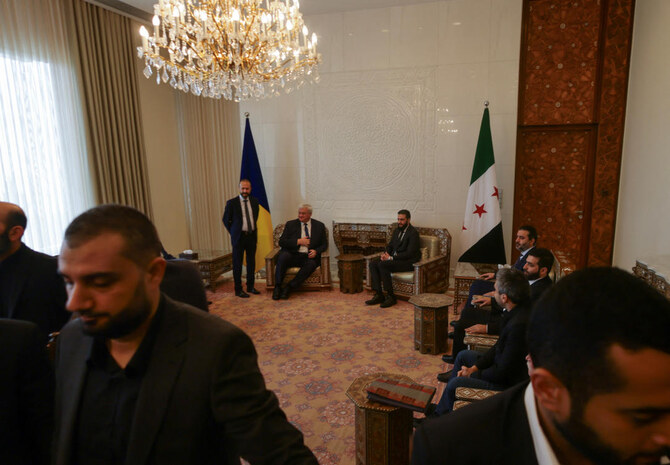
Syria’s de facto leader Ahmed Al-Sharaa and Foreign Minister Asaad Hassan Al-Shibani meet with the Ukrainian delegation in Damascus on Dec. 30, 2024. (Reuters)
2 / 2
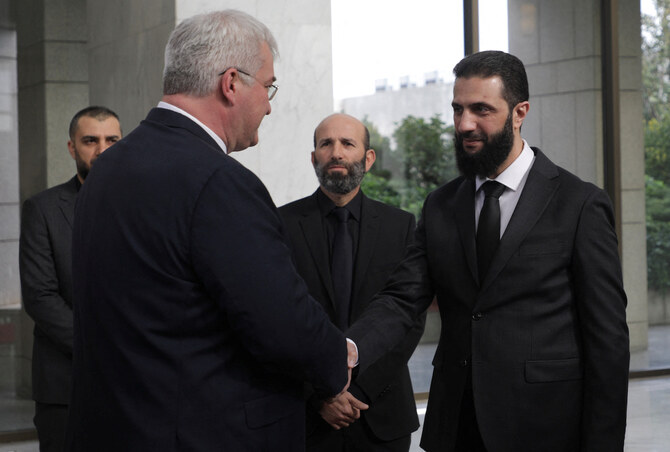
Syria’s de factor leader Ahmed Al-Sharaa, right, receives Ukraine’s Foreign Minister Andrii Sybiha in Damascus on Dec. 30, 2024. (AFP)
Short Url
Updated 31 December 2024
Follow

Syria eyes ‘strategic’ ties with Ukraine, Kyiv vows more food aid shipments

  • Kyiv moves to build ties with the new leadership in Damascus

DAMASCUS: Syria hopes for “strategic partnerships” with Ukraine, its new foreign minister told his Ukrainian counterpart on Monday, as Kyiv moves to build ties with the new Islamist rulers in Damascus amid waning Russian influence.
Russia was a staunch ally of ousted President Bashar Assad and has given him political asylum. Moscow has said it is in contact with the new administration in Damascus, including over the fate of Russian military facilities in Syria.
“There will be strategic partnerships between us and Ukraine on the political, economic and social levels, and scientific partnerships,” Syria’s newly appointed foreign minister, Asaad Hassan Al-Shibani, told Ukraine’s Andrii Sybiha.
“Certainly the Syrian people and the Ukrainian people have the same experience and the same suffering that we endured over 14 years,” he added, apparently drawing a parallel between Syria’s brutal 2011-24 civil war and Russia’s seizure of Ukrainian territory culminating in its full-scale 2022 invasion.
Sybiha, who also met Syria’s new de facto ruler Ahmed Al-Sharaa in Damascus on Monday, said Ukraine would send more food aid shipments to Syria after the expected arrival of 20 shipments of flour on Tuesday.
Ukrainian President Volodymyr Zelensky announced last Friday the dispatch of Ukraine’s first batch of food aid to Syria comprising 500 metric tons of wheat flour as part of Kyiv’s humanitarian “Grain from Ukraine” initiative in cooperation with the United Nations World Food Programme.

RUSSIAN INFLUENCE SQUEEZED
Ukraine, a global producer and exporter of grain and oilseeds, traditionally exports wheat and corn to countries in the Middle East, but not to Syria, which in the Assad era imported food from Russia.
Russian wheat supplies to Syria have been suspended because of uncertainty about the new government in Damascus and payment delays, Russian and Syrian sources told Reuters in early December. Russia had supplied wheat to Syria using complex financial and logistical arrangements to circumvent Western sanctions imposed on both Moscow and Damascus.
The ousting of Assad by Al-Sharaa’s Islamist group, Hayat Tahrir Al-Sham, has thrown the future of Russia’s military bases in Syria — the Hmeimim air base in Latakia and the Tartous naval facility — into question.
Russian Foreign Minister Sergei Lavrov said the status of Russia’s military bases would be the subject of negotiations with the new leadership in Damascus.
Al-Sharaa said this month that Syria’s relations with Russia should serve common interests. In an interview published on Sunday, he said Syria shared strategic interests with Russia, striking a conciliatory tone, though he did not elaborate.


Last Christians gather in ruins of Turkiye’s quake-hit Antakya

Updated 58 min 12 sec ago
Follow

Last Christians gather in ruins of Turkiye’s quake-hit Antakya

  • Saint Peter’s, one of the world’s oldest rock churches, is a sacred rallying point for the isolated Christians still left in quake-hit Antakya in southeastern Turkiye

ANTAKYA: Saint Peter’s, one of the world’s oldest rock churches, is a sacred rallying point for the isolated Christians still left in quake-hit Antakya in southeastern Turkiye, the city known in ancient times as Antioch.
“Since the earthquake, our community has scattered,” said worshipper Mari Ibri.
“Those who remain are trying to regroup. We each had our own church but, like mine, they have been destroyed.”
The landscape around the cave remains scarred by the disaster nearly three years ago, when two earthquakes devastated Hatay province on February 6, 2023 and its jewel, Antakya, the gateway to Syria.
Sad fields of rubble and the silhouettes of cracked, abandoned buildings still scar the city — all enveloped in the ever-present grey dust.
Since the earthquakes, Antakya city has emptied and the Christian community has shrunk from 350 families to fewer than 90, Father Dimitri Dogum told AFP.
“Before, Christmas at our house was grandiose,” Ibri recalled.
“Our churches were full. People came from everywhere.”
Ibri’s own church in the city center was rendered inaccessible by the earthquakes.
Now she and other worshippers gather at the cave on December 24 — Christmas Eve in some Christian calendars.
It is here, they believe, that Peter, the disciple Jesus assigned to found the Christian church, held his first religious service in the 1st century.
The rock church was later enlarged and 11th-century crusaders added a pale stone facade.
It is now a museum, opened to the faithful only on rare occasions.
Christmas Eve is one.
The morning sun was still glowing red in the sky when Fadi Hurigil, leader of Antakya’s Orthodox Christian community, and his assistants prepared the service.
They draped the stone altar and unpacked candles, holy oil, chalices and plastic chairs.
Out in front they placed figurines of Christ and three saints near a bottle of rough red wine, bread baskets and presents for the children.
The sound system played a recording of the bells of Saint Peter and Paul church, which now stands empty in Antakya city center.
“That was my church,” said Ibri, crossing herself. “They recorded the peals.”
Around one hundred worshippers soon squeezed into the incense-filled cave and at least as many congregated outside.
A large police contingent looked on. Sniffer dogs had already inspected the cave and esplanade.
“It’s normal,” said Iliye, a 72-year-old from Iskenderun, 60 kilometers (40 miles) further north. “We’re a minority. It’s to protect us.”
The slow chanting of Orthodox hymns heralded the start of the two-hour service, conducted entirely in chants sung in Arabic and Turkish by Dogum and another cleric.
“It’s very moving for us to be here in the world’s first cave church, where the first disciples gathered,” the priest said.
“There used to be crowds here,” he added.
“In 2022, there were at least 750 people outside, Christians and non-Christians alike.”
Since the earthquakes, the gathering has been much smaller, although it is now starting to grow again.
At the end of the service, when Christmas carols fill the air, Dogum and Hurigil cut a huge rectangular cake.
The Nativity scene at its center — Mary, baby Jesus, the ox and the ass — was edged with whipped cream.
“There’s the religious dimension but it’s also important that people can gather here again,” a worshipper said.
“After February 6, our fellow citizens scattered. But they’re starting to come back. We’re happy about that.”