DAMASCUS: A few days after insurgents in Syria overthrew President Bashar Assad, his ruling Baath party announced it was freezing its activities, marking a stunning change in fortunes for the political group that had ruled for more than six decades.
Many members of the party’s leadership have gone into hiding and some have fled the country. In a symbolic move, Syria’s new rulers have turned the former party headquarters in Damascus into a center where former members of the army and security forces line up to register their names and hand over their weapons.
Calls are on the rise to officially dissolve the Arab Socialist Baath Party that had ruled Syria since 1963.
Many Syrians — including former party members — say its rule damaged relations with other Arab countries and aided in the spread of corruption that brought the war-torn nation to its knees.
“The party should not only be dissolved, it should go to hell,” said Mohammed Hussein Ali, 64, who worked for a state oil company and was a party member for decades until he quit at the start of Syria’s anti-government uprising in 2011 that turned into civil war. He never left the country and said he is happy the Baath rule is over.
An official with Hayat Tahrir Al-Sham, or HTS, the group that led the insurgent offensive that overthrew Assad, said no official decision has been made on what to do with the Baath party.
The official, who spoke on condition of anonymity because he was not authorized to speak publicly about the matter, noted that HTS leader Ahmad Al-Sharaa has said that officials who committed crimes against the Syrian people over the past decades will be brought to justice and hinted that they include party members.
The Baath party, whose aim was to unify Arab states in one nation, was founded by two Syrian Arab nationalists, Michel Aflaq and Salaheddine Bitar, in 1947 and at one point ruled two Arab countries, Iraq and Syria.
A rivalry developed between the Syrian branch under Assad and his late father, Hafez, and the one in Iraq under Saddam Hussein, who was removed from power by a US-led invasion in 2003.
In Syria, the Baath party became inextricably associated with the Assad family, which took power in 1970. For decades, the family used the party and its pan-Arab ideology to control the country. Many senior military jobs were held by members of the family’s minority Alawite sect, and party membership was used as a cover to give it a nationalist rather than a sectarian nature.
A former soldier and decades-long Baath party member who came to party headquarters to cut his military ties, Abdul-Rahman Ali, said he had no idea it was founded by Aflaq and Bitar. He had always thought that Hafez Assad was the founder.
“I am happy. We have been liberated from fear,” said Ali, 43. “Even the walls had ears. We didn’t dare express opinions with anyone.” He was referring to the dreaded security and intelligence agencies that detained and tortured people who expressed criticism of Assad or government officials.
Many Syrians were required to join the Baath Vanguards, the party’s youth branch, while in elementary school, where Arab nationalist and socialist ideology was emphasized.
It was difficult for people who were not party members to get government jobs or join the army or the security and intelligence services.
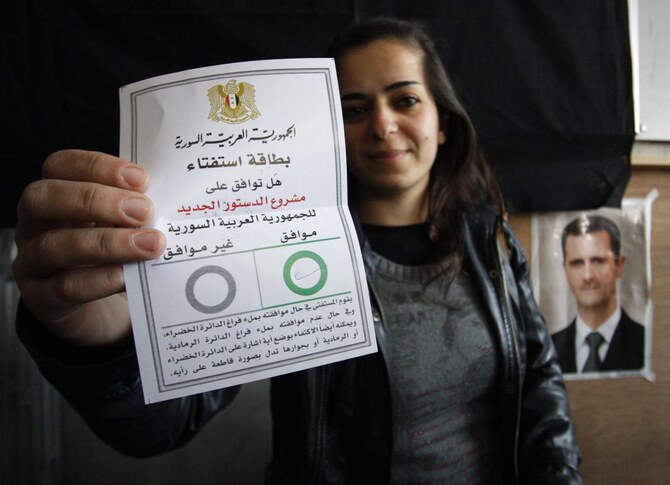
In 2012, a year after Syria’s uprising began, a paragraph of the constitution stating that the Baath party was the leader of the nation and society was abolished, in a move aimed to appease the public’s demand for political reforms. In practice, however, the party remained in control, with members holding majority seats in parliament and government.
Another former soldier, who gave only his first name, Ghadir, out of fear of reprisals as a member of the Alawite sect, said he came from a poor family and joined the party so he could enter the military for a stable income.
“You could not take any job if you were not a Baathist,” he said.
While few are mourning the party’s fall in Syria, some are concerned that the Sunni majority that now controls the country could carry out a purge similar to the one in Iraq after Saddam’s fall.
A de-Baathification committee was formed in Iraq and its main job was purging Saddam loyalists from government and military institutions. The Sunni minority considered it a means of sectarian score-settling by Iraq’s Shiite majority. The Sunni resentment and disenfranchisement that followed helped to drive the rise of extremist groups in the country including Al-Qaeda and the Islamic State in Iraq.
In Syria, a Baath party statement issued three days after Assad’s fall called on all members to hand their weapons and public cars to the new authorities.
On Dec. 24, party member and former army colonel Mohammed Merhi was among hundreds who lined up at the former party headquarters and handed over weapons.
Merhi said the Baath party should be given another opportunity because its principles are good but were exploited over decades. But he said he might want to join another party if Syria becomes a multiparty democracy in the future.
He handed over his Soviet Makarov pistol and received a document saying he can now move freely in the country after reconciling with the new authorities.
“I want to become again a normal Syrian citizen and work to build a new Syria,” he said.


![]()

Now Syria’s long-ruling Baath party is collapsing, too
Short Url
https://arab.news/nz9js
Now Syria’s long-ruling Baath party is collapsing, too
- Many members of the party’s leadership have gone into hiding and some have fled the country
- Calls are on the rise to officially dissolve the Arab Socialist Baath Party that had ruled Syria since 1963


Latest updates


© 2026 SAUDI RESEARCH & PUBLISHING COMPANY, All Rights Reserved And subject to Terms of Use Agreement.